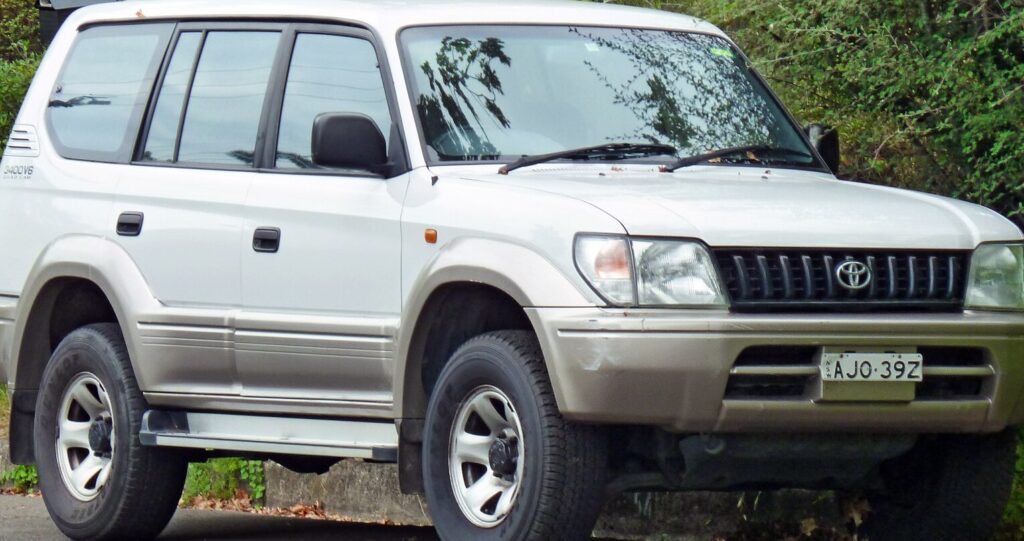
The Toyota Land Cruiser Prado J90, produced from 1996 to 1999, represented a significant evolution in Toyota’s long-running Land Cruiser lineage. This generation, designated J90, moved towards a more comfortable and family-oriented SUV while retaining the rugged capability expected of the Land Cruiser nameplate. The 5-door configuration became increasingly popular, offering enhanced passenger space and practicality. Among the engine options available, the 2.7-liter 16V (152 hp) 4WD Automatic variant occupied a crucial position as the entry-level offering in many markets, balancing affordability with Land Cruiser durability and off-road prowess. It was built on the 1HX0 platform, shared with the Lexus RX300, marking a shift towards more sophisticated underpinnings.
The 2.7L 16V Engine and Automatic Transmission
The heart of this Prado variant is the 3RZ-FE engine, a 2.7-liter inline-four cylinder gasoline engine. This engine is a naturally aspirated, single overhead camshaft (SOHC) design, featuring multi-port fuel injection. The 3RZ-FE boasts a displacement of 2694 cc (164.4 cubic inches) and produces 152 horsepower at 4800 rpm and 240 Nm (177.01 lb-ft) of torque at 4000 rpm. The engine’s bore and stroke are both 95mm, resulting in a square configuration. A compression ratio of 9.5:1 contributes to its balance of power and efficiency. The engine utilizes a timing chain, contributing to its reputation for longevity and reduced maintenance compared to timing belts.
Paired with the 3RZ-FE is a 4-speed automatic transmission. This transmission, while not as sophisticated as later electronically controlled units, was known for its robustness and reliability. The gear ratios were optimized for both on-road cruising and off-road crawling, providing a reasonable balance between acceleration and low-speed control. The automatic transmission was a key selling point for buyers prioritizing ease of use over outright performance, particularly in urban environments.
Powertrain Architecture Details
The 3RZ-FE engine is longitudinally mounted in the Prado’s engine bay. Fuel delivery is managed by a multi-port fuel injection system, ensuring efficient combustion and contributing to relatively smooth power delivery. The valvetrain consists of a single overhead camshaft (SOHC) operating four valves per cylinder (DOHC). This configuration provides a good compromise between simplicity, reliability, and performance. Engine oil capacity is 5.4 liters (5.71 US quarts / 4.75 UK quarts), and the recommended oil specification should be consulted in the vehicle’s owner’s manual. The cooling system requires 10 liters (10.57 US quarts / 8.8 UK quarts) of coolant.
Driving Characteristics
The 2.7-liter Prado Automatic offered a distinctly different driving experience compared to its more powerful siblings, such as those equipped with the 3.4-liter V6 engine. Acceleration was adequate for everyday driving, but not particularly brisk. The 0-60 mph time was estimated to be around 12-14 seconds. The automatic transmission, while smooth, could sometimes feel hesitant during quick overtaking maneuvers. However, the engine’s torque characteristics provided sufficient power for moderate off-road excursions. The 4WD system, a part-time system with a low-range transfer case, allowed for confident traction in challenging terrain.
The Prado’s weight of approximately 1750 kg (3858.09 lbs) contributed to a weight-to-power ratio of 11.5 kg/hp. This meant the engine had to work harder to propel the vehicle, impacting fuel economy. The gear ratios in the 4-speed automatic were tuned for a balance of fuel efficiency and usability. First gear was relatively low for off-road crawling, while higher gears were geared for comfortable highway cruising. Overall, the driving experience was characterized by comfort and capability rather than outright performance.
Equipment & Trim Levels
The 2.7-liter Prado Automatic typically served as the base trim level in many markets. Standard equipment generally included air conditioning, power windows, power locks, and a basic audio system. Interior upholstery was typically cloth, although leather options were available as upgrades. The dashboard layout was functional and straightforward, prioritizing usability over luxury. Depending on the market, features like alloy wheels, a sunroof, and upgraded audio systems were offered as optional extras.
The Prado J90 offered seating for up to eight passengers, with a 50/50 split folding third-row seat. Trunk space varied depending on the configuration of the rear seats, ranging from 742 liters (26.2 cu. ft) with all seats up to 1150 liters (40.61 cu. ft) with the third-row seats folded down. The fuel tank capacity was a generous 90 liters (23.78 US gallons / 19.8 UK gallons), providing a long driving range.
Chassis & Braking
The Prado J90 featured a robust chassis designed to withstand both on-road and off-road stresses. The front suspension utilized a coil spring, double wishbone configuration with a transverse stabilizer bar, providing a comfortable ride and good handling. The rear suspension employed a rigid axle setup with coil springs, offering durability and off-road capability. The front brakes were ventilated discs, providing ample stopping power, while the rear brakes were drums. This combination was typical for vehicles in this weight class during the late 1990s.
The Prado was equipped with an Anti-lock Braking System (ABS) as standard equipment, enhancing safety during emergency braking situations. The steering system was a rack and pinion setup with hydraulic power steering, providing precise and responsive steering feel. Tire size was typically 215/80 R16, mounted on 16-inch steel or alloy wheels. Ground clearance was a respectable 230mm (9.06 inches), allowing for confident navigation of rough terrain.
Market Reception & Comparison
The 2.7-liter Prado Automatic was generally well-received as a practical and reliable SUV. Critics praised its durability, off-road capability, and comfortable ride. However, some reviewers noted its lack of outright performance compared to higher-powered variants. Fuel economy was also a point of concern, with urban consumption reaching 18 l/100 km (13.1 US mpg / 15.7 UK mpg). Compared to the 3.4-liter V6 models, the 2.7-liter offered a more affordable entry point into Land Cruiser ownership, but at the expense of performance. Compared to the diesel options available in some markets, the 2.7-liter gasoline engine offered a smoother and quieter driving experience, but with lower fuel economy.
Technical Specifications
| Brand | Toyota |
| Model | Land Cruiser Prado |
| Generation | Land Cruiser Prado (J90) 5-door |
| Type | 2.7 16V (152 Hp) 4WD Automatic |
| Start of production | 1996 |
| End of production | 1999 |
| Engine Model/Code | 3RZ-FE |
| Engine displacement | 2694 cm3 (164.4 cu. in.) |
| Number of cylinders | 4 |
| Engine configuration | Inline |
| Cylinder Bore | 95 mm (3.74 in.) |
| Piston Stroke | 95 mm (3.74 in.) |
| Compression ratio | 9.5:1 |
| Power | 152 Hp @ 4800 rpm |
| Torque | 240 Nm @ 4000 rpm (177.01 lb.-ft. @ 4000 rpm) |
| Fuel injection system | Multi-port manifold injection |
| Engine aspiration | Naturally aspirated |
| Kerb Weight | 1750 kg (3858.09 lbs.) |
| Max. weight | 2680 kg (5908.39 lbs.) |
| Fuel tank capacity | 90 l (23.78 US gal / 19.8 UK gal) |
| Length | 4675 mm (184.06 in.) |
| Width | 1820 mm (71.65 in.) |
| Height | 1880 mm (74.02 in.) |
| Wheelbase | 2675 mm (105.31 in.) |
| Tires size | 215/80 R16 |
| Number of gears and type of gearbox | 4 gears, automatic transmission |
Legacy
The 2.7-liter Prado Automatic has proven to be a remarkably durable and reliable vehicle. The 3RZ-FE engine is known for its longevity and relatively simple maintenance requirements. Today, these Prados are sought after by enthusiasts and those seeking a dependable off-road vehicle. While parts availability may be diminishing in some regions, the engine’s simplicity and widespread use in other Toyota vehicles ensure that components remain relatively accessible. The Prado J90, particularly the 2.7-liter variant, continues to hold its value as a capable and trustworthy SUV, representing a sweet spot between affordability, reliability, and Land Cruiser heritage.