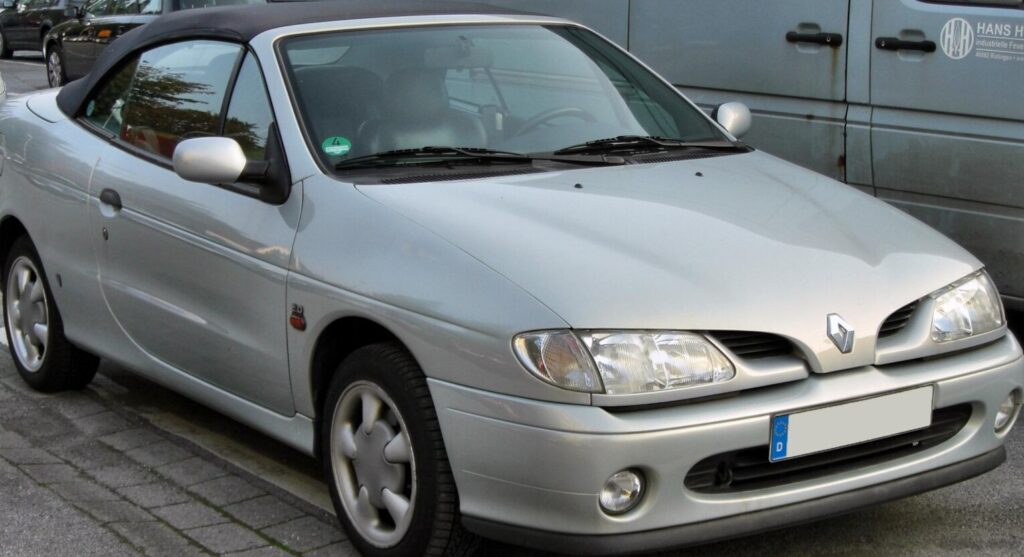
The Renault Megane I Cabriolet (EA) 2.0i, producing 109 horsepower, was a short-lived but notable variant of the first-generation Megane Cabriolet, manufactured between 1998 and 1999. Positioned as the upper-mid-range offering within the Cabriolet lineup, it provided a step up in performance and refinement compared to the base 1.6-liter models, while remaining more accessible than potential future, higher-performance iterations. The Megane I Cabriolet, designated the EA series, represented Renault’s entry into the competitive compact convertible market, built on the shared 1HX0/A3 platform also utilized by the Renault Scenic and other models.
Powertrain & Engine Architecture
The heart of the Megane I Cabriolet 2.0i is the Renault F3R engine, a 1.998-liter (121.93 cubic inches) inline-four cylinder gasoline engine. This engine is characterized by its naturally aspirated design and a dual overhead camshaft (DOHC) valvetrain with two valves per cylinder. The F3R engine utilizes a multi-port fuel injection system, delivering fuel directly into the intake ports. This configuration, common for the era, provided a balance between performance and fuel efficiency. The engine’s bore measures 82.7 mm (3.26 inches) and its stroke is 93 mm (3.66 inches).
While a five-speed manual transmission was standard, the 2.0i engine was also offered with a four-speed automatic transmission. This automatic, while providing convenience, was a key differentiator in the driving experience compared to the manual versions. The automatic transmission featured standard torque converter technology and was geared towards smooth operation rather than outright performance. Engine oil capacity is 6 liters (6.34 US quarts / 5.28 UK quarts), and coolant capacity is 7 liters (7.4 US quarts / 6.16 UK quarts).
Engine Codes and Variations
The F3R engine code designates this specific iteration of the 2.0-liter engine. Renault utilized various iterations of the F3R engine across its model range, with slight variations in tuning and components. The 109 hp output for the Megane Cabriolet represents a mid-range tuning of the F3R, prioritizing a balance between power and fuel economy for the convertible application.
Driving Characteristics
The 2.0i engine in the Megane Cabriolet provided a noticeable improvement in performance over the lower-displacement engines. Acceleration from 0 to 100 km/h (0-62 mph) was achieved in approximately 9.7 seconds, with a calculated 0-60 mph time of 9.2 seconds. Maximum speed was rated at 200 km/h (124.27 mph). However, the four-speed automatic transmission impacted these figures. Compared to the manual transmission equipped models, the automatic version exhibited slightly slower acceleration due to gear ratios and torque converter losses.
The power delivery was relatively linear, with peak torque of 168 Nm (123.91 lb-ft) available at 4250 rpm. This provided adequate pulling power for everyday driving and overtaking maneuvers. The automatic transmission’s shift points were programmed for comfort and fuel efficiency, sometimes resulting in the engine feeling slightly strained during aggressive acceleration. The weight-to-power ratio of 10.6 kg/Hp and weight-to-torque ratio of 6.9 kg/Nm reflected the car’s moderate performance capabilities.
Equipment & Trim Levels
The 2.0i Cabriolet typically included a higher level of standard equipment compared to the base models. This included features such as power windows, central locking, and an upgraded audio system. Interior upholstery was generally cloth, with options for leather available as an extra-cost upgrade. The dashboard layout was typical of the Megane I generation, featuring a functional and straightforward design.
Optional extras for the 2.0i Cabriolet could include air conditioning, alloy wheels, and a more sophisticated sound system. The Cabriolet also featured a power-operated soft top, a key selling point for the model. Safety features included ABS (Anti-lock Braking System) as standard equipment, a significant advancement for the time.
Chassis & Braking
The Megane I Cabriolet utilized an independent coil spring suspension at the front, providing a comfortable ride and reasonable handling. The rear suspension employed a torsion beam setup, a cost-effective solution common in compact cars. The front brakes were ventilated discs, offering good stopping power, while the rear brakes were drum brakes. This combination was typical for vehicles in this weight class during the late 1990s.
The steering system was a rack and pinion setup with hydraulic power steering, providing light and responsive steering feel. Tire size was typically 185/55 R15, mounted on 15-inch steel or alloy wheels. The chassis was reinforced to compensate for the lack of a fixed roof, ensuring structural rigidity and minimizing body flex.
Market Reception & Comparison
The Renault Megane I Cabriolet 2.0i was generally well-received by automotive critics as a stylish and affordable convertible. However, the automatic transmission was sometimes criticized for its lack of responsiveness compared to the manual gearbox. Fuel economy was rated at 8.4 l/100 km (28 US mpg / 33.6 UK mpg combined), which was reasonable for a vehicle of this type and era.
Compared to other trims in the Megane Cabriolet lineup, the 2.0i offered a significant performance advantage over the 1.6-liter models. It provided a more engaging driving experience, particularly with the manual transmission. However, it was priced higher than the base models, making it a less accessible option for budget-conscious buyers. Compared to competitors like the Peugeot 206 CC and the Fiat Barchetta, the Megane Cabriolet offered a good balance of style, practicality, and affordability.
Technical Specifications
| Brand | Renault |
| Model | Megane |
| Generation | Megane I Cabriolet (EA) |
| Type (Engine) | 2.0i (109 Hp) |
| Start of production | 1998 |
| End of production | 1999 |
| Powertrain Architecture | Internal Combustion engine |
| Body type | Cabriolet |
| Seats | 4 |
| Doors | 2 |
| Fuel consumption (urban) | 11.7 l/100 km (20.1 US mpg / 24.1 UK mpg) |
| Fuel consumption (extra urban) | 6.4 l/100 km (36.8 US mpg / 44.1 UK mpg) |
| Fuel consumption (combined) | 8.4 l/100 km (28 US mpg / 33.6 UK mpg) |
| CO2 emissions | 198 g/km |
| Fuel Type | Petrol (Gasoline) |
| Acceleration 0 – 100 km/h | 9.7 sec |
| Acceleration 0 – 62 mph | 9.7 sec |
| Acceleration 0 – 60 mph | 9.2 sec |
| Maximum speed | 200 km/h (124.27 mph) |
| Weight-to-power ratio | 10.6 kg/Hp |
| Weight-to-torque ratio | 6.9 kg/Nm |
| Power | 109 Hp @ 5400 rpm |
| Torque | 168 Nm @ 4250 rpm (123.91 lb.-ft. @ 4250 rpm) |
| Engine layout | Front, Transverse |
| Engine Model/Code | F3R |
| Engine displacement | 1998 cm3 (121.93 cu. in.) |
| Number of cylinders | 4 |
| Engine configuration | Inline |
| Cylinder Bore | 82.7 mm (3.26 in.) |
| Piston Stroke | 93 mm (3.66 in.) |
| Number of valves per cylinder | 2 |
| Fuel injection system | Multi-port manifold injection |
| Engine aspiration | Naturally aspirated |
| Valvetrain | DOHC |
| Engine oil capacity | 6 l (6.34 US qt | 5.28 UK qt) |
| Coolant | 7 l (7.4 US qt | 6.16 UK qt) |
| Kerb Weight | 1155 kg (2546.34 lbs.) |
| Max. weight | 1635 kg (3604.56 lbs.) |
| Max load | 480 kg (1058.22 lbs.) |
| Trunk (boot) space – minimum | 281 l (9.92 cu. ft.) |
| Fuel tank capacity | 60 l (15.85 US gal | 13.2 UK gal) |
| Length | 4028 mm (158.58 in.) |
| Width | 1698 mm (66.85 in.) |
| Height | 1368 mm (53.86 in.) |
| Wheelbase | 2468 mm (97.17 in.) |
| Front track | 1450 mm (57.09 in.) |
| Rear track | 1432 mm (56.38 in.) |
| Minimum turning circle | 10.5 m (34.45 ft.) |
| Drivetrain Architecture | Front wheel drive |
| Number of gears and type of gearbox | 5 gears, manual transmission |
| Front suspension | Independent coil spring |
| Front brakes | Ventilated discs |
| Rear brakes | Drum |
| Assisting systems | ABS (Anti-lock braking system) |
| Steering type | Steering rack and pinion |
| Power steering | Hydraulic |
| Tires size | 185/55 R15 |
| Wheel rims size | 15 |
Legacy
The Renault Megane I Cabriolet 2.0i, while a relatively short-lived model, has gained a following among enthusiasts. The F3R engine, when properly maintained, is known for its durability. However, like many engines of this era, it can be susceptible to oil leaks and cooling system issues. The automatic transmission, while convenient, is generally considered less robust than the manual gearbox.
On the used car market, the 2.0i Cabriolet commands a slightly higher price than the 1.6-liter models, reflecting its improved performance and equipment levels. Well-maintained examples are becoming increasingly rare, making them desirable for collectors and enthusiasts seeking a classic French convertible. The car represents a significant moment in Renault’s history, demonstrating their ability to produce stylish and affordable open-top vehicles.