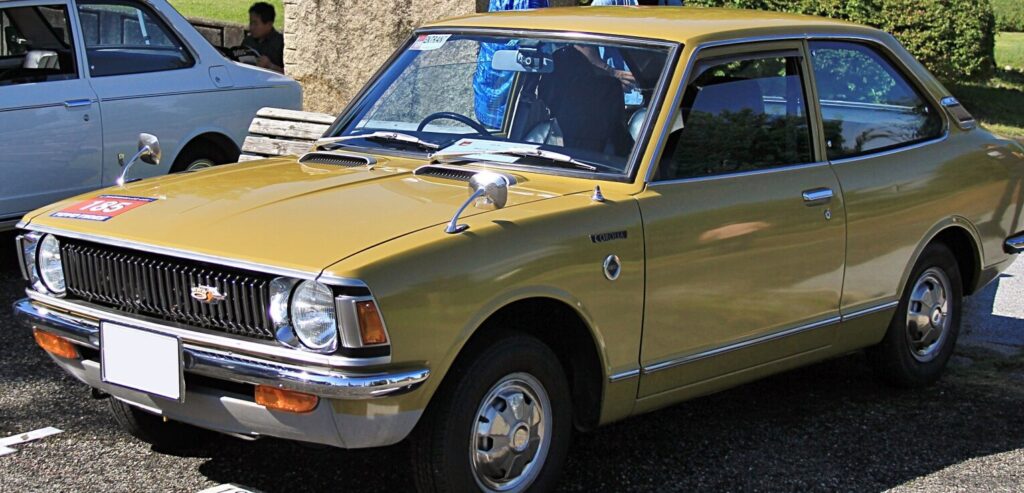
The Toyota Corolla II 2-door sedan (E20) 1200, powered by the 73 horsepower engine, was a significant model in Toyota’s early expansion into international markets. Produced between 1970 and 1974, this variant represented an entry-level offering within the broader E20 Corolla range, which also included coupe and wagon body styles. It was positioned as an affordable and economical vehicle, targeting buyers seeking basic transportation with Toyota’s burgeoning reputation for reliability. The E20 series, built on the A10 platform, marked a step up in size and refinement compared to its predecessor, the Corolla E10, and the 1200 model served as the foundation for many buyers entering the Toyota family.
Powertrain & Engine Architecture
The heart of the Corolla II 1200 was the 3K-D engine, a 1.2-liter (1166 cc) inline-four cylinder gasoline engine. This engine was a naturally aspirated unit, utilizing a single carburetor for fuel delivery. The 3K-D featured an overhead valve (OHV) valvetrain with two valves per cylinder. Bore and stroke dimensions were 75mm x 66mm, resulting in a compression ratio of 10:1. The engine produced 73 horsepower at 6,600 rpm and 94 Nm (69.33 lb-ft) of torque at 4,200 rpm. Power per liter was a respectable 62.6 hp/l for the era.
While a four-speed manual transmission was standard, an optional two-speed automatic transmission was available, though less common. The automatic was a relatively simple design for the time, prioritizing durability and ease of use over outright performance. The drivetrain was configured with rear-wheel drive (RWD), a common layout for compact cars of the early 1970s. The engine was mounted longitudinally in the front of the vehicle.
Engine Code Specifics
The 3K engine family, including the 3K-D variant, was known for its simplicity and robustness. The ‘D’ designation typically indicated a slightly detuned version optimized for fuel economy and longevity. The carburetor was a key component influencing the engine’s performance and emissions characteristics. Regular maintenance, including carburetor adjustments, was crucial for optimal operation. The 3K engine’s design prioritized low-end torque, making it suitable for everyday driving conditions.
Driving Characteristics
The Corolla II 1200 with the 73 hp engine and manual transmission offered modest but adequate performance for its time. Acceleration was not its strong suit, but it provided sufficient power for navigating city streets and highways. The four-speed manual gearbox allowed drivers to keep the engine in its optimal power band. The automatic transmission, while offering convenience, noticeably reduced acceleration and responsiveness. Top speed was approximately 150 km/h (93.21 mph). The weight-to-power ratio of 10.4 kg/hp indicated a relatively light vehicle, contributing to its fuel efficiency.
Handling was typical of rear-wheel-drive cars of the era – predictable but not particularly sporty. The steering, utilizing a cone worm and recirculation balls system, provided adequate feedback but required a reasonable amount of effort. The overall driving experience was focused on practicality and ease of use rather than dynamic performance.
Equipment & Trim Levels
The Corolla II 1200 was generally sparsely equipped, reflecting its position as an entry-level model. Standard features typically included basic instrumentation (speedometer, fuel gauge), vinyl upholstery, and simple steel wheels with hubcaps. Interior appointments were functional rather than luxurious. The two-door sedan configuration offered limited rear passenger space compared to the four-door models.
Optional extras included upgraded upholstery, a radio, and whitewall tires. Higher trim levels, if available in certain markets, might have included features like a heater, more comfortable seats, and chrome trim. The dashboard layout was straightforward, with minimal distractions. The focus was on providing a durable and reliable vehicle at an affordable price point.
Chassis & Braking
The Corolla II 1200 featured a relatively simple chassis design. The front suspension utilized independent coil springs with a transverse stabilizer bar, providing a reasonable level of ride comfort. The rear suspension employed a rigid axle with leaf springs, a common setup for rear-wheel-drive cars of the period. This configuration prioritized durability and load-carrying capacity.
Braking was accomplished via disc brakes on the front wheels and drum brakes on the rear. This combination provided adequate stopping power for the vehicle’s weight and performance. The steering system, as mentioned previously, was a cone worm and recirculation balls setup. The vehicle’s kerb weight of 760 kg (1675.51 lbs) contributed to its relatively nimble handling.
Market Reception & Comparison
The Toyota Corolla II 1200 was generally well-received by critics and consumers alike. It was praised for its reliability, fuel economy (4.7 l/100 km, 50 US mpg, 60.1 UK mpg), and affordability. Compared to its competitors, such as the Datsun 1200 and Ford Cortina, the Corolla offered a compelling combination of value and dependability. However, some reviewers noted its lack of power and relatively basic interior.
Compared to other Corolla variants, such as the 1600 GT, the 1200 model was significantly less powerful and offered a more utilitarian driving experience. The 1600 GT was aimed at enthusiasts seeking sporty performance, while the 1200 catered to buyers prioritizing economy and practicality. The 1.8L and diesel variants offered different trade-offs in terms of performance, fuel efficiency, and cost.
Technical Specifications
| Brand | Toyota |
| Model | Corolla II 2-door sedan (E20) |
| Generation | Corolla II 2-door sedan (E20) |
| Type (Engine) | 1200 (73 Hp) |
| Start of production | 1970 |
| End of production | 1974 |
| Powertrain Architecture | Internal Combustion engine |
| Body type | Sedan |
| Seats | 5 |
| Doors | 2 |
| Fuel consumption (combined) | 4.7 l/100 km (50 US mpg, 60.1 UK mpg, 21.3 km/l) |
| Maximum speed | 150 km/h (93.21 mph) |
| Weight-to-power ratio | 10.4 kg/Hp |
| Weight-to-torque ratio | 8.1 kg/Nm |
| Power | 73 Hp @ 6600 rpm |
| Torque | 94 Nm @ 4200 rpm (69.33 lb.-ft. @ 4200 rpm) |
| Engine layout | Front, Longitudinal |
| Engine Model/Code | 3K-D |
| Engine displacement | 1166 cm3 (71.15 cu. in.) |
| Number of cylinders | 4 |
| Engine configuration | Inline |
| Cylinder Bore | 75 mm (2.95 in.) |
| Piston Stroke | 66 mm (2.6 in.) |
| Compression ratio | 10:1 |
| Number of valves per cylinder | 2 |
| Fuel injection system | Carburettor |
| Engine aspiration | Naturally aspirated |
| Valvetrain | OHV |
| Kerb Weight | 760 kg (1675.51 lbs.) |
| Fuel tank capacity | 45 l (11.89 US gal | 9.9 UK gal) |
| Length | 3945 mm (155.31 in.) |
| Width | 1505 mm (59.25 in.) |
| Height | 1375 mm (54.13 in.) |
| Wheelbase | 2335 mm (91.93 in.) |
| Front track | 1255 mm (49.41 in.) |
| Rear track | 1245 mm (49.02 in.) |
| Minimum turning circle | 9 m (29.53 ft.) |
| Drivetrain Architecture | Rear wheel drive |
| Number of gears | 4 gears, manual transmission |
| Front suspension | Independent coil spring, Transverse stabilizer |
| Rear suspension | Rigid axle suspension, Leaf spring |
| Front brakes | Disc |
| Rear brakes | Drum |
| Steering type | Cone worm with recirculation balls |
Legacy
The Toyota Corolla II 1200, particularly the 3K-D engine variant, established Toyota as a reliable and affordable car manufacturer in many international markets. The 3K engine proved to be exceptionally durable, and many examples remained on the road for decades. In the used car market today, these Corollas are sought after by enthusiasts and collectors, particularly those seeking a classic Japanese automobile. While parts availability can be a challenge, the engine’s simplicity makes it relatively easy to maintain and repair. The 1200 model represents a significant chapter in Toyota’s history, demonstrating the company’s commitment to quality and value.