
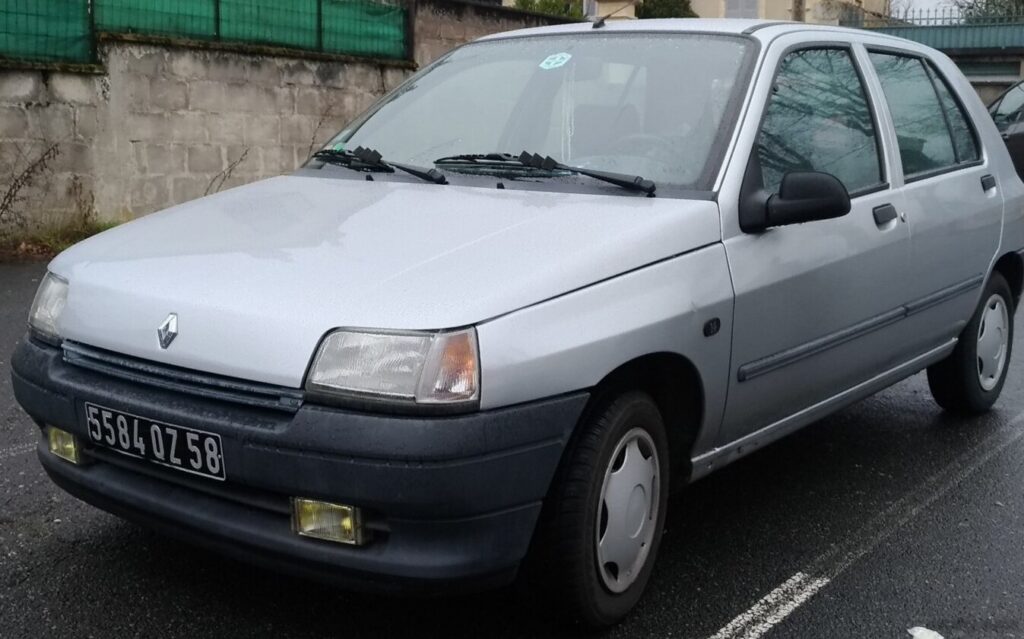
The Renault Clio I (Phase I) 1.8i, produced between 1990 and 1995, represented a significant step up in performance and refinement for Renault’s supermini. Positioned as the top-of-the-line trim level within the Phase I Clio range, it offered a more powerful engine option compared to the 1.4 and 1.6 liter variants. The Clio I, internally designated the B/C57 platform, was a crucial model for Renault, replacing the aging Renault 5 and establishing a new benchmark in the small hatchback segment. The 1.8i model aimed to attract buyers seeking a blend of practicality, style, and spirited driving performance.
Powertrain & Engine Architecture
The heart of the Clio 1.8i is the Renault F3P engine, an 1794cc (109.48 cubic inches) inline-four cylinder gasoline engine. This engine produced 110 horsepower (hp) at 5500 rpm and 158 Newton-meters (116.53 lb-ft) of torque at 4250 rpm, resulting in a power-to-liter ratio of 61.3 hp/l. The F3P featured a naturally aspirated configuration with multi-port fuel injection, a relatively sophisticated system for its time, contributing to improved fuel efficiency and smoother power delivery. The engine utilized an overhead camshaft (OHC) valvetrain with two valves per cylinder. Compression ratio was set at 9.8:1. Engine oil capacity was 3.7 liters (3.91 US quarts), and coolant capacity was 6.5 liters (6.87 US quarts).
Transmission
While a five-speed manual transmission was the most common pairing for the 1.8i engine, an optional four-speed automatic transmission was also available. This automatic gearbox, while offering convenience, did impact acceleration and fuel economy compared to the manual version. The automatic transmission featured standard torque converter technology and was designed for smooth, comfortable shifts, prioritizing ease of use over outright performance. The gear ratios were tailored to provide adequate acceleration from a standstill and reasonable cruising speeds.
Driving Characteristics
The Clio 1.8i offered a noticeable performance advantage over its lower-powered siblings. Acceleration from 0 to 100 km/h (0-62 mph) took approximately 8.9 seconds, and 0 to 60 mph was achieved in around 8.5 seconds. Maximum speed was rated at 195 km/h (121.17 mph). The engine provided a responsive feel, particularly in the mid-range, making it well-suited for both city driving and longer highway journeys. The automatic transmission, while smooth, resulted in some power loss and a less engaging driving experience compared to the manual. The weight-to-power ratio of 8.7 kg/hp contributed to a lively feel, though it wasn’t a particularly lightweight car. The suspension, tuned for comfort, provided a reasonably compliant ride, but handling was not as sharp as some of its competitors.
Equipment & Trim Levels
The 1.8i trim level was generally well-equipped for its time. Standard features typically included power steering, central locking, and a basic stereo system. Interior upholstery was usually cloth, with options for upgraded materials. Dashboard configuration was relatively simple and functional, with clear instrumentation. Optional extras available for the 1.8i included electric windows, a sunroof, and alloy wheels. The availability of these options varied depending on the specific market. The 1.8i was often distinguished by subtle exterior styling cues, such as body-colored bumpers and door handles.
Chassis & Braking
The Clio I utilized a front-wheel-drive layout with a transverse engine mounting. Front suspension consisted of a MacPherson strut setup, while the rear suspension employed a torsion beam axle. This configuration provided a good balance between ride comfort and handling. Braking systems varied depending on the specific model year and market. Generally, the front brakes were disc brakes, while the rear brakes were drum brakes. Anti-lock Braking System (ABS) was available as an optional extra, enhancing braking performance and safety. Steering was provided by a rack and pinion system, offering precise and responsive control. The standard tire size was 175/60 R14, mounted on 14-inch steel or alloy wheels.
Market Reception & Comparison
The Clio 1.8i was generally well-received by automotive critics. It was praised for its lively performance, comfortable ride, and stylish design. However, some critics noted that the automatic transmission detracted from the driving experience and that the interior, while functional, lacked the sophistication of some competitors. Compared to the 1.4 and 1.6 liter versions, the 1.8i offered a significant performance boost, making it a more appealing option for drivers who prioritized driving enjoyment. Fuel economy was reasonable for the time, with combined fuel consumption figures around 7.9 l/100 km (29.8 US mpg). Reliability was generally good, although the automatic transmission could be prone to issues if not properly maintained. The 1.8i was often positioned as a competitor to other small hatchbacks such as the Peugeot 205 and the Volkswagen Polo.
Technical Specifications
| Brand | Renault |
| Model | Clio |
| Generation | Clio I (Phase I) |
| Type (Engine) | 1.8 i (110 Hp) |
| Start of production | 1990 |
| End of production | 1995 |
| Fuel consumption (urban) | 10.3 l/100 km (22.8 US mpg) |
| Fuel consumption (extra urban) | 6.2 l/100 km (37.9 US mpg) |
| Fuel consumption (combined) | 7.9 l/100 km (29.8 US mpg) |
| Fuel Type | Petrol (Gasoline) |
| Acceleration 0-100 km/h | 8.9 sec |
| Acceleration 0-62 mph | 8.9 sec |
| Acceleration 0-60 mph | 8.5 sec |
| Maximum speed | 195 km/h (121.17 mph) |
| Power | 110 Hp @ 5500 rpm |
| Torque | 158 Nm @ 4250 rpm (116.53 lb.-ft. @ 4250 rpm) |
| Engine layout | Front, Transverse |
| Engine Model/Code | F3P |
| Engine displacement | 1794 cm3 (109.48 cu. in.) |
| Number of cylinders | 4 |
| Engine configuration | Inline |
| Cylinder Bore | 82.7 mm (3.26 in.) |
| Piston Stroke | 83.5 mm (3.29 in.) |
| Compression ratio | 9.8:1 |
| Number of valves per cylinder | 2 |
| Kerb Weight | 955 kg (2105.41 lbs.) |
| Max. weight | 1400 kg (3086.47 lbs.) |
| Trunk (boot) space (minimum) | 265 l (9.36 cu. ft.) |
| Trunk (boot) space (maximum) | 1055 l (37.26 cu. ft.) |
| Fuel tank capacity | 43 l (11.36 US gal) |
| Length | 3709 mm (146.02 in.) |
| Width | 1616 mm (63.62 in.) |
| Height | 1395 mm (54.92 in.) |
Legacy
The Renault Clio I 1.8i remains a popular choice among classic car enthusiasts. The F3P engine, when properly maintained, is known for its durability and relatively straightforward mechanics. However, age-related issues such as corrosion and wear on rubber components are common. The automatic transmission, while convenient, requires careful attention to fluid levels and maintenance to prevent premature failure. Today, the 1.8i variant commands a slightly higher price in the used car market compared to the lower-powered models, reflecting its performance advantage and relative rarity. It represents a significant milestone in Renault’s history, establishing the Clio as a successful and enduring model in the supermini segment.
