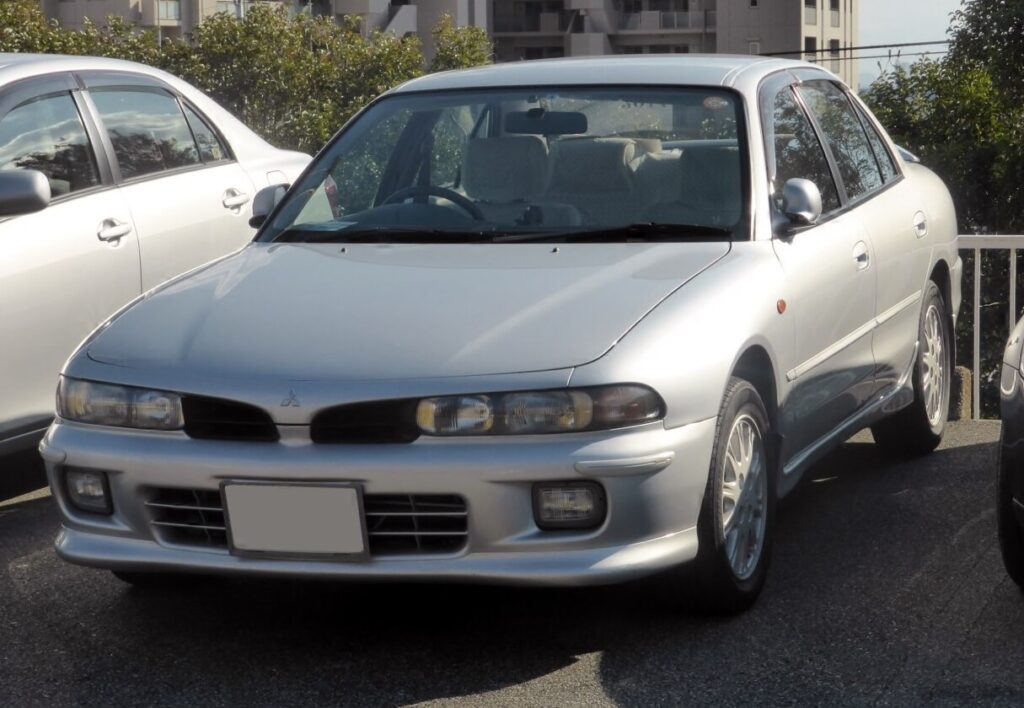
The Mitsubishi Galant VII 1.8 (E52A), produced between 1994 and 1996, represented a key entry point into the seventh generation of Mitsubishi’s long-running Galant lineage. This variant, powered by a 1.8-liter four-cylinder engine producing 116 horsepower, was positioned as the more economical and accessible option within the Galant VII range, which also included higher-performance trims like the VR-4 and larger displacement engines. The E52A chassis code designates this specific body style and engine combination. It was built on the 1HX0 platform, shared with other Mitsubishi and Chrysler models of the era, reflecting a period of collaboration between the two automakers.
The 1.8L E52A Galant: Positioning and Market Role
The 1.8L Galant served as the base model for the seventh generation, targeting buyers seeking a comfortable, reliable, and reasonably priced mid-size sedan. It was designed to appeal to families and commuters prioritizing fuel efficiency and practicality over outright performance. Compared to the more expensive and powerful 2.0L and V6 variants, the 1.8L offered a lower purchase price and reduced running costs, making it a popular choice in many markets. It directly competed with other mainstream mid-size sedans like the Toyota Camry, Honda Accord, and Nissan Maxima, offering a blend of features and value.
Powertrain & Engine Architecture
The heart of the Galant VII 1.8 is the 4G60 inline-four cylinder engine, specifically tuned to produce 116 horsepower at 6000 rpm and 162 Nm (119.49 lb-ft) of torque at 3000 rpm. This engine features a 10:1 compression ratio, a double overhead camshaft (DOHC) valvetrain with four valves per cylinder, and multi-port fuel injection. The engine’s displacement is 1834 cc (111.92 cubic inches), with a bore of 81 mm (3.19 inches) and a stroke of 89 mm (3.5 inches). The 4G60 engine family is known for its durability and relative simplicity, contributing to the Galant’s reputation for reliability. The engine is transversely mounted in the front of the vehicle.
The Galant VII 1.8 was primarily offered with a five-speed manual transmission. However, a four-speed automatic transmission was also available, and it is this automatic variant that is the focus of this article. The automatic transmission, while providing ease of use, did impact acceleration and fuel economy compared to the manual version. The automatic transmission’s gear ratios were optimized for smooth cruising and acceptable acceleration, but it lacked the responsiveness of a manual gearbox.
Fuel Injection and Valvetrain Details
The multi-port fuel injection system delivers fuel directly to each cylinder, optimizing combustion efficiency and contributing to the engine’s relatively smooth operation. The DOHC valvetrain allows for precise control of valve timing, enhancing both power and torque across the engine’s operating range. The engine is naturally aspirated, meaning it does not utilize a turbocharger or supercharger to force air into the cylinders.
Driving Characteristics
The 1.8L automatic Galant VII offered a comfortable and predictable driving experience. Acceleration from 0 to 60 mph was achieved in approximately 9.5 seconds, and 0-100 km/h in 10 seconds, which was adequate for everyday driving but noticeably slower than the more powerful trims. The automatic transmission provided smooth gear changes, but downshifts could be somewhat hesitant, particularly during overtaking maneuvers. The power delivery was linear, with peak torque available at 3000 rpm, making it reasonably responsive in typical driving situations. The weight-to-power ratio of 10.6 kg/Hp meant the car wasn’t particularly sporty, but it was manageable and predictable.
Compared to the manual transmission version, the automatic suffered a slight performance penalty. The manual offered quicker acceleration and better fuel economy due to its more direct connection to the engine. The higher-output 2.0L and V6 models provided significantly more power and torque, resulting in much brisker acceleration and a more engaging driving experience. However, these trims came at a higher price point.
Equipment & Trim Levels
The Galant VII 1.8 typically came standard with features such as power steering, air conditioning, cloth upholstery, and an AM/FM radio. Depending on the market and optional packages, additional features could include power windows and locks, a sunroof, alloy wheels, and upgraded audio systems. Interior trim levels varied, with higher trims offering more luxurious fabrics and additional comfort features. The dashboard layout was functional and straightforward, with easy-to-read gauges and logically placed controls. Safety features included ABS (Anti-lock Braking System) as standard equipment in many markets.
Chassis & Braking
The Galant VII 1.8 utilized a front-engine, front-wheel-drive layout. The front suspension consisted of a double wishbone setup, providing a comfortable ride and good handling characteristics. The rear suspension employed a spring strut design. The braking system featured ventilated discs on the front wheels and solid discs on the rear wheels, providing adequate stopping power for the vehicle’s weight and performance. The steering system was a rack and pinion type with hydraulic power assistance, offering precise steering feel and ease of maneuverability. The standard tire size was 185/70 R14.
Market Reception & Comparison
The Mitsubishi Galant VII 1.8 was generally well-received by automotive critics as a practical and reliable mid-size sedan. It was praised for its comfortable ride, spacious interior, and fuel efficiency. However, some critics noted that its performance was somewhat underwhelming compared to its competitors, particularly the higher-performance trims within the Galant lineup. Fuel economy was rated at 7.5 l/100 km (31.4 US mpg, 37.7 UK mpg), which was competitive for its class. Reliability was generally good, with the 4G60 engine proving to be durable and long-lasting. Compared to the 2.0L and V6 models, the 1.8L offered a more affordable entry point into the Galant range, making it a popular choice for budget-conscious buyers.
Technical Specifications
| Brand | Mitsubishi |
| Model | Galant |
| Generation | Galant VII |
| Type (Engine) | 1.8 (E52A) (116 Hp) |
| Start of production | 1994 |
| End of production | 1996 |
| Body type | Sedan |
| Seats | 5 |
| Doors | 4 |
| Fuel consumption (combined) | 7.5 l/100 km |
| Fuel Type | Petrol (Gasoline) |
| Acceleration 0 – 100 km/h | 10 sec |
| Acceleration 0 – 62 mph | 10 sec |
| Acceleration 0 – 60 mph | 9.5 sec |
| Maximum speed | 195 km/h (121.17 mph) |
| Weight-to-power ratio | 10.6 kg/Hp |
| Weight-to-torque ratio | 7.6 kg/Nm |
| Power | 116 Hp @ 6000 rpm |
| Torque | 162 Nm @ 3000 rpm (119.49 lb.-ft. @ 3000 rpm) |
| Engine layout | Front, Transverse |
| Engine displacement | 1834 cm3 (111.92 cu. in.) |
| Number of cylinders | 4 |
| Engine configuration | Inline |
| Cylinder Bore | 81 mm (3.19 in.) |
| Piston Stroke | 89 mm (3.5 in.) |
| Compression ratio | 10:1 |
| Number of valves per cylinder | 4 |
| Fuel injection system | Multi-port manifold injection |
| Engine aspiration | Naturally aspirated |
| Valvetrain | DOHC |
| Kerb Weight | 1231 kg (2713.89 lbs.) |
| Max. weight | 1705 kg (3758.88 lbs.) |
| Max load | 474 kg (1044.99 lbs.) |
| Trunk (boot) space – minimum | 450 l (15.89 cu. ft.) |
| Fuel tank capacity | 64 l (16.91 US gal | 14.08 UK gal) |
| Length | 4620 mm (181.89 in.) |
| Width | 1730 mm (68.11 in.) |
| Height | 1395 mm (54.92 in.) |
| Wheelbase | 2635 mm (103.74 in.) |
| Front track | 1510 mm (59.45 in.) |
| Rear (Back) track | 1505 mm (59.25 in.) |
| Drivetrain Architecture | Front wheel drive |
| Number of gears and type of gearbox | 5 gears, manual transmission / 4 gears, automatic transmission |
| Front suspension | Double wishbone |
| Rear suspension | Spring Strut |
| Front brakes | Ventilated discs |
| Rear brakes | Disc |
| Assisting systems | ABS (Anti-lock braking system) |
| Steering type | Steering rack and pinion |
| Power steering | Hydraulic Steering |
| Tires size | 185/70 R14 |
Legacy
The Mitsubishi Galant VII 1.8, particularly the automatic transmission variant, remains a relatively affordable and reliable option in the used car market. The 4G60 engine is known for its longevity, and with proper maintenance, can provide many years of service. While not a performance standout, the 1.8L Galant offers a comfortable and practical driving experience, making it a suitable choice for those seeking a dependable mid-size sedan. Parts availability is generally good, although some specific trim pieces may become increasingly difficult to find. The Galant VII, as a whole, is remembered as a solid and well-built car that represented a high point in Mitsubishi’s engineering and design.