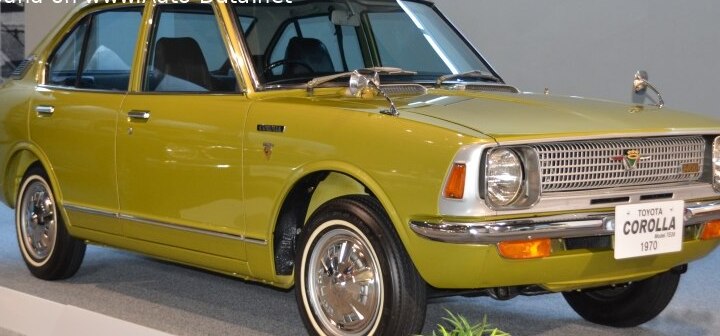
The Toyota Corolla II 4-door sedan (E20) 1200, powered by the 73 horsepower engine, was a pivotal model in Toyota’s expansion into global markets. Produced between 1970 and 1974, this variant represented the second generation of the Corolla, building upon the success of the original. The E20 chassis, part of the broader Corolla lineage, offered a more refined and spacious package compared to its predecessor, aiming for broader appeal within the burgeoning compact car segment. This 1200 model served as an entry point into the Corolla range, offering economical transportation for families and commuters.
The 1200 Variant: Positioning and Role
Within the E20 Corolla lineup, the 1200 (73 hp) model occupied the base trim level. It was designed to be the most affordable and fuel-efficient option, appealing to buyers prioritizing practicality and economy over outright performance. Higher trim levels, such as the 1600 Deluxe, offered more powerful engines and additional features, catering to customers willing to spend more for enhanced comfort and performance. The 1200 was specifically targeted at buyers seeking reliable, no-frills transportation, making it a popular choice in both domestic Japanese markets and export destinations.
Powertrain & Engine Architecture
The heart of the Corolla II 1200 was the 3K-D engine, a 1.2-liter (1166 cc) inline-four cylinder gasoline engine. This engine produced 73 horsepower at 6600 rpm and 94 Nm (69.33 lb-ft) of torque at 4200 rpm. The engine featured a compression ratio of 10:1 and utilized an overhead valve (OHV) valvetrain with two valves per cylinder. Fuel delivery was managed by a carburetor, a common technology for the era, prioritizing simplicity and cost-effectiveness. The engine’s longitudinal front-engine layout, coupled with rear-wheel drive, was a conventional configuration for automobiles of the time. The 3K-D engine was known for its durability and relatively simple maintenance requirements, contributing to the Corolla’s reputation for reliability.
Driving Characteristics
The 1200’s driving experience was characterized by its focus on fuel efficiency and ease of use. With 73 horsepower propelling a relatively lightweight vehicle (780 kg or 1719.61 lbs), acceleration was modest. Top speed was recorded at 150 km/h (93.21 mph). The four-speed manual transmission offered precise gear changes, but the engine’s limited torque meant frequent downshifting was often necessary, particularly when navigating hills or overtaking. Compared to the more powerful 1600cc variants, the 1200 felt noticeably slower, but its lighter weight and simpler mechanicals contributed to a more nimble and responsive feel in city driving. The weight-to-power ratio of 10.7 kg/Hp and weight-to-torque ratio of 8.3 kg/Nm reflected the engine’s modest output relative to the vehicle’s mass.
Equipment & Trim Levels
The Corolla II 1200 was typically equipped with basic, functional features. Standard equipment included cloth upholstery, vinyl floor covering, and a simple dashboard layout. The instrumentation was limited to a speedometer, fuel gauge, and temperature indicator. While not lavishly appointed, the interior offered adequate space for five passengers. Optional extras, depending on the market, could include a radio, heater, and upgraded seat materials. The exterior styling was understated, with a focus on practicality rather than aesthetics. Chrome trim was minimal, and the overall design emphasized clean lines and functional simplicity.
Chassis & Braking
The Corolla II 1200 featured a conventional chassis design for the early 1970s. The front suspension utilized an independent coil spring setup with a transverse stabilizer bar, providing a reasonable level of ride comfort and handling. The rear suspension employed a rigid axle with leaf springs, a cost-effective and durable solution. Braking duties were handled by disc brakes at the front and drum brakes at the rear. The steering system was a cone worm type with recirculation balls, offering adequate precision but lacking the responsiveness of more modern steering technologies. The relatively simple suspension and braking systems contributed to the vehicle’s affordability and ease of maintenance.
Market Reception & Comparison
The Toyota Corolla II 1200 was generally well-received by automotive critics and consumers alike. It was praised for its fuel economy (4.7 l/100 km, 50 US mpg, 60.1 UK mpg, 21.3 km/l), reliability, and affordability. Compared to its domestic Japanese rivals, such as the Datsun 1200, the Corolla offered a similar level of practicality and economy, but often benefited from Toyota’s growing reputation for quality and durability. Against the higher-trim Corolla variants, the 1200 offered a more accessible price point, making it an attractive option for budget-conscious buyers. However, its limited performance and basic features meant it wasn’t the ideal choice for those seeking a more engaging driving experience or a more luxurious interior.
Technical Specifications
| Brand | Toyota |
| Model | Corolla II |
| Generation | Corolla II 4-door sedan (E20) |
| Type (Engine) | 1200 (73 Hp) |
| Start of production | 1970 |
| End of production | 1974 |
| Powertrain Architecture | Internal Combustion engine |
| Body type | Sedan |
| Seats | 5 |
| Doors | 4 |
| Fuel consumption (combined) | 4.7 l/100 km (50 US mpg, 60.1 UK mpg, 21.3 km/l) |
| Maximum speed | 150 km/h (93.21 mph) |
| Weight-to-power ratio | 10.7 kg/Hp |
| Weight-to-torque ratio | 8.3 kg/Nm |
| Power | 73 Hp @ 6600 rpm |
| Torque | 94 Nm @ 4200 rpm (69.33 lb.-ft. @ 4200 rpm) |
| Engine layout | Front, Longitudinal |
| Engine Model/Code | 3K-D |
| Engine displacement | 1166 cm3 (71.15 cu. in.) |
| Number of cylinders | 4 |
| Engine configuration | Inline |
| Cylinder Bore | 75 mm (2.95 in.) |
| Piston Stroke | 66 mm (2.6 in.) |
| Compression ratio | 10:1 |
| Number of valves per cylinder | 2 |
| Fuel injection system | Carburettor |
| Engine aspiration | Naturally aspirated |
| Valvetrain | OHV |
| Kerb Weight | 780 kg (1719.61 lbs.) |
| Fuel tank capacity | 45 l (11.89 US gal | 9.9 UK gal) |
| Length | 3945 mm (155.31 in.) |
| Width | 1505 mm (59.25 in.) |
| Height | 1375 mm (54.13 in.) |
| Wheelbase | 2335 mm (91.93 in.) |
| Front track | 1255 mm (49.41 in.) |
| Rear track | 1245 mm (49.02 in.) |
| Minimum turning circle | 9 m (29.53 ft.) |
| Drivetrain Architecture | Rear wheel drive |
| Drive wheel | Rear wheel drive |
| Number of gears | 4 |
| Gearbox type | Manual transmission |
| Front suspension | Independent coil spring, Transverse stabilizer |
| Rear suspension | Rigid axle suspension, Leaf spring |
| Front brakes | Disc |
| Rear brakes | Drum |
| Steering type | Cone worm with recirculation balls |
Legacy
The Toyota Corolla II 1200, particularly the 3K-D engine, proved to be remarkably durable and reliable. Many examples continued to operate for decades after their initial production, a testament to Toyota’s engineering and build quality. In the used car market today, these Corollas are sought after by enthusiasts and collectors, particularly those interested in classic Japanese automobiles. While parts availability can be a challenge, the simplicity of the 3K-D engine and the overall mechanical design makes them relatively easy to maintain for those with mechanical aptitude. The 1200 variant remains a significant chapter in the Corolla’s history, representing a crucial step in Toyota’s journey to becoming a global automotive leader.