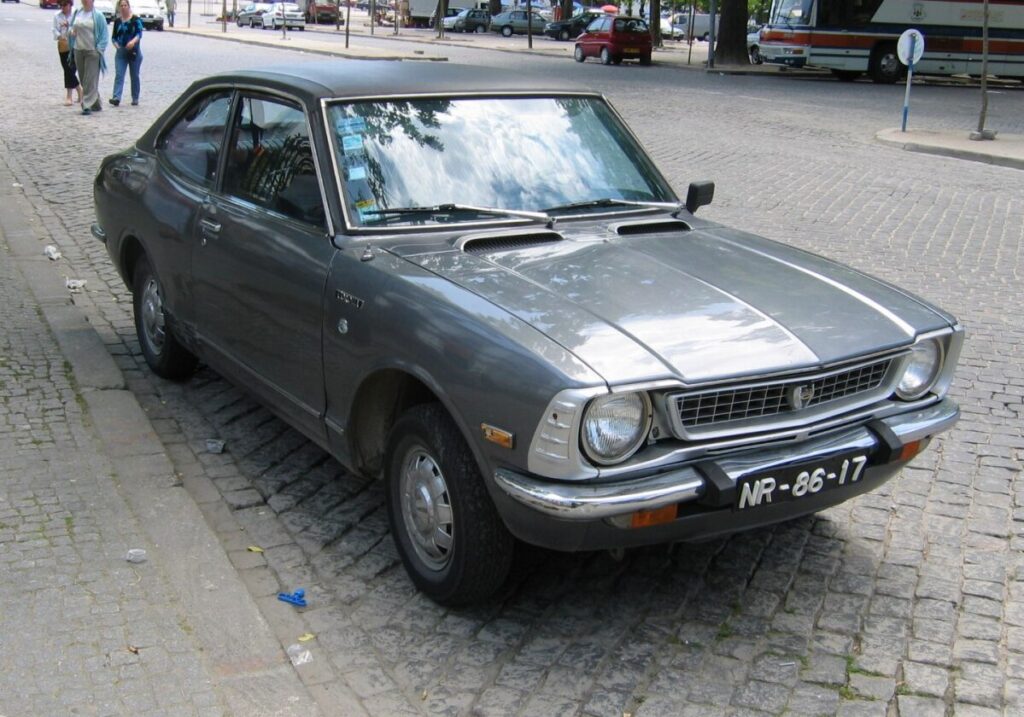
The Toyota Corolla II Coupe (E20) 1200, producing 68 horsepower, was a significant model in Toyota’s early expansion into international markets. Produced from May 1970 to July 1974, this coupe represented the second generation of the Corolla, designated the E20 series. It was positioned as a more stylish and sporty alternative to the standard Corolla sedan, appealing to a younger demographic. The E20 chassis, part of the broader Corolla family, offered a more compact and lightweight design compared to its predecessor, contributing to improved fuel efficiency and handling. This particular 1200 variant served as the entry point into the Corolla II Coupe range, offering affordable transportation with a touch of personality.
The 3K Engine and Powertrain
The heart of the Corolla II Coupe 1200 was the Toyota 3K engine, a 1.2-liter (1166 cc) inline-four cylinder gasoline engine. This engine was a mainstay of Toyota’s early production, known for its reliability and simplicity. The 3K featured a cast iron block and cylinder head, with a two-valve per cylinder overhead valve (OHV) valvetrain. Fuel delivery was managed by a single carburetor, a common setup for vehicles of this era. The engine produced 68 horsepower at 6000 rpm and 93 Nm (68.59 lb-ft) of torque at 3800 rpm. The engine’s longitudinal front-engine layout, coupled with rear-wheel drive, was typical for cars of this period. Power was transmitted to the rear wheels through a four-speed manual transmission, the standard offering for this trim level. While an automatic transmission was available on some Corolla models, it was not typically paired with the base 1200 engine due to the limited power output.
Engine Specifications in Detail
The 3K engine’s bore and stroke measured 75mm (2.95 inches) and 66mm (2.6 inches) respectively, resulting in a compression ratio of 9:1. This relatively low compression ratio contributed to the engine’s ability to run on lower octane fuels, which were prevalent at the time. The engine’s design prioritized durability and ease of maintenance over outright performance. The carburetor system, while less efficient than modern fuel injection, was relatively simple to repair and adjust. The OHV valvetrain, while not as sophisticated as overhead camshaft designs, was robust and reliable.
Driving Characteristics
The Corolla II Coupe 1200, with its 68 horsepower and relatively lightweight construction (745 kg or 1642.44 lbs), offered adequate performance for everyday driving. Acceleration was modest, but the car felt nimble and responsive, particularly in urban environments. The four-speed manual transmission allowed drivers to keep the engine in its optimal power band, maximizing acceleration and fuel efficiency. Compared to higher-spec Corolla models with larger engines, the 1200 lacked the punch for quick overtaking maneuvers or highway cruising. However, its lighter weight and simpler mechanicals made it a more engaging driving experience than its larger counterparts. The rear-wheel-drive configuration provided a balanced feel, although it lacked the stability control systems found in modern vehicles. The car’s handling was predictable, but the leaf spring rear suspension could result in a somewhat bumpy ride on uneven surfaces.
Equipment and Trim Levels
The Corolla II Coupe 1200 was positioned as the entry-level model in the coupe range, and its standard equipment reflected this. The interior typically featured vinyl upholstery and basic instrumentation, including a speedometer, fuel gauge, and temperature gauge. The dashboard was functional and straightforward in its design. Features like a radio, heater, and upgraded interior trim were often optional extras. The coupe body style itself was considered a step up in terms of aesthetics compared to the standard sedan, offering a more youthful and sporty appearance. The two-door configuration and sloping roofline contributed to its distinctive look. While not lavishly equipped, the Corolla II Coupe 1200 provided a comfortable and practical interior for its time.
Chassis and Braking
The Corolla II Coupe 1200 utilized a body-on-frame construction, which was common for vehicles of this era. The front suspension consisted of independent coil springs with a transverse stabilizer bar, providing a reasonable level of ride comfort and handling. The rear suspension employed a rigid axle with leaf springs, a simpler and more cost-effective design. The braking system featured disc brakes on the front wheels and drum brakes on the rear wheels. The steering system was a cone worm with recirculation balls, providing a relatively direct steering feel. The car’s relatively light weight helped to compensate for the limitations of the braking system. The 1200’s suspension setup was tuned for comfort and durability rather than outright performance.
Market Reception and Comparison
The Toyota Corolla II Coupe 1200 was generally well-received by critics and consumers alike. It was praised for its reliability, fuel efficiency, and affordability. Its compact size and nimble handling made it a popular choice for urban drivers. Compared to other vehicles in its class, such as the Datsun 1200, the Corolla II Coupe offered a similar level of performance and economy. However, the Corolla was often lauded for its build quality and durability. The 1200 variant, while the least powerful in the Corolla II Coupe lineup, offered a compelling value proposition for buyers seeking a practical and economical coupe. The larger-engined Corolla II Coupes (1600 and 2000) offered more performance but came at a higher price point. The 1200’s fuel economy was a significant selling point, achieving approximately 4.7 l/100 km (50 US mpg, 60.1 UK mpg).
Technical Specifications
| Brand | Toyota |
| Model | Corolla II Coupe |
| Generation | E20 |
| Type (Engine) | 1200 (68 Hp) |
| Start of production | May, 1970 |
| End of production | July, 1974 |
| Powertrain Architecture | Internal Combustion Engine |
| Body type | Coupe |
| Seats | 5 |
| Doors | 2 |
| Fuel consumption (combined) | 4.7 l/100 km (50 US mpg, 60.1 UK mpg) |
| Maximum speed | 150 km/h (93.21 mph) |
| Weight-to-power ratio | 11 kg/Hp |
| Engine Model/Code | 3K |
| Engine displacement | 1166 cm3 (71.15 cu. in.) |
| Number of cylinders | 4 |
| Engine configuration | Inline |
| Cylinder Bore | 75 mm (2.95 in.) |
| Piston Stroke | 66 mm (2.6 in.) |
| Compression ratio | 9:1 |
| Number of valves per cylinder | 2 |
| Fuel injection system | Carburettor |
| Engine aspiration | Naturally aspirated |
| Valvetrain | OHV |
| Kerb Weight | 745 kg (1642.44 lbs.) |
| Fuel tank capacity | 45 l (11.89 US gal | 9.9 UK gal) |
| Length | 3945 mm (155.31 in.) |
| Width | 1505 mm (59.25 in.) |
| Height | 1345 mm (52.95 in.) |
| Wheelbase | 2335 mm (91.93 in.) |
| Number of gears and type of gearbox | 4 gears, manual transmission |
Legacy
The Toyota Corolla II Coupe 1200, while not a high-performance machine, holds a significant place in Toyota’s history. Its reliability and affordability helped to establish the Corolla as a global automotive brand. The 3K engine, in particular, became renowned for its durability and longevity. Today, well-maintained examples of the Corolla II Coupe 1200 are sought after by classic car enthusiasts. While parts availability can be a challenge, the engine’s simplicity makes it relatively easy to repair and maintain. The car’s enduring appeal lies in its nostalgic charm and its representation of a simpler era in automotive design. In the used car market, these coupes command a modest but growing value, particularly among collectors seeking a piece of Toyota’s early heritage.