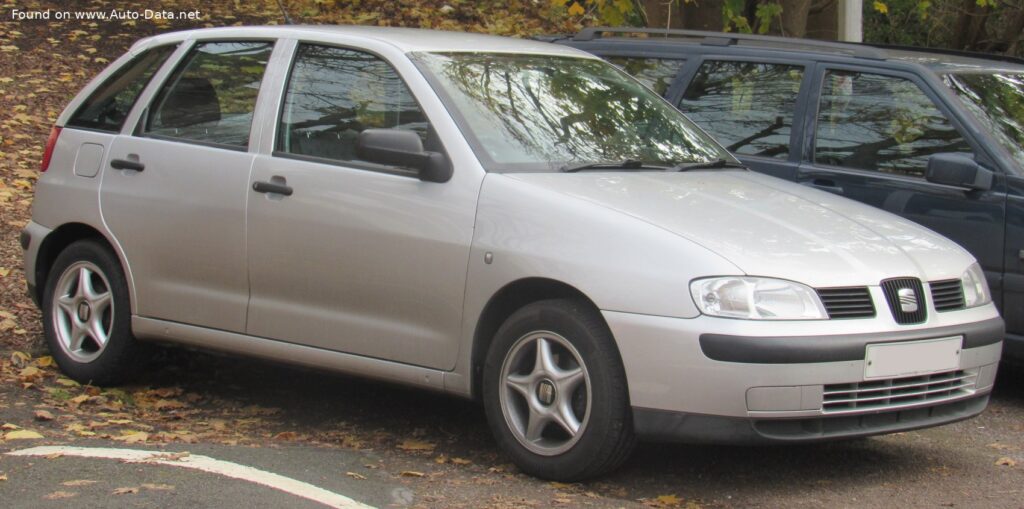
The Seat Ibiza II (facelift 1999) 1.9 SDI, producing 68 horsepower, was a key variant within the second generation of the popular Spanish hatchback. Introduced in April 1999 and continuing through May 2002, this model represented an economical and practical entry point into the Ibiza range, appealing to buyers prioritizing fuel efficiency and low running costs. It was built on the Volkswagen Group’s 1HX0/A3 platform, shared with models like the Volkswagen Polo and Škoda Fabia. The 1.9 SDI occupied the lower end of the Ibiza II’s engine lineup, positioned below the more powerful petrol and TDI diesel options.
1.9 SDI Powertrain & Engine Architecture
The heart of the Ibiza II 1.9 SDI is the AGP or AQM engine code, a 1.9-liter, inline four-cylinder diesel engine. This engine utilized a direct injection (DI) system, a technology that improved fuel economy and reduced emissions compared to older indirect injection diesels. Direct injection involved injecting fuel directly into the combustion chamber, rather than into the intake manifold. This allowed for more precise fuel control and a higher compression ratio of 19.5:1. The engine featured an overhead camshaft (OHC) valvetrain with two valves per cylinder.
Unlike many contemporary gasoline engines, the 1.9 SDI did not employ a turbocharger or intercooler, relying instead on naturally aspirated induction. This contributed to its relatively modest power output of 68 hp at 4200 rpm and 98.1 lb-ft of torque at 2200 rpm. The engine’s bore and stroke measured 79.5 mm (3.13 in) and 95.5 mm (3.76 in) respectively, resulting in a displacement of 1896 cm³ (115.7 cu. in). Engine oil capacity was 4.5 liters (4.76 US qt / 3.96 UK qt), and the cooling system required 6 liters (6.34 US qt / 5.28 UK qt) of coolant.
Transmission
The 1.9 SDI Ibiza II was exclusively offered with a five-speed manual transmission. An automatic transmission was not available for this specific engine configuration. The gearbox was designed to maximize fuel efficiency and provide adequate, though not sporty, performance. The gear ratios were optimized for low-end torque, prioritizing drivability in urban environments and during highway cruising.
Driving Characteristics
The driving experience in the Ibiza II 1.9 SDI was characterized by its practicality and economy rather than outright performance. Acceleration from 0 to 100 km/h (0-62 mph) took approximately 16 seconds, and 0 to 60 mph was achieved in around 15.2 seconds. The top speed was limited to 161 km/h (100.04 mph). The engine’s torque delivery was relatively flat, providing usable power across a narrow rev range. This made it easy to drive in everyday conditions, but overtaking maneuvers required careful planning.
Compared to the more powerful petrol versions of the Ibiza II, such as the 1.6-liter or 2.0-liter models, the 1.9 SDI felt significantly slower. However, it offered a substantial advantage in fuel economy. Compared to the 1.9 TDI, the SDI version lacked the turbocharger, resulting in lower power and torque figures, but also potentially lower maintenance costs due to the absence of a turbo system. The manual transmission, while not particularly engaging, was robust and reliable.
Equipment & Trim Levels
The 1.9 SDI Ibiza II typically represented the entry-level trim within the range. Standard equipment generally included power steering, central locking, and basic instrumentation. Interior upholstery was typically cloth, and the dashboard featured a functional, if somewhat spartan, design. Air conditioning, electric windows, and alloy wheels were often offered as optional extras, allowing buyers to customize their vehicle to some extent.
Trim levels varied slightly depending on the market, but generally, the 1.9 SDI was positioned as a value-oriented option. Higher trim levels, available with the more powerful engines, offered features like upgraded audio systems, more luxurious interior materials, and additional safety equipment.
Chassis & Braking
The Ibiza II 1.9 SDI utilized a front-wheel-drive layout with a relatively simple suspension setup. The front suspension consisted of wishbones, while the rear employed a spring strut arrangement. This configuration provided a comfortable ride, although it wasn’t particularly sporty. The kerb weight of the vehicle was 1042 kg (2297.22 lbs), contributing to its manageable handling characteristics.
Braking was handled by disc brakes at the front and drum brakes at the rear. An Anti-lock Braking System (ABS) was often included as standard equipment, enhancing safety by preventing wheel lockup during hard braking. The steering system was a hydraulic power steering rack and pinion, providing reasonable assistance at low speeds. The vehicle was equipped with 175/70 R13 tires.
Market Reception & Comparison
The Seat Ibiza II 1.9 SDI was generally well-received as a practical and economical hatchback. Critics praised its fuel efficiency and low running costs, making it an attractive option for budget-conscious buyers. However, its modest performance was often noted as a drawback. Fuel consumption figures were impressive, averaging around 6.7 l/100 km (35.1 US mpg / 42.2 UK mpg) in urban conditions and 4 l/100 km (58.8 US mpg / 70.6 UK mpg) on the open road.
Compared to other vehicles in its class, such as the Volkswagen Polo and Škoda Fabia (which shared the same platform), the Ibiza II 1.9 SDI offered a similar level of practicality and economy. The 1.9 TDI versions of the Ibiza II provided significantly more power and performance, but at a higher price point. The petrol-powered models offered a more refined driving experience, but typically consumed more fuel.
Technical Specifications
| Brand | Seat |
| Model | Ibiza |
| Generation | Ibiza II (facelift 1999) |
| Type (Engine) | 1.9 SDI (68 Hp) |
| Start of production | April, 1999 |
| End of production | May, 2002 |
| Powertrain Architecture | Internal Combustion engine |
| Body type | Hatchback |
| Seats | 5 |
| Doors | 3-5 |
| Fuel consumption (urban) | 6.7 l/100 km (35.1 US mpg / 42.2 UK mpg) |
| Fuel consumption (extra urban) | 4 l/100 km (58.8 US mpg / 70.6 UK mpg) |
| Fuel Type | Diesel |
| Acceleration 0 – 100 km/h | 16 sec |
| Acceleration 0 – 62 mph | 16 sec |
| Acceleration 0 – 60 mph | 15.2 sec |
| Maximum speed | 161 km/h (100.04 mph) |
| Weight-to-power ratio | 15.3 kg/Hp |
| Power | 68 Hp @ 4200 rpm |
| Torque | 133 Nm @ 2200 rpm (98.1 lb.-ft. @ 2200 rpm) |
| Engine layout | Front, Transverse |
| Engine Model/Code | AGP, AQM |
| Engine displacement | 1896 cm3 (115.7 cu. in.) |
| Number of cylinders | 4 |
| Engine configuration | Inline |
| Cylinder Bore | 79.5 mm (3.13 in.) |
| Piston Stroke | 95.5 mm (3.76 in.) |
| Compression ratio | 19.5:1 |
| Number of valves per cylinder | 2 |
| Fuel injection system | Direct injection |
| Engine aspiration | Naturally aspirated |
| Valvetrain | OHC |
| Engine oil capacity | 4.5 l (4.76 US qt | 3.96 UK qt) |
| Coolant | 6 l (6.34 US qt | 5.28 UK qt) |
| Kerb Weight | 1042 kg (2297.22 lbs.) |
| Max. weight | 1505 kg (3317.96 lbs.) |
| Trunk (boot) space – minimum | 250 l (8.83 cu. ft.) |
| Trunk (boot) space – maximum | 782 l (27.62 cu. ft.) |
| Fuel tank capacity | 45 l (11.89 US gal | 9.9 UK gal) |
| Length | 3877 mm (152.64 in.) |
| Width | 1640 mm (64.57 in.) |
| Height | 1422 mm (55.98 in.) |
| Wheelbase | 2443 mm (96.18 in.) |
| Drive wheel | Front wheel drive |
| Number of gears | 5 |
| Gearbox type | Manual transmission |
Legacy
The Seat Ibiza II 1.9 SDI, while not a performance icon, has proven to be a durable and reliable vehicle. The 1.9 SDI engine, when properly maintained, is known for its longevity. In the used car market, these models are often sought after by buyers looking for an affordable and economical runabout. Maintenance costs are generally low, and parts availability remains reasonable. However, potential buyers should be aware of the typical wear and tear associated with any vehicle of this age, such as suspension components and brake systems. The simplicity of the engine and the absence of a turbocharger contribute to its relatively straightforward maintenance requirements, making it a popular choice for those seeking a dependable and cost-effective vehicle.