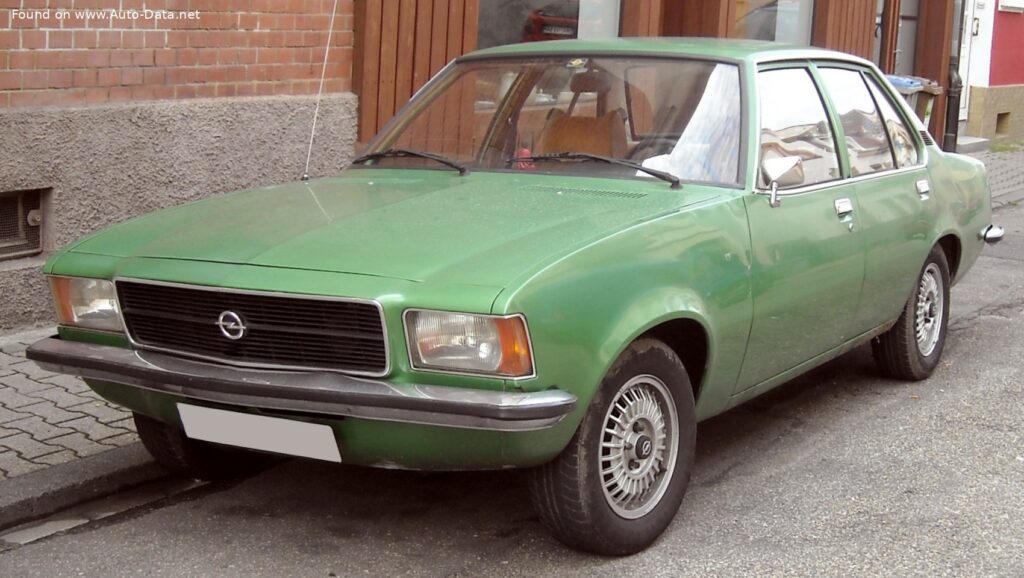
The Opel Rekord D 1.7, producing 60 horsepower, was a variant of the Rekord D series manufactured between 1975 and 1977. Positioned as the entry-level model within the Rekord D range, it offered a more affordable option for buyers seeking a spacious, practical family sedan. The Rekord D itself was a significant model for Opel, representing a move towards more modern styling and engineering, built on the H-platform. This 1.7-liter version aimed to provide economical transportation, prioritizing fuel efficiency and affordability over outright performance. It served as a stepping stone into the Rekord lineup, with buyers potentially upgrading to the larger engine options for increased power.
Powertrain & Engine Architecture
The heart of the Rekord D 1.7 was a 1,698 cc (103.62 cubic inches) inline-four cylinder engine. This engine, utilizing a single overhead camshaft (SOHC) valvetrain with two valves per cylinder, was designed for reliability and fuel economy rather than high output. The engine featured a relatively low 8:1 compression ratio, contributing to its ability to run on the lower octane fuels commonly available at the time. Fuel delivery was managed by a carburetor, a common setup for vehicles of this era. The engine produced 60 hp at 4800 rpm and 112 Nm (82.61 lb-ft) of torque between 2200-3000 rpm.
While a four-speed manual transmission was standard, an optional three-speed automatic transmission was available, though less common. The automatic transmission was a traditional hydraulic unit, offering smooth but not particularly quick shifts. The automatic version significantly altered the driving experience, prioritizing convenience over performance. The engine oil capacity was 3.8 liters (4.02 US quarts / 3.34 UK quarts), and the cooling system required 6.5 liters (6.87 US quarts / 5.72 UK quarts) of coolant.
Engine Codes and Variations
The engine was generally identified by its displacement, but specific internal variations existed. While not always explicitly documented for this specific output, Opel engine codes were used for identification and parts ordering. These codes would have denoted minor differences in components or calibration. The carburetor type and specific timing settings could vary slightly depending on the production year and market.
Driving Characteristics
The Rekord D 1.7 with 60 hp was not a performance-oriented vehicle. Acceleration was leisurely, taking approximately 21.5 seconds to reach 100 km/h (62 mph) and 20.4 seconds to reach 60 mph. The car’s top speed was around 140 km/h (87 mph). The manual transmission version offered a more engaging driving experience, allowing the driver to keep the engine in its optimal power band. However, even with the manual, the engine lacked significant low-end torque, requiring frequent downshifts for overtaking or climbing hills.
The automatic transmission further reduced the car’s responsiveness. While providing ease of use, it resulted in slower acceleration and a noticeable lack of power when attempting to merge onto highways or navigate uphill. The gear ratios were optimized for fuel economy rather than performance, with a relatively tall final drive. The car felt most comfortable cruising at moderate speeds on flat roads.
Equipment & Trim Levels
As the entry-level Rekord D, the 1.7-liter model came with a relatively basic level of equipment. Standard features typically included cloth upholstery, vinyl floor covering, and basic instrumentation consisting of a speedometer, fuel gauge, and temperature gauge. The steering wheel was typically a two-spoke design made of plastic. Heating and ventilation were standard, but air conditioning was generally an optional extra.
Optional extras included upgraded upholstery, a radio, whitewall tires, and a sunroof. Higher trim levels within the Rekord D range, such as those equipped with the larger 1.9 or 2.1-liter engines, offered more luxurious features like velour upholstery, woodgrain trim, and more comprehensive instrumentation. The 1.7-liter model was often seen as a practical, no-frills option for buyers prioritizing affordability and functionality.
Chassis & Braking
The Rekord D 1.7 utilized a traditional body-on-frame construction. The front suspension consisted of a double wishbone setup, providing a reasonable level of ride comfort. The rear suspension employed a spring strut design, which was simpler and more cost-effective. The car’s kerb weight of 1095 kg (2414.06 lbs) contributed to its somewhat sluggish handling characteristics.
Braking was accomplished via disc brakes on the front wheels and drum brakes on the rear. This configuration was typical for vehicles of this size and price point in the 1970s. While adequate for normal driving conditions, the braking system lacked the stopping power and fade resistance of more modern systems. The car’s turning circle was 11.4 meters (37.4 feet).
Market Reception & Comparison
The Opel Rekord D 1.7 was generally well-received as an affordable and practical family sedan. Critics acknowledged its spacious interior and reasonable fuel economy (10.1 l/100 km combined, 23.3 US mpg, 28 UK mpg). However, its lack of power was a common criticism. Compared to the higher-output Rekord D models, such as the 1.9 and 2.1-liter versions, the 1.7 felt significantly underpowered, especially when fully loaded with passengers and luggage.
The 1.9-liter Rekord D offered a noticeable improvement in performance, making it a more appealing option for drivers who frequently traveled on highways or needed to carry heavy loads. The Rekord D also competed with other mid-size sedans from manufacturers like Ford, Volkswagen, and Peugeot. The Opel offered a good balance of space, comfort, and affordability, making it a popular choice in many European markets.
Technical Specifications
| Body type | Sedan, 2-4 Doors, 5 Seats |
| Fuel economy (combined) | 10.1 l/100 km (23.3 US mpg, 28 UK mpg, 9.9 km/l) |
| Fuel type | Petrol (Gasoline) |
| Acceleration 0-100 km/h | 21.5 sec |
| Acceleration 0-60 mph | 20.4 sec |
| Maximum speed | 140 km/h (86.99 mph) |
| Weight-to-power ratio | 18.3 kg/Hp |
| Engine displacement | 1698 cm3 (103.62 cu. in.) |
| Number of cylinders | 4 |
| Engine configuration | Inline |
| Cylinder Bore | 88 mm (3.46 in.) |
| Piston Stroke | 69.8 mm (2.75 in.) |
| Compression ratio | 8:1 |
| Number of valves per cylinder | 2 |
| Fuel injection system | Carburettor |
| Engine oil capacity | 3.8 l (4.02 US qt | 3.34 UK qt) |
| Coolant capacity | 6.5 l (6.87 US qt | 5.72 UK qt) |
| Kerb Weight | 1095 kg (2414.06 lbs.) |
| Max. weight | 1575 kg (3472.28 lbs.) |
| Trunk (boot) space (minimum) | 408 l (14.41 cu. ft.) |
| Fuel tank capacity | 70 l (18.49 US gal | 15.4 UK gal) |
| Length | 4567 mm (179.8 in.) |
| Width | 1718 mm (67.64 in.) |
| Height | 1415 mm (55.71 in.) |
| Wheelbase | 2668 mm (105.04 in.) |
| Drive wheel | Rear wheel drive |
| Number of gears | 4 (manual) |
| Front brakes | Disc |
| Rear brakes | Drum |
Legacy
The Opel Rekord D 1.7, while not the most powerful or exciting variant of the Rekord D, remains a relatively reliable and affordable classic car. The engine, though simple, is known for its durability when properly maintained. Parts availability can be a challenge, but many components are still available through specialist suppliers. Today, the Rekord D 1.7 is often sought after by enthusiasts looking for a classic German sedan that is easy to maintain and offers a nostalgic driving experience. The automatic transmission versions, while less desirable to some, offer a comfortable and convenient driving experience for those seeking a classic cruiser. The car represents a significant era in Opel’s history and continues to be appreciated by classic car enthusiasts.