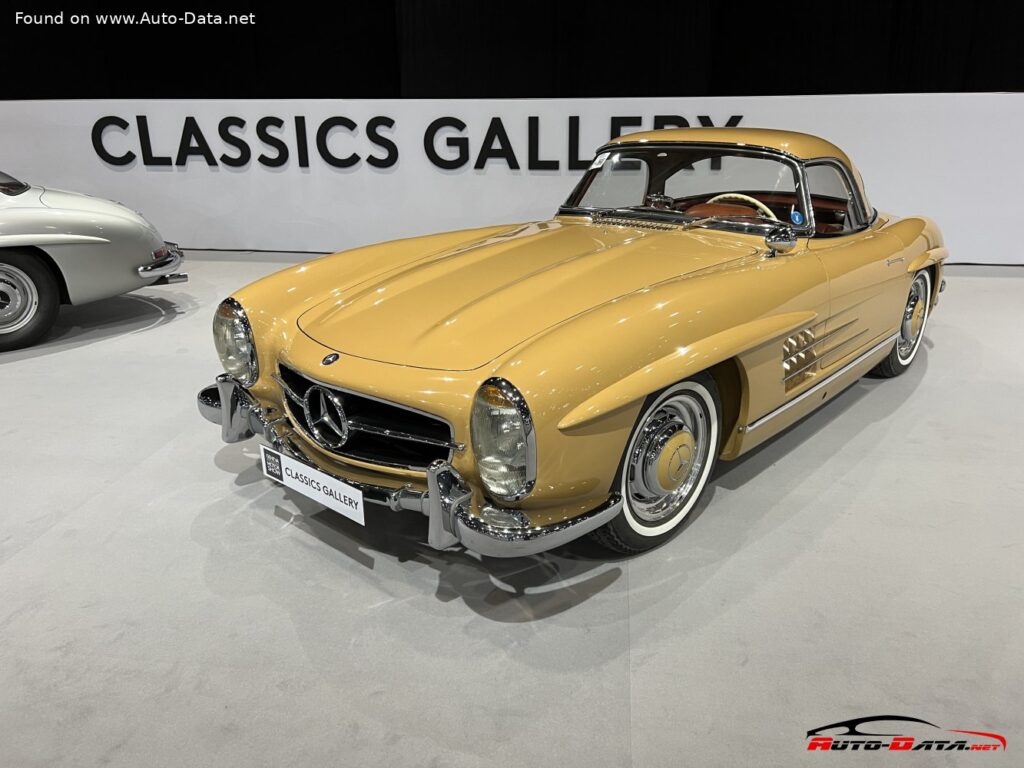
The Mercedes-Benz 300 SL Roadster (W198 II) Hardtop, produced between October 1958 and February 1963, represents a refined evolution of the iconic 300 SL “Gullwing” coupe. While sharing the same fundamental engineering as its predecessor, the Roadster offered increased practicality and a slightly more accessible price point, broadening the appeal of this high-performance sports car. It was built on the W198 platform, representing the second series of the 300 SL, and distinguished itself with conventional doors and a more conventional, though still elegant, roadster configuration. The 300 SL Roadster, particularly the hardtop variant, aimed to deliver a luxurious and exhilarating driving experience, cementing its place as a cornerstone of Mercedes-Benz’s heritage.
Powertrain & Engine Architecture
The heart of the 300 SL Roadster was the M198.980 and M198.982 inline-six cylinder engine, a 2,996 cc (182.83 cubic inches) masterpiece of engineering for its time. This engine, a naturally aspirated unit, produced 215 horsepower at 5,800 rpm and 275 Nm (202.83 lb-ft) of torque at 4,600 rpm. A key feature was its direct fuel injection system, a relatively advanced technology in the late 1950s, which contributed to the engine’s high specific output of 71.8 hp per liter. The engine employed a single overhead camshaft (SOHC) valvetrain with two valves per cylinder, operating with a compression ratio of 8.55:1.
The engine was mounted longitudinally in the front of the vehicle. While a four-speed manual transmission was standard, an optional four-speed automatic transmission was available, though less common. The automatic transmission, while offering convenience, did slightly diminish the car’s overall performance compared to the manual version. Engine oil capacity was 15 liters (15.85 US quarts / 13.2 UK quarts), and the cooling system held 15.5 liters (16.38 US quarts / 13.64 UK quarts).
Engine Codes & Variations
The M198.980 engine was initially used, with the M198.982 representing a later iteration with minor refinements. Both versions shared the same fundamental design and performance characteristics. The direct fuel injection system utilized a high-pressure mechanical pump and individual injectors for each cylinder, a complex system requiring precise maintenance.
Driving Characteristics
The 300 SL Roadster, even with the 215 hp engine, delivered a spirited driving experience. Acceleration from 0 to 60 mph was achieved in approximately 9.5 seconds, and 0 to 100 km/h took around 10 seconds. Top speed was rated at 250 km/h (155.34 mph). The car’s relatively light weight (1,370 kg / 3,020.33 lbs curb weight) contributed to its agile handling. The manual transmission allowed for precise control, while the automatic, though smoother, resulted in some power loss. The Roadster’s suspension, featuring coil springs and double wishbones at the front and independent coil springs at the rear, provided a comfortable yet firm ride. The weight-to-power ratio of 6.4 kg/hp and weight-to-torque ratio of 5 kg/Nm further highlighted the car’s performance capabilities.
Compared to the earlier “Gullwing” coupe, the Roadster offered a more compliant ride due to subtle suspension tuning changes. However, it lacked the sheer drama and collectibility of the coupe. The automatic transmission, while providing ease of use, was often criticized by enthusiasts for diminishing the car’s responsiveness and overall driving engagement.
Equipment & Trim Levels
The 300 SL Roadster was positioned as a premium sports car, and its standard equipment reflected this status. The interior featured high-quality leather upholstery, often in shades of red, beige, or black. The dashboard was elegantly designed with a comprehensive array of gauges, including a speedometer, tachometer, oil temperature gauge, and fuel level indicator. A wood-rimmed steering wheel was a common feature.
Optional extras included a detachable hardtop (which gave the variant its name), a soft top, Becker Mexico radio, and various trim options. The hardtop provided improved weather protection and a more refined driving experience, while the soft top offered open-air motoring. The interior trim could be customized with different leather colors and wood finishes.
Chassis & Braking
The 300 SL Roadster utilized a robust chassis construction, employing a space frame design – a pioneering technique for its time. This space frame, constructed from steel tubes, provided exceptional rigidity and contributed to the car’s handling prowess. The front suspension featured coil springs, double wishbones, and a transverse stabilizer bar, while the rear suspension utilized independent coil springs.
Braking was accomplished via drum brakes on all four wheels. While effective for the era, the drum brakes lacked the stopping power and fade resistance of modern disc brake systems. The steering system was a cone worm with recirculation balls, providing a relatively direct and precise feel. Tire size was 165/90 R15, mounted on 5.5J x 15 inch wheel rims.
Market Reception & Comparison
The 300 SL Roadster was generally well-received by automotive critics, who praised its performance, handling, and luxurious appointments. However, its high price tag limited its appeal to a relatively small segment of the market. Compared to other sports cars of the era, such as the Jaguar E-Type and the Porsche 356, the 300 SL Roadster offered a unique blend of sophistication and performance. The Roadster was often seen as a more practical and comfortable alternative to the “Gullwing” coupe, but it lacked the coupe’s iconic status and collectibility.
Fuel economy was relatively poor by modern standards, ranging from 12 to 19 liters per 100 kilometers (19.6 to 12.4 US mpg / 23.5 to 14.9 UK mpg / 8.3 to 5.3 km/l). Reliability was generally good, but the complex fuel injection system required regular maintenance and could be prone to issues if neglected.
Technical Specifications
| Brand | Mercedes-Benz |
| Model | SL |
| Generation | SL Roadster (W198 II) Hardtop |
| Type (Engine) | 300 SL (215 Hp) |
| Start of production | October, 1958 |
| End of production | February, 1963 |
| Powertrain Architecture | Internal Combustion engine |
| Body type | Roadster |
| Seats | 2 |
| Doors | 2 |
| Fuel consumption (combined) | 12-19 l/100 km |
| Fuel Type | Petrol (Gasoline) |
| Acceleration 0 – 100 km/h | 10 sec |
| Acceleration 0 – 62 mph | 10 sec |
| Acceleration 0 – 60 mph | 9.5 sec |
| Maximum speed | 250 km/h / 155.34 mph |
| Weight-to-power ratio | 6.4 kg/Hp |
| Weight-to-torque ratio | 5 kg/Nm |
| Power | 215 Hp @ 5800 rpm |
| Torque | 275 Nm @ 4600 rpm / 202.83 lb.-ft. @ 4600 rpm |
| Engine layout | Front, Longitudinal |
| Engine Model/Code | M 198.980, M 198.982 |
| Engine displacement | 2996 cm3 / 182.83 cu. in. |
| Number of cylinders | 6 |
| Engine configuration | Inline |
| Cylinder Bore | 85 mm / 3.35 in. |
| Piston Stroke | 88 mm / 3.46 in. |
| Compression ratio | 8.55:1 |
| Number of valves per cylinder | 2 |
| Fuel injection system | Direct injection |
| Engine aspiration | Naturally aspirated engine |
| Valvetrain | SOHC |
| Engine oil capacity | 15 l / 15.85 US qt | 13.2 UK qt |
| Coolant | 15.5 l / 16.38 US qt | 13.64 UK qt |
| Kerb Weight | 1370 kg / 3020.33 lbs |
| Max. weight | 1560-1660 kg / 3439.21 – 3659.67 lbs |
| Max load | 190-290 kg / 418.88 – 639.34 lbs |
| Fuel tank capacity | 100 l / 26.42 US gal | 22 UK gal |
| Length | 4570 mm / 179.92 in |
| Width | 1790 mm / 70.47 in |
| Height | 1300 mm / 51.18 in |
| Wheelbase | 2400 mm / 94.49 in |
| Front track | 1398 mm / 55.04 in |
| Rear track | 1448 mm / 57.01 in |
| Minimum turning circle | 11.5 m / 37.73 ft |
| Drivetrain Architecture | Rear wheel drive |
| Number of gears and type of gearbox | 4 gears, manual transmission |
| Front suspension | Coil spring, Double wishbone, Transverse stabilizer |
| Rear suspension | Independent coil spring |
| Front brakes | Drum |
| Rear brakes | Drum |
| Steering type | Cone worm with recirculation balls |
| Tires size | 165/90 R15 |
| Wheel rims size | 5.5J x 15 |
Legacy
The 300 SL Roadster remains a highly sought-after classic car, representing a pinnacle of 1950s automotive engineering and design. While the “Gullwing” coupe often commands higher prices, the Roadster offers a more attainable entry point into the world of classic Mercedes-Benz ownership. The engine, while complex, is known for its durability when properly maintained. Today, well-preserved examples of the 300 SL Roadster are prized by collectors and enthusiasts alike, serving as a testament to the enduring appeal of this iconic sports car. The direct fuel injection system, while requiring specialized knowledge for maintenance, is considered a landmark achievement in engine technology.