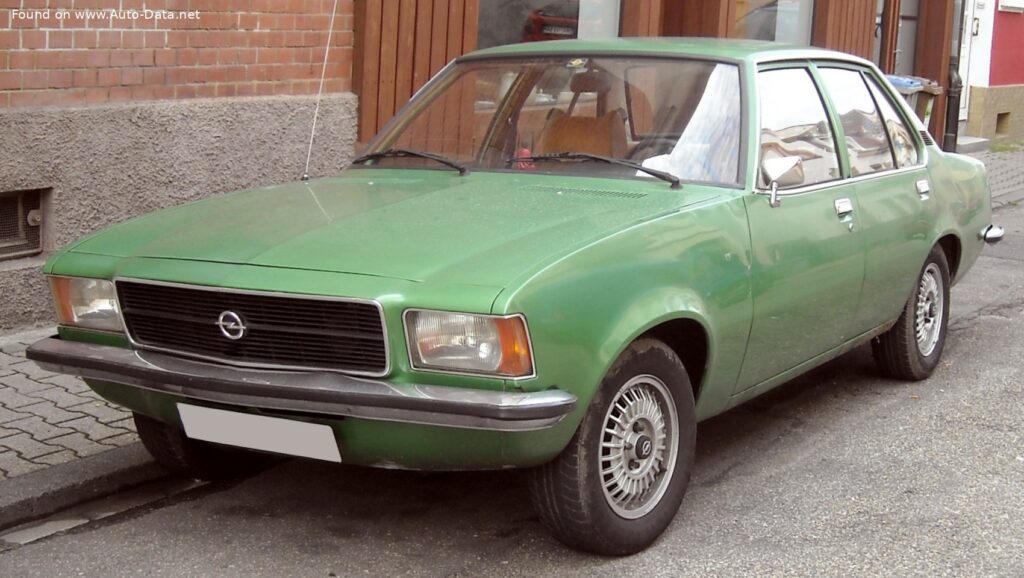
The Opel Rekord D 1.9 (90 hp) was a variant of the Rekord D series produced between 1975 and 1977. Positioned as an entry-level to mid-range offering within the Rekord D lineup, it provided a more economical alternative to the larger-displacement engines available. The Rekord D itself was a significant model for Opel, representing a modern, spacious family sedan built on the H-platform (internally designated 1HX0/A3). This generation aimed to offer improved comfort, safety, and styling compared to its predecessor, the Rekord C.
The 1.9-Liter Powertrain & Engine Architecture
The heart of the Rekord D 1.9 was its 1,897 cc (115.76 cubic inches) inline-four cylinder engine. Designated with engine codes likely including variations depending on specific market and year, this engine was a naturally aspirated, overhead camshaft (SOHC) design. It featured a two-valve per cylinder configuration. Fuel delivery was managed by a carburetor, a common setup for the time, rather than fuel injection. The engine produced 90 horsepower at 4,800 rpm and 145 Nm (106.95 lb-ft) of torque at 3,800 rpm. This resulted in a power-to-liter ratio of 47.4 hp/l.
The 1.9-liter engine was typically paired with a four-speed manual transmission, although an automatic transmission was also available, albeit less common. The automatic transmission was a three-speed unit, designed for smooth, comfortable operation rather than outright performance. The gear ratios were optimized for fuel efficiency and everyday drivability, prioritizing relaxed cruising over rapid acceleration. The engine’s bore and stroke measured 93 mm (3.66 in) and 69.8 mm (2.75 in) respectively, with a compression ratio of 8.8:1.
Comparison to Other Rekord D Engines
Compared to the other engines offered in the Rekord D range, the 1.9-liter was the smallest displacement option. Larger engines, such as the 2.1-liter and 2.8-liter six-cylinder variants, offered significantly more power and performance. The 2.8-liter, in particular, was aimed at buyers seeking a more premium driving experience. The 1.9-liter, however, appealed to those prioritizing fuel economy and affordability. While the larger engines provided quicker acceleration and higher top speeds, they also consumed more fuel and carried a higher price tag. The 1.9-liter offered a balance between usability and cost, making it a popular choice for families and commuters.
Driving Characteristics
The Rekord D 1.9 with the manual transmission offered adequate performance for everyday driving. Acceleration from 0 to 100 km/h (0-62 mph) took approximately 14 seconds, while 0 to 60 mph was achieved in around 13.3 seconds. The top speed was around 160 km/h (99.42 mph). With the three-speed automatic transmission, acceleration was predictably slower, as the automatic sapped some power. The car felt relatively relaxed at highway speeds, but overtaking required careful planning. The engine delivered its peak torque at a relatively low 3,800 rpm, providing reasonable pulling power in everyday driving situations. The weight-to-power ratio of 12.2 kg/hp and weight-to-torque ratio of 7.6 kg/Nm reflected the car’s modest performance capabilities.
The driving experience was characterized by a comfortable ride and predictable handling. The Rekord D was not a sports car, but it offered a stable and secure feel on the road. The steering was relatively light, making it easy to maneuver in urban environments. The suspension, while not particularly sophisticated, effectively absorbed bumps and irregularities in the road surface.
Equipment & Trim Levels
The Rekord D 1.9 typically came equipped with a standard level of features for a family sedan of its era. This included cloth upholstery, basic instrumentation (speedometer, fuel gauge, temperature gauge), and a four-spoke steering wheel. Depending on the market and optional packages, features like a radio, heater, and upgraded interior trim were available. The dashboard layout was functional and straightforward, prioritizing ease of use over aesthetic flair. The Rekord D 1.9 was often offered in a variety of exterior colors, with options for two- or four-door body styles.
Higher trim levels, often associated with the larger-engine Rekord D models, offered additional features such as vinyl upholstery, woodgrain interior trim, and more advanced instrumentation. However, the 1.9-liter variant generally focused on providing essential features at an affordable price point.
Chassis & Braking
The Rekord D 1.9 featured a rear-wheel-drive layout. The front suspension utilized independent coil springs, while the rear suspension employed a live axle with leaf springs. The braking system consisted of disc brakes at the front and drum brakes at the rear. This configuration was typical for cars of this size and price range during the 1970s. The curb weight of the Rekord D 1.9 was approximately 1,095 kg (2,414.06 lbs), with a maximum weight of 1,575 kg (3,472.28 lbs). The drag coefficient was 0.46, which was fairly typical for cars of that era.
The minimum turning circle was 11.4 meters (37.4 ft). The front and rear track widths were 1,431 mm (56.34 in) and 1,412 mm (55.59 in) respectively. Ride height (ground clearance) was 130 mm (5.12 in).
Market Reception & Comparison
The Opel Rekord D 1.9 was generally well-received by automotive critics as a practical and affordable family sedan. It was praised for its spacious interior, comfortable ride, and reasonable fuel economy. However, some critics noted that the 1.9-liter engine lacked the power and refinement of the larger-displacement options. Compared to competitors such as the Ford Taunus and Volkswagen Passat, the Rekord D 1.9 offered a competitive combination of features, performance, and price. Fuel consumption was rated at 11.5 l/100 km (20.5 US mpg, 24.6 UK mpg, 8.7 km/l).
In terms of reliability, the Rekord D 1.9 was generally considered to be a durable and dependable car. The 1.9-liter engine was relatively simple in design, making it easier to maintain and repair. However, like all cars of its era, it was susceptible to rust, particularly in regions with harsh winters.
Technical Specifications
| Brand | Opel |
| Model | Rekord |
| Generation | Rekord D |
| Type (Engine) | 1.9 (90 Hp) |
| Start of production | 1975 |
| End of production | 1977 |
| Body type | Sedan |
| Seats | 5 |
| Doors | 2-4 |
| Fuel consumption (combined) | 11.5 l/100 km |
| Fuel Type | Petrol (Gasoline) |
| Acceleration 0 – 100 km/h | 14 sec |
| Acceleration 0 – 62 mph | 14 sec |
| Acceleration 0 – 60 mph | 13.3 sec |
| Maximum speed | 160 km/h (99.42 mph) |
| Weight-to-power ratio | 12.2 kg/Hp |
| Weight-to-torque ratio | 7.6 kg/Nm |
| Power | 90 Hp @ 4800 rpm |
| Torque | 145 Nm @ 3800 rpm (106.95 lb.-ft. @ 3800 rpm) |
| Engine displacement | 1897 cm3 (115.76 cu. in.) |
| Number of cylinders | 4 |
| Engine configuration | Inline |
| Cylinder Bore | 93 mm (3.66 in) |
| Piston Stroke | 69.8 mm (2.75 in) |
| Compression ratio | 8.8:1 |
| Number of valves per cylinder | 2 |
| Fuel injection system | Carburettor |
| Engine aspiration | Naturally aspirated |
| Valvetrain | SOHC |
| Kerb Weight | 1095 kg (2414.06 lbs) |
| Max. weight | 1575 kg (3472.28 lbs) |
| Max load | 480 kg (1058.22 lbs) |
| Trunk (boot) space – minimum | 408 l (14.41 cu. ft) |
| Fuel tank capacity | 70 l (18.49 US gal | 15.4 UK gal) |
| Length | 4567 mm (179.8 in) |
| Width | 1718 mm (67.64 in) |
| Height | 1415 mm (55.71 in) |
| Wheelbase | 2668 mm (105.04 in) |
Legacy
The Opel Rekord D 1.9 (90 hp) remains a relatively common sight in the classic car market today. Its simple design and robust engine make it a relatively easy car to maintain and repair. While not particularly valuable, it represents an affordable entry point into classic car ownership. The 1.9-liter engine, while not known for its exceptional performance, proved to be a reliable and durable unit. The Rekord D 1.9 continues to be appreciated by enthusiasts for its practicality, comfort, and nostalgic appeal. Parts availability is generally good, although some specific components may be difficult to find. Overall, the Rekord D 1.9 stands as a testament to Opel’s commitment to building practical and dependable family cars during the 1970s.