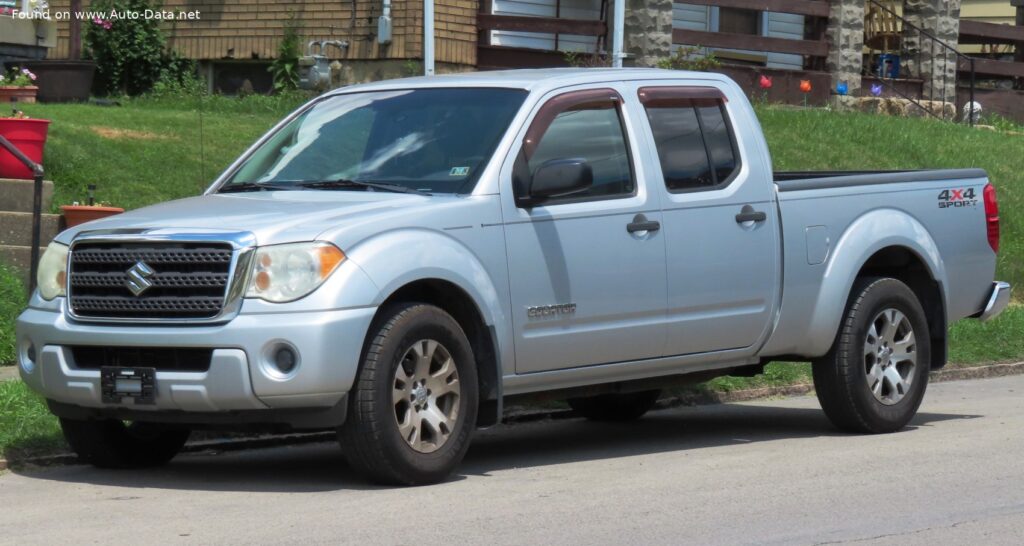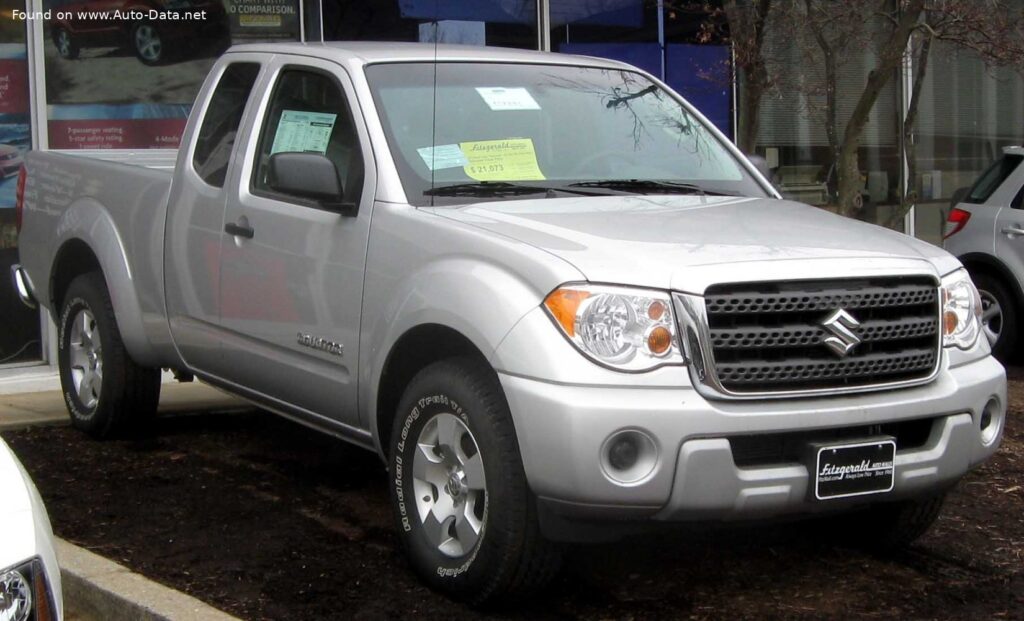
The Suzuki Equator Extended Cab 2.5, produced from 2008 to 2012, was a mid-size pickup truck offered by Suzuki in the North American market. It represented Suzuki’s entry into the competitive compact pickup segment, aiming to provide a value-oriented alternative to established players like the Toyota Tacoma and Nissan Frontier. The Equator was essentially a rebadged Nissan Frontier, a result of a manufacturing agreement between the two automakers. The 2.5-liter, 152 horsepower variant with a five-speed manual transmission occupied the base trim level, serving as the most affordable option within the Equator lineup. This model was designed to appeal to buyers prioritizing practicality and affordability over outright performance.
Suzuki Equator 2.5: Positioning and Market Context
The Equator Extended Cab 2.5 (152 hp) was positioned as the entry-level model in the Equator range. Above it sat the higher-trim levels, which often included options like four-wheel drive and potentially a more luxurious interior. The primary target audience for this base model was budget-conscious buyers needing a capable pickup for light-duty tasks, such as hauling materials for home improvement projects or weekend recreational activities. It was intended to be a work truck first and foremost, offering a reasonable level of utility at a competitive price point. Compared to the higher-trim Equators, the 2.5-liter engine offered less power and fewer features, but it also came with a lower purchase price and potentially better fuel economy.
Powertrain & Engine Architecture
The heart of the Equator 2.5 was the QR25DE 2.5-liter inline-four cylinder gasoline engine. This engine, sourced directly from Nissan, was a naturally aspirated powerplant featuring a cast iron block and aluminum cylinder head. It utilized a multi-port fuel injection system for precise fuel delivery and a Double Overhead Camshaft (DOHC) valvetrain with Variable Valve Timing (VVT) to optimize performance and efficiency across the rev range. The engine produced 152 horsepower at 5200 rpm and 232 Nm (171.11 lb-ft) of torque at 4400 rpm. The engine’s displacement was 2488 cm³ (151.83 cubic inches), with a bore of 89 mm (3.5 inches) and a stroke of 100 mm (3.94 inches). The engine oil capacity was 4.6 liters (4.86 US quarts or 4.05 UK quarts), and the cooling system held 9.4 liters (9.93 US quarts or 8.27 UK quarts). The engine was mounted longitudinally in the chassis.
The base Equator 2.5 was equipped with a five-speed manual transmission. This transmission was chosen to maximize fuel efficiency and provide a direct connection between the engine and the rear wheels. The gear ratios were tuned for everyday driving, prioritizing acceleration in the lower gears and comfortable cruising at highway speeds. The transmission was a conventional manual unit, offering a straightforward and reliable shifting experience.
Driving Characteristics
The driving experience in the Equator 2.5 was characterized by its practicality and affordability. The 152 horsepower engine provided adequate power for most everyday driving situations, but it wasn’t particularly quick or sporty. Acceleration was modest, and passing maneuvers required careful planning. The five-speed manual transmission allowed drivers to maintain control over the engine’s powerband, but it also demanded more driver involvement than an automatic transmission. The rear-wheel-drive configuration provided a simple and durable drivetrain, but it limited traction in slippery conditions. The suspension, tuned for comfort and load-carrying capacity, offered a reasonably smooth ride, even when the truck was lightly loaded. The steering was hydraulically assisted, providing a responsive and predictable feel.
Equipment & Trim Levels
The base Equator Extended Cab 2.5 was relatively sparsely equipped, focusing on essential features. Standard equipment typically included air conditioning, a basic audio system, and cloth upholstery. Power windows and locks were often optional extras. The interior was functional and durable, with hard-wearing materials designed to withstand the rigors of truck ownership. The extended cab configuration provided limited rear seating, suitable for occasional passengers or small cargo. Optional extras could include alloy wheels, a premium audio system, and a towing package. The dashboard layout was straightforward and easy to use, with clearly labeled controls.
Chassis & Braking
The Equator’s chassis was based on the Nissan Frontier platform, featuring a body-on-frame construction for durability and strength. The front suspension consisted of an independent coil spring setup with a transverse stabilizer bar, while the rear suspension utilized a rigid axle with leaf springs. This configuration provided a good balance between ride comfort and load-carrying capacity. The braking system featured ventilated discs on all four wheels, providing adequate stopping power for the truck’s weight. An Anti-lock Braking System (ABS) was standard, enhancing safety and control during emergency braking situations. The tires were typically 235/75 R15 size, mounted on 15-inch steel or alloy wheels.
Market Reception & Comparison
The Suzuki Equator, and specifically the 2.5-liter manual variant, received mixed reviews from automotive critics. While praised for its affordability and practicality, it was often criticized for its lack of refinement and relatively low power output compared to competitors. Fuel economy was considered average for its class, with EPA estimates of 12.4 l/100 km (19 US mpg) in the city and 10.2 l/100 km (23.1 US mpg) on the highway. Reliability was generally good, benefiting from the proven Nissan Frontier platform. However, some owners reported minor issues with the interior trim and electrical components. Compared to the higher-trim Equators, the 2.5-liter manual offered the best fuel economy and the lowest purchase price, but it also lacked the features and performance of its more expensive siblings.
Technical Specifications
| Body Type | Pick-up, 4 Doors, 4 Seats |
| Engine Size | 2.5 l, 2488 cm³, 151.83 cu. in. |
| Engine Model/Code | QR25DE |
| Number of Cylinders | 4, Inline |
| Power | 152 Hp @ 5200 rpm |
| Torque | 232 Nm @ 4400 rpm, 171.11 lb.-ft. @ 4400 rpm |
| Fuel Type | Petrol (Gasoline) |
| Transmission | 5 gears, manual transmission |
| Drivetrain | Rear wheel drive |
| Kerb Weight | 1672 kg, 3686.13 lbs. |
| Max. Weight | 2119 kg, 4671.6 lbs. |
| Max Load | 447 kg, 985.47 lbs. |
| Fuel Tank Capacity | 80 l, 21.13 US gal, 17.6 UK gal |
| Length | 5248 mm, 206.61 in. |
| Width | 1849 mm, 72.8 in. |
| Height | 1745 mm, 68.7 in. |
Legacy
The Suzuki Equator, while a relatively short-lived model, left a modest mark on the North American pickup truck market. Its primary legacy lies in providing an affordable and practical option for buyers seeking a basic work truck. The 2.5-liter QR25DE engine, sourced from Nissan, proved to be a reliable and durable powerplant. Today, used Equators are relatively affordable and can be found in reasonable condition. However, potential buyers should be aware of the truck’s limited features and modest performance. The Equator’s association with the Nissan Frontier also means that parts availability is generally good, making maintenance and repairs relatively straightforward. While not a collector’s item, the Equator 2.5 remains a viable option for those seeking a simple and inexpensive pickup truck.