
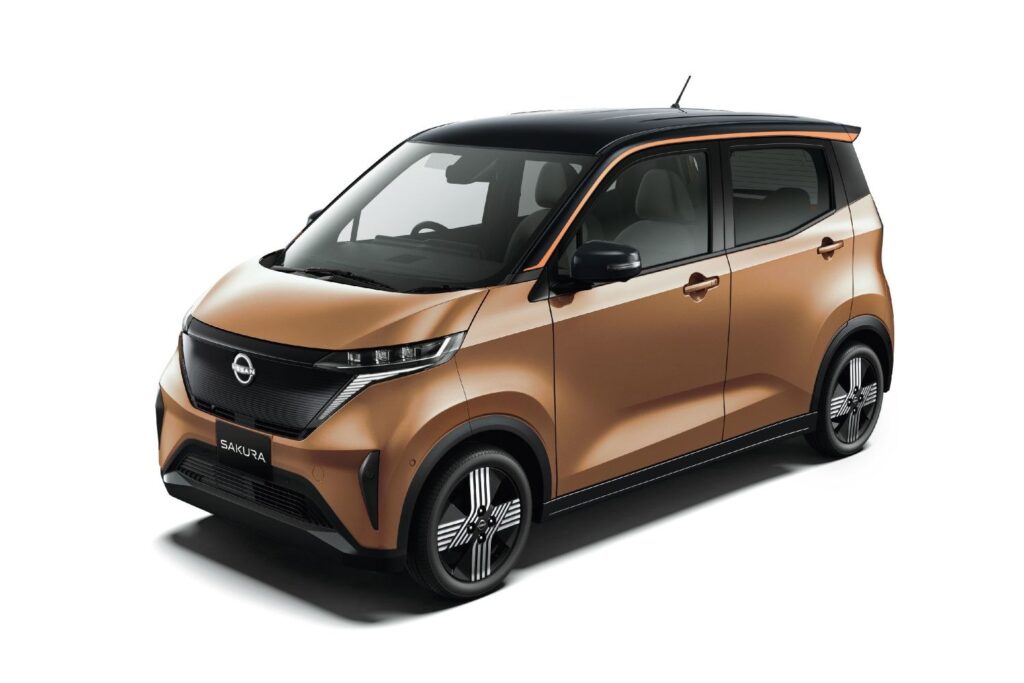
The Nissan Sakura 20 kWh (64 hp) is a battery electric vehicle (BEV) introduced by Nissan in May 2022. Positioned as an entry-level offering within the Sakura lineup, it represents Nissan’s commitment to accessible electric mobility, particularly within the Japanese Kei car segment. The Sakura is built on a dedicated EV platform, signifying a departure from adapting existing internal combustion engine (ICE) vehicle architectures. This model is a five-door hatchback designed to accommodate four passengers, focusing on practicality and efficiency for urban driving.
Powertrain & Engine Architecture
The Nissan Sakura 20 kWh utilizes a single electric motor, designated MM48, driving the front wheels. This motor produces a maximum of 64 horsepower (48 kW) between 2302 and 10455 rpm, and 195 Nm (143.82 lb-ft) of torque available from 0 to 2302 rpm. The powertrain operates on a 350V system. The battery pack, utilizing Lithium-ion technology, has a gross capacity of 20 kWh and is located under the floor of the vehicle, contributing to a lower center of gravity and maximizing cabin space. The Sakura employs a single-speed automatic transmission, typical of most BEVs, simplifying the driving experience and focusing on smooth, linear acceleration. The electric motor’s control system is designed to optimize energy efficiency and deliver responsive performance in city traffic.
Electric Motor Details
The MM48 electric motor is a synchronous motor, chosen for its efficiency and compact size. It features a robust cooling system to maintain optimal operating temperatures during extended use. The motor’s power electronics are integrated into the overall powertrain control system, allowing for precise control of torque delivery and regenerative braking. The placement of the motor – front, transverse – contributes to the vehicle’s balanced handling characteristics.
Driving Characteristics
The Nissan Sakura 20 kWh delivers a driving experience tailored for urban environments. With 64 hp and 195 Nm of torque, acceleration is brisk enough for city driving, though not geared towards high-speed performance. The single-speed automatic transmission provides seamless power delivery, eliminating the need for gear changes. The instant torque characteristic of electric motors allows for quick responses from a standstill. The weight-to-power ratio of 16.7 kg/hp results in a noticeable, yet manageable, acceleration profile. While not as powerful as potential higher-trim Sakura variants, the 20 kWh model prioritizes efficiency and ease of use. The regenerative braking system enhances efficiency by capturing energy during deceleration, extending the vehicle’s range.
Equipment & Trim Levels
The base Nissan Sakura 20 kWh trim focuses on providing essential features for daily commuting. Standard equipment typically includes air conditioning, power windows, power door locks, and a basic audio system. Safety features such as ABS (Anti-lock Braking System) are standard. Interior upholstery is typically a durable cloth material. Optional extras, depending on the market and package selected, could include a touchscreen infotainment system, navigation, and advanced driver-assistance systems (ADAS) like automatic emergency braking and lane departure warning. The dashboard layout is designed for simplicity and ease of use, with a focus on displaying key information related to the electric powertrain, such as battery charge level and energy consumption.
Chassis & Braking
The Nissan Sakura utilizes an independent McPherson strut suspension system at the front, providing a comfortable ride and responsive handling. The rear suspension employs an independent multi-link setup, further enhancing ride quality and stability. The front brakes are ventilated discs, offering strong stopping power, while the rear brakes are drums, a cost-saving measure common in this vehicle segment. The steering system is an electric power steering rack and pinion, providing light and precise steering feel. The Sakura is equipped with 155/65 R14 or 165/55 R15 tires, mounted on 4.5J x 14 or 4.5J x 15 wheels, respectively. The ride height (ground clearance) is 145 mm (5.71 inches), suitable for navigating typical urban road conditions.
Market Reception & Comparison
The Nissan Sakura 20 kWh has been well-received in the Japanese market, particularly due to its affordability and practicality as a city car. Critics have praised its efficient use of space, comfortable ride, and ease of driving. Compared to potential future higher-output Sakura trims, the 20 kWh model offers a more accessible price point, making it attractive to budget-conscious buyers. Its all-electric range of 180 km (111.85 miles) on the WLTC cycle is sufficient for most daily commutes. The average energy consumption of 12.4 kWh/100 km (19.96 kWh/100 miles) translates to a respectable 169 MPGe. While the range is less than some longer-range EVs, it aligns with the intended use case of the Sakura as a city vehicle. The Sakura competes with other Kei car EVs in Japan, offering a compelling combination of price, efficiency, and practicality.
Technical Specifications
| Brand | Nissan |
| Model | Sakura |
| Type (Engine) | 20 kWh (64 Hp) BEV |
| Start of production | May, 2022 |
| Body type | Hatchback |
| Seats | 4 |
| Doors | 5 |
| Fuel Type | Electricity |
| Maximum speed | 130 km/h (80.78 mph) |
| Weight-to-power ratio | 16.7 kg/Hp |
| Weight-to-torque ratio | 5.5 kg/Nm |
| Gross battery capacity | 20 kWh |
| Battery voltage | 350 V |
| Battery technology | Lithium-ion (Li-Ion) |
| Battery location | Below the floor |
| All-electric range (WLTC) | 180 km (111.85 mi) |
| Average Energy consumption (WLTC) | 12.4 kWh/100 km (19.96 kWh/100 mi) |
| Electric motor power | 64 Hp @ 2302-10455 rpm |
| Electric motor Torque | 195 Nm @ 0-2302 rpm (143.82 lb.-ft. @ 0-2302 rpm) |
| Electric motor model/code | MM48 |
| Electric motor location | Front, Transverse |
| Kerb Weight | 1070-1080 kg (2358.95 – 2380.99 lbs.) |
| Max. weight | 1300 kg (2866.01 lbs.) |
| Max load | 220-230 kg (485.02 – 507.06 lbs.) |
| Trunk (boot) space – minimum | 107 l (3.78 cu. ft.) |
| Length | 3395 mm (133.66 in.) |
| Width | 1475 mm (58.07 in.) |
| Height | 1655 mm (65.16 in.) |
| Wheelbase | 2495 mm (98.23 in.) |
| Drive wheel | Front wheel drive |
| Number of gears and type of gearbox | 1 gears, automatic transmission |
| Front brakes | Ventilated discs |
| Rear brakes | Drum |
| Tires size | 155/65 R14 75S; 165/55 R15 75V |
Legacy
The Nissan Sakura 20 kWh represents a significant step in Nissan’s electrification strategy, offering an affordable and practical EV option for urban commuters. While long-term reliability data is still emerging, the use of proven Lithium-ion battery technology and a relatively simple powertrain architecture suggests a reasonable expectation of durability. In the used car market, the Sakura 20 kWh is expected to hold its value due to the increasing demand for EVs and the vehicle’s practicality. As battery technology continues to improve and charging infrastructure expands, the Sakura is poised to become an increasingly popular choice for environmentally conscious drivers.
