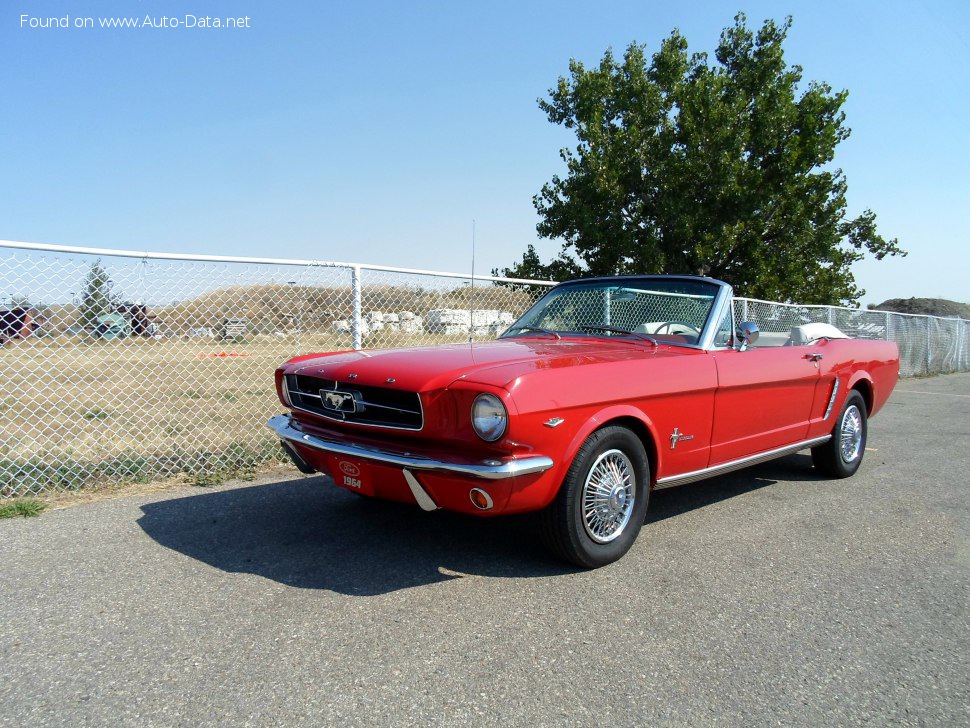
The Ford Mustang Convertible I 2.8 V6 (101 hp) represents a pivotal, though often overlooked, entry point into the iconic Mustang lineage. Produced solely during the 1964 model year, this variant served as the initial convertible offering for the newly launched Mustang, establishing the foundation for what would become America’s most enduring pony car. It was built on the Ford Falcon platform, designated as the 1964 ½ Mustang, and played a crucial role in the model’s unprecedented sales success. This particular configuration, with its 2.8-liter V6 engine and three-speed manual transmission, occupied the entry-level position in the convertible lineup, appealing to buyers seeking affordable open-air motoring.
Powertrain & Engine Architecture
The heart of the 1964 Mustang Convertible I 2.8 V6 was the Ford 170 cubic inch (2.8L) inline-six cylinder engine. While often referred to as a V6, it is important to note that this engine is an inline-six. Designated internally as the 170 CID, it produced 101 horsepower at 4,400 rpm and 156 lb-ft of torque at 2,400 rpm. This engine utilized a single-barrel carburetor for fuel delivery, a relatively simple system for the time. The valvetrain employed an overhead valve (OHV) configuration with two valves per cylinder. The engine’s longitudinal front-engine layout contributed to the Mustang’s balanced handling characteristics. The 170 engine was known for its durability and relative simplicity, making it a cost-effective choice for Ford. It featured a compression ratio of 8.7:1. Engine oil capacity was 4.3 liters (4.54 US quarts), and coolant capacity was 9 liters (9.51 US quarts).
Transmission Details
The standard transmission for the 1964 Mustang Convertible I 2.8 V6 was a three-speed manual transmission. This transmission was a conventional setup, designed for durability and ease of maintenance. While an automatic transmission was available as an option, the three-speed manual was the most common pairing for the base 2.8L engine. The gear ratios were optimized for everyday driving, prioritizing fuel economy and smooth acceleration over outright performance. The manual transmission contributed to the car’s relatively low starting price, making it accessible to a wider range of buyers.
Driving Characteristics
The 1964 Mustang Convertible I 2.8 V6 offered a driving experience focused on comfortable cruising rather than high-performance thrills. With 101 horsepower propelling a curb weight of approximately 2,740 pounds, acceleration was adequate for merging onto highways and navigating city streets. The three-speed manual transmission required deliberate shifting, but provided a direct connection between driver and machine. Compared to the more powerful V8-equipped Mustangs, the 2.8L version felt noticeably slower, particularly during acceleration and uphill climbs. However, the lighter weight of the inline-six engine contributed to slightly improved handling balance. The power delivery was relatively linear, making the car easy to control for novice drivers. The overall driving experience was best described as relaxed and enjoyable, perfectly suited for leisurely weekend drives.
Equipment & Trim Levels
The 1964 Mustang Convertible I 2.8 V6 was offered with a relatively basic level of standard equipment, reflecting its position as the entry-level model. Standard features included a simple dashboard layout with basic instrumentation, vinyl upholstery, and a two-spoke steering wheel. The convertible top was manually operated. Optional extras included a radio, whitewall tires, a deluxe interior trim package, and upgraded wheel covers. The interior color options were limited, typically consisting of shades of black, red, and blue. The exterior paint colors were more varied, offering a range of solid and two-tone combinations. The trim level was largely defined by the options selected by the buyer, allowing for a degree of personalization.
Chassis & Braking
The 1964 Mustang Convertible I 2.8 V6 utilized a conventional chassis design based on the Ford Falcon. The front suspension featured a double wishbone setup, providing a comfortable ride and reasonable handling. The rear suspension employed a rigid axle with leaf springs, a cost-effective and durable design. The braking system consisted of drum brakes on all four wheels, measuring 228.6 mm in diameter. While adequate for the car’s performance capabilities, the drum brakes lacked the stopping power of disc brakes. The steering system was a cone worm with recirculation balls, offering a reasonable level of precision. Tire size was 165/80 R13 for both front and rear wheels, mounted on 6.5J x 13 inch steel rims.
Market Reception & Comparison
The 1964 Mustang Convertible I 2.8 V6 was generally well-received by the automotive press and the public. Critics praised the car’s stylish design, affordable price, and comfortable ride. However, some reviewers noted the lack of power from the 2.8L engine, particularly when compared to the V8 options. Fuel economy was considered reasonable for the time, averaging around 20-25 miles per gallon. In terms of reliability, the 2.8L engine proved to be quite durable, with relatively few reported issues. Compared to the V8-equipped Mustangs, the 2.8L version was significantly more affordable, making it accessible to a wider range of buyers. The 1.8L engine was often seen as a good choice for those prioritizing fuel economy and everyday usability over outright performance.
Technical Specifications
| Brand | Ford |
| Model | Mustang |
| Generation | Mustang Convertible I |
| Type (Engine) | 2.8 V6 (101 Hp) |
| Start of production | 1964 |
| End of production | 1964 |
| Powertrain Architecture | Internal Combustion engine |
| Body type | Cabriolet |
| Seats | 4 |
| Doors | 2 |
| Fuel Type | Petrol (Gasoline) |
| Weight-to-power ratio | 12.3 kg/Hp |
| Weight-to-torque ratio | 5.9 kg/Nm |
| Power | 101 Hp @ 4400 rpm |
| Torque | 212 Nm @ 2400 rpm (156.36 lb.-ft. @ 2400 rpm) |
| Engine layout | Front, Longitudinal |
| Engine displacement | 2786 cm3 (170.01 cu. in.) |
| Number of cylinders | 6 |
| Engine configuration | Inline |
| Cylinder Bore | 88.9 mm (3.5 in.) |
| Piston Stroke | 74.68 mm (2.94 in.) |
| Compression ratio | 8.7:1 |
| Number of valves per cylinder | 2 |
| Fuel injection system | Carburettor |
| Engine aspiration | Naturally aspirated engine |
| Valvetrain | OHV |
| Engine oil capacity | 4.3 l (4.54 US qt | 3.78 UK qt) |
| Coolant | 9 l (9.51 US qt | 7.92 UK qt) |
| Kerb Weight | 1243 kg (2740.35 lbs.) |
| Trunk (boot) space – minimum | 218 l (7.7 cu. ft.) |
| Fuel tank capacity | 61 l (16.11 US gal | 13.42 UK gal) |
| Length | 4613 mm (181.61 in.) |
| Width | 1732 mm (68.19 in.) |
| Height | 1298 mm (51.1 in.) |
| Wheelbase | 2763 mm (108.78 in.) |
| Front track | 1407 mm (55.39 in.) |
| Rear (Back) track | 1422 mm (55.98 in.) |
| Minimum turning circle (turning diameter) | 11.6 m (38.06 ft.) |
| Drivetrain Architecture | Rear wheel drive |
| Number of gears and type of gearbox | 3 gears, manual transmission |
| Front suspension | Double wishbone |
| Rear suspension | Rigid axle suspension, Leaf spring |
| Front brakes | Drum, 228.6 mm |
| Rear brakes | Drum, 228.6 mm |
| Steering type | Cone worm with recirculation balls |
| Power steering | Hydraulic Steering |
| Tires size | Front wheel tires: 165/80 R13 Rear wheel tires: 165/80 R13 |
| Wheel rims size | Front wheel rims: 6.5J x 13 Rear wheel rims: 6.5J x 13 |
Legacy
The 1964 Mustang Convertible I 2.8 V6, while not the most powerful or sought-after variant, holds a significant place in automotive history. Its affordability and accessibility helped to launch the Mustang as a cultural icon. Today, these early Mustangs are highly collectible, with well-preserved examples commanding premium prices. The 2.8L engine, while not known for its high performance, proved to be remarkably durable, and many examples are still running today. The simplicity of the engine and transmission makes it relatively easy to maintain and repair. In the used car market, these Mustangs are often sought after by enthusiasts looking for a classic American convertible experience. The 1964 Mustang Convertible I 2.8 V6 remains a testament to Ford’s ability to create a car that captured the spirit of a generation.