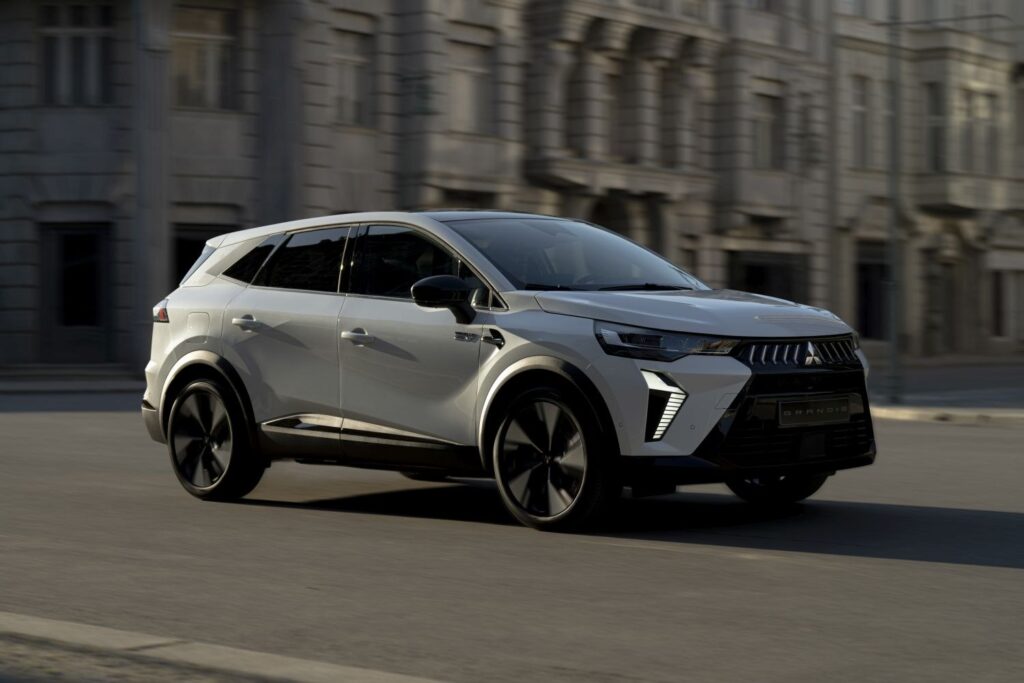
The Mitsubishi Grandis (2025) 1.8 (158 Hp) Hybrid Multi-Mode represents Mitsubishi’s entry into the modern, fuel-efficient SUV market, launched in October 2025. This variant occupies a key position within the redesigned Grandis lineup, offering a balance between affordability, practicality, and hybrid technology. Built on Mitsubishi’s contemporary platform, it aims to appeal to families and individuals seeking a versatile vehicle with reduced emissions. The Grandis, in this configuration, is a five-seater, five-door SUV designed to compete with other compact and mid-size crossovers.
Powertrain & Engine Architecture
At the heart of the Grandis 1.8 Hybrid Multi-Mode lies a 1.8-liter inline-four cylinder gasoline engine, designated for internal use with specific codes not publicly released as of late 2025. This engine produces 109 horsepower at 5500 rpm and 170 Nm (125.39 lb-ft) of torque at 3500 rpm, resulting in a power-to-liter ratio of 60.9 hp/l. The engine utilizes direct fuel injection, contributing to improved efficiency and reduced emissions. The valvetrain employs a Double Overhead Camshaft (DOHC) configuration, optimizing valve control for enhanced performance. A Start & Stop system is standard, further aiding fuel conservation during city driving. The engine also incorporates a particulate filter to meet stringent Euro 6e-bis-FCM emission standards.
Crucially, this is a Full Hybrid Electric Vehicle (FHEV) system. Supplementing the gasoline engine is a synchronous electric motor producing 49 horsepower. The combined system output reaches 158 horsepower. Power is stored in a 1.4 kWh lithium-ion battery operating at 185 volts. The “Multi-Mode” designation refers to the transmission’s ability to operate in various modes, including all-electric, hybrid, and gasoline-only, seamlessly managed by the vehicle’s control system. The transmission itself is a 6-speed automatic, specifically tuned for the hybrid powertrain to maximize efficiency and smooth power delivery.
Hybrid System Operation
The hybrid system prioritizes electric drive at low speeds and during gentle acceleration, minimizing fuel consumption. During heavier acceleration or when the battery charge is low, the gasoline engine engages, providing additional power. The system intelligently manages the interplay between the engine and motor, optimizing for both performance and fuel economy. Regenerative braking captures energy during deceleration, replenishing the battery and further enhancing efficiency.
Driving Characteristics
The Grandis 1.8 Hybrid Multi-Mode delivers a comfortable and refined driving experience. Acceleration from 0 to 100 km/h (0-62 mph) takes 9.1 seconds, while 0-60 mph is achieved in approximately 8.6 seconds. The maximum speed is electronically limited to 180 km/h (111.85 mph). The automatic transmission provides smooth and seamless gear changes, contributing to a relaxed driving experience. While not a performance-oriented vehicle, the combined output of the engine and electric motor provides adequate power for everyday driving situations, including highway merging and overtaking. The electric motor provides instant torque, improving responsiveness at lower speeds. Compared to potential higher-output gasoline-only versions of the Grandis (if offered), this hybrid variant prioritizes fuel efficiency over outright performance.
The Multi-Mode transmission is programmed to favor higher gears at cruising speeds, further reducing fuel consumption. The steering is light and precise, making the Grandis easy to maneuver in urban environments. The suspension is tuned for comfort, absorbing bumps and imperfections in the road surface effectively.
Equipment & Trim Levels
The Grandis 1.8 Hybrid Multi-Mode is generally positioned as a mid-range trim level within the Grandis lineup. Standard equipment typically includes air conditioning, power windows and locks, a touchscreen infotainment system with smartphone integration (Apple CarPlay and Android Auto), and a suite of safety features such as ABS (Anti-lock Braking System), electronic stability control, and multiple airbags. Interior upholstery is typically cloth, with options for leather upgrades available. Dashboard configuration features a modern design with integrated displays for vehicle information and infotainment. Optional extras may include a sunroof, upgraded audio system, navigation system, and advanced driver-assistance systems (ADAS) such as adaptive cruise control and lane departure warning.
Chassis & Braking
The Grandis 1.8 Hybrid Multi-Mode utilizes an independent McPherson strut suspension at the front and an independent multi-link suspension at the rear, providing a comfortable ride and stable handling. Ventilated discs are used for the front brakes, while solid discs are employed at the rear. The vehicle’s kerb weight of 1390 kg (3064.43 lbs) is relatively moderate for its class, contributing to its manageable handling characteristics. Electric power steering provides a light and responsive steering feel. Tire sizes are typically 215/55 R18 or 225/45 R19, depending on the specific trim level and optional wheel packages.
Market Reception & Comparison
Initial reviews of the Mitsubishi Grandis 1.8 Hybrid Multi-Mode have been generally positive, with critics praising its fuel efficiency, comfortable ride, and well-equipped interior. Fuel consumption figures, according to WLTP testing, range from 4.3-4.4 l/100 km (54.7-53.5 US mpg) combined, making it a competitive offering in the hybrid SUV segment. Compared to potential gasoline-only versions of the Grandis, the hybrid variant offers significantly improved fuel economy, albeit with slightly reduced performance. Reliability assessments are still emerging given the recent launch, but Mitsubishi has a generally positive reputation for build quality and durability. The Grandis 1.8 Hybrid Multi-Mode competes with vehicles such as the Toyota RAV4 Hybrid, Honda CR-V Hybrid, and Nissan Qashqai e-Power.
Technical Specifications
| Brand | Mitsubishi |
| Model | Grandis |
| Generation | Grandis (2025) |
| Type | 1.8 (158 Hp) Hybrid Multi-Mode |
| Start of production | October, 2025 |
| Powertrain Architecture | FHEV (Full Hybrid Electric Vehicle) |
| Body type | SUV |
| Seats | 5 |
| Doors | 5 |
| Fuel consumption at Low speed (WLTP) | 5.0-5.1 l/100 km (47 – 46.1 US mpg) |
| Fuel consumption at Medium speed (WLTP) | 3.5-3.6 l/100 km (67.2 – 65.3 US mpg) |
| Fuel consumption at High speed (WLTP) | 3.9-4.1 l/100 km (60.3 – 57.4 US mpg) |
| Fuel consumption at Very High speed (WLTP) | 4.9-5.0 l/100 km (48 – 47 US mpg) |
| Combined fuel consumption (WLTP) | 4.3-4.4 l/100 km (54.7 – 53.5 US mpg) |
| CO2 emissions (WLTP) | 98-101 g/km |
| Fuel Type | Petrol (Gasoline) |
| Acceleration 0 – 100 km/h | 9.1 sec |
| Acceleration 0 – 62 mph | 9.1 sec |
| Acceleration 0 – 60 mph | 8.6 sec |
| Maximum speed | 180 km/h (111.85 mph) |
| Emission standard | Euro 6e-bis-FCM |
| Weight-to-power ratio | 8.8 kg/Hp |
| Weight-to-torque ratio | 8.2 kg/Nm |
| Gross battery capacity | 1.4 kWh |
| Battery voltage | 185 V |
| Battery technology | Lithium-ion (Li-Ion) |
| Electric motor power | 49 Hp |
| System power | 158 Hp |
| Engine Power | 109 Hp @ 5500 rpm |
| Engine Torque | 170 Nm @ 3500 rpm (125.39 lb.-ft. @ 3500 rpm) |
| Engine displacement | 1789 cm3 (109.17 cu. in.) |
| Number of cylinders | 4 |
| Kerb Weight | 1390 kg (3064.43 lbs.) |
| Max. weight | 1920 kg (4232.88 lbs.) |
| Trunk (boot) space – minimum | 492-624 l (17.37 – 22.04 cu. ft.) |
| Trunk (boot) space – maximum | 1582 l (55.87 cu. ft.) |
| Fuel tank capacity | 48 l (12.68 US gal | 10.56 UK gal) |
| Length | 4413 mm (173.74 in.) |
| Width | 1797 mm (70.75 in.) |
| Height | 1575 mm (62.01 in.) |
| Wheelbase | 2638 mm (103.86 in.) |
Legacy
The Mitsubishi Grandis 1.8 Hybrid Multi-Mode represents a significant step forward for Mitsubishi in the hybrid SUV market. While long-term reliability data is still being gathered, the combination of a proven gasoline engine, a well-integrated hybrid system, and Mitsubishi’s reputation for durability suggests a positive outlook. In the used car market, this variant is expected to hold its value well due to its fuel efficiency and modern features. The powertrain’s focus on efficiency and reduced emissions positions it favorably in an increasingly environmentally conscious automotive landscape.