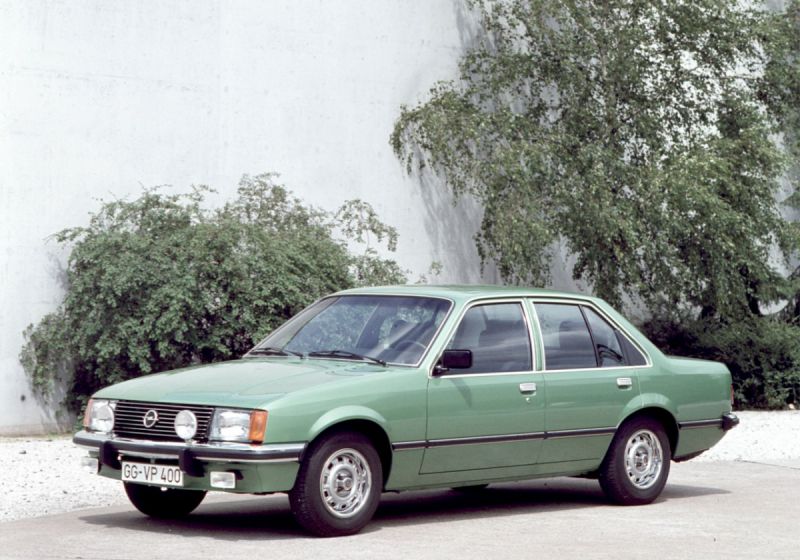
The Opel Rekord E 1.9 (75 hp) was a variant of the Rekord E produced between 1977 and 1982. Positioned as an entry-level to mid-range offering within the Rekord E lineup, it provided a more economical alternative to the larger-displacement engines available. The Rekord E itself was a significant model for Opel, representing a modern, comfortable, and relatively affordable family sedan during a period of increasing fuel costs and changing automotive tastes. It was built on the GM’s H-platform, shared with other European Opel and Vauxhall models.
The 1.9-Liter Engine and its Role in the Rekord E Lineup
The 1.9-liter engine, designated the 19N, was a key component of the Rekord E’s appeal to budget-conscious buyers. While the Rekord E was also offered with larger 2.0L and 2.2L engines, the 1.9L provided a balance between acceptable performance and improved fuel economy. This made it a popular choice for families and individuals who prioritized practicality over outright speed. The 1.9L version was often seen as the “standard” Rekord E, forming the backbone of sales volume. It sat below the more powerful, and often better-equipped, 2.0 and 2.2-liter models, and above any potential base-level, smaller displacement options that may have been available in certain markets.
Powertrain & Engine Architecture
The 19N engine is a 1,897 cc (115.76 cubic inches) inline-four cylinder engine. It featured a single overhead camshaft (SOHC) valvetrain with two valves per cylinder. The engine’s bore and stroke measured 93 mm (3.66 inches) and 69.8 mm (2.75 inches) respectively, resulting in a compression ratio of 7.9:1. Fuel delivery was managed by a carburetor, a common feature for engines of this era. This carburetor system, while relatively simple, was known for requiring periodic adjustment to maintain optimal performance. The engine produced 75 horsepower at 4,800 rpm and 132 Nm (97.36 lb-ft) of torque between 2,200 and 3,400 rpm. The engine was naturally aspirated, meaning it did not utilize a turbocharger or supercharger.
The Rekord E 1.9 was typically paired with a four-speed manual transmission, however, an optional three-speed automatic transmission was available. The automatic transmission, while offering convenience, did impact acceleration and fuel economy compared to the manual version. The automatic’s gear ratios were geared towards comfortable cruising rather than spirited driving. The rear-wheel drive configuration was standard for all Rekord E models.
Driving Characteristics
The Rekord E 1.9 with the automatic transmission offered a comfortable, but not particularly exciting, driving experience. Acceleration from 0 to 62 mph (0-100 km/h) took approximately 16 seconds. Top speed was around 96.31 mph (155 km/h). The automatic transmission’s shift points were relatively conservative, prioritizing smooth operation over maximizing engine power. Compared to the manual transmission version, the automatic resulted in a noticeable decrease in responsiveness. The 1.9L engine provided adequate power for everyday driving, but struggled when fully loaded or tackling steep inclines. The rear-wheel drive layout provided predictable handling, but lacked the stability of more modern front-wheel drive systems.
Equipment & Trim Levels
The Rekord E 1.9 typically came with a fairly basic level of equipment, reflecting its position as an entry-level model. Standard features generally included cloth upholstery, basic instrumentation (speedometer, fuel gauge, temperature gauge), and a two-spoke steering wheel. Optional extras included a radio, upgraded upholstery, power windows, and a sunroof. Higher trim levels, often denoted by suffixes like “L” or “GL”, added features such as more luxurious interior trim, additional chrome exterior accents, and improved sound insulation. The dashboard layout was functional and straightforward, with clearly labeled controls. The interior space was generous for its time, offering comfortable seating for five passengers.
Chassis & Braking
The Rekord E featured a conventional chassis design with independent front suspension and a live rear axle. The front suspension utilized coil springs and wishbones, while the rear suspension employed leaf springs. The steering was a recirculating ball system, providing a relatively heavy but precise feel. Braking was accomplished via ventilated discs on the front wheels and drum brakes on the rear wheels. The braking system was adequate for normal driving conditions, but lacked the stopping power of more modern systems. Stabilizer bars were typically fitted to the front suspension to reduce body roll during cornering. The curb weight of the Rekord E 1.9 was approximately 2,425.08 lbs (1,100 kg).
Market Reception & Comparison
The Opel Rekord E 1.9 was generally well-received by automotive critics as a practical and affordable family sedan. It was praised for its comfortable ride, spacious interior, and relatively low running costs. However, it was also criticized for its somewhat bland styling and lack of performance. Compared to other vehicles in its class, such as the Ford Taunus and the Volkswagen Passat, the Rekord E offered a good balance of features and value. The 1.9L engine’s fuel consumption of 9.9 l/100 km (23.8 US mpg) was considered reasonable for its time, although it was less fuel-efficient than some of its competitors. Reliability was generally good, although the carburetor required periodic maintenance. The automatic transmission, while convenient, was sometimes criticized for its sluggish performance.
Technical Specifications
| Brand | Opel |
| Model | Rekord |
| Generation | Rekord E |
| Type (Engine) | 1.9 (75 Hp) |
| Start of production | 1977 |
| End of production | 1982 |
| Engine Model/Code | 19N |
| Engine displacement | 1897 cm3 (115.76 cu. in.) |
| Number of cylinders | 4 |
| Engine configuration | Inline |
| Cylinder Bore | 93 mm (3.66 in.) |
| Piston Stroke | 69.8 mm (2.75 in.) |
| Compression ratio | 7.9:1 |
| Number of valves per cylinder | 2 |
| Fuel injection system | Carburettor |
| Engine aspiration | Naturally aspirated |
| Valvetrain | SOHC |
| Power | 75 Hp @ 4800 rpm |
| Torque | 132 Nm @ 2200-3400 rpm (97.36 lb.-ft. @ 2200-3400 rpm) |
| Fuel consumption (combined) | 9.9 l/100 km (23.8 US mpg, 28.5 UK mpg, 10.1 km/l) |
| Acceleration 0 – 100 km/h | 16 sec |
| Acceleration 0 – 62 mph | 16 sec |
| Acceleration 0 – 60 mph | 15.2 sec |
| Maximum speed | 155 km/h (96.31 mph) |
| Kerb Weight | 1100 kg (2425.08 lbs) |
| Max. weight | 1600 kg (3527.4 lbs) |
| Trunk (boot) space – minimum | 540 l (19.07 cu. ft.) |
Legacy
The Opel Rekord E 1.9, while not a particularly sought-after classic today, remains a relatively reliable and affordable option for those seeking a vintage European sedan. The 19N engine, while simple in design, is known for its durability and ease of maintenance. Parts availability is generally good, although some components may be difficult to find. The automatic transmission, however, can be prone to wear and tear. In the used car market, the Rekord E 1.9 typically commands modest prices, making it an accessible entry point into classic car ownership. It represents a significant piece of automotive history, embodying the design and engineering philosophies of the late 1970s and early 1980s.