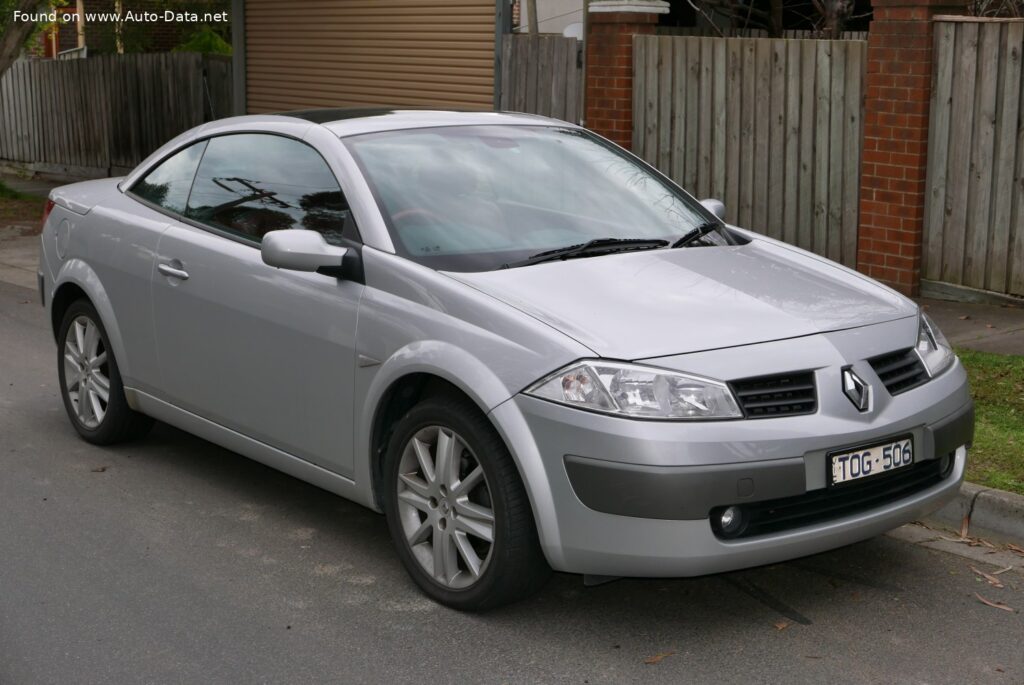
The Renault Megane II Coupe-Cabriolet (CC) 2.0 16V, producing 135 horsepower, was a stylish and popular offering from Renault between 2004 and 2005. Positioned as a mid-range trim within the Megane II CC lineup, it bridged the gap between the more economical base models and the performance-oriented variants. This model combined the practicality of a coupe with the open-air enjoyment of a convertible, appealing to buyers seeking a versatile and fashionable vehicle. It was built on the Renault-Nissan Alliance’s C platform, known internally as the 1HX0 for the Megane II.
Powertrain & Engine Architecture
The heart of the Megane II CC 2.0 16V is the Renault F4R engine, a 1.998-liter (121.93 cubic inches) inline-four cylinder gasoline engine. This engine is a naturally aspirated design, meaning it doesn’t utilize forced induction like a turbocharger or supercharger. The ‘16V’ designation indicates the engine features four valves per cylinder, contributing to improved breathing and power output. The F4R engine is known for its relative reliability and widespread use across various Renault and Nissan models during this period.
Fuel delivery is managed by a multi-port fuel injection system, where fuel is injected into the intake ports just before the intake valves. This system provides precise fuel metering for optimal combustion. The engine utilizes a double overhead camshaft (DOHC) valvetrain, further enhancing valve control and engine efficiency. The compression ratio is set at 9.8:1, a common figure for naturally aspirated engines of this era. The engine requires 5.4 liters (5.71 US quarts / 4.75 UK quarts) of engine oil, specified to Renault standards. Coolant capacity is 6 liters (6.34 US quarts / 5.28 UK quarts).
Transmission
While a manual transmission was available, the 2.0 16V engine was frequently paired with a six-speed automatic transmission. This automatic gearbox was designed to provide smooth and comfortable shifting, catering to drivers prioritizing convenience over outright performance. The automatic transmission’s gear ratios were tuned to balance acceleration with fuel efficiency, though it didn’t offer the same level of responsiveness as the manual option.
Driving Characteristics
The Megane II CC 2.0 16V Automatic delivers a respectable driving experience, though it’s not designed for outright speed. Acceleration from 0 to 100 km/h (0-62 mph) takes approximately 9.9 seconds, while 0-60 mph is achieved in around 9.4 seconds. The maximum speed is rated at 205 km/h (127.38 mph). The engine produces 135 hp at 5500 rpm and 191 Nm (140.87 lb-ft) of torque at 3750 rpm.
Compared to the manual transmission version, the automatic slightly diminishes acceleration due to inherent transmission losses. The power delivery is relatively linear, making it predictable and easy to control. However, drivers seeking a more engaging experience would likely prefer the manual gearbox, which allows for greater control over gear selection and engine speed. Compared to higher-output versions of the Megane II, such as those equipped with the 2.0 Turbo engine, the 2.0 16V feels less powerful, particularly during overtaking maneuvers.
Equipment & Trim Levels
The Megane II CC 2.0 16V typically came equipped with a reasonable level of standard features. These included air conditioning, power windows, power door locks, and a basic audio system. Interior upholstery was generally cloth, though leather options were available as upgrades. The dashboard layout was functional and ergonomically designed, with easy-to-read gauges and intuitive controls.
Optional extras included features like automatic climate control, upgraded audio systems with CD changers, alloy wheels, and parking sensors. The convertible top was electrically operated, adding to the convenience of the vehicle. Safety features such as ABS (Anti-lock Braking System) were standard. Trim levels varied slightly depending on the market, but generally, the 2.0 16V offered a good balance of features and affordability.
Chassis & Braking
The Megane II CC 2.0 16V utilizes an independent McPherson strut suspension system at the front, providing a comfortable ride and responsive handling. The rear suspension employs a torsion beam setup, which is a cost-effective and space-saving solution. The front brakes are ventilated discs, offering good stopping power, while the rear brakes are solid discs. The steering system is a rack and pinion type with electric power steering, providing light and precise steering feel.
The car rides on 205/55 R16 tires mounted on 6.5J x 16 inch wheel rims. The curb weight of the vehicle is 1390 kg (3064.43 lbs), and the maximum weight is 1845 kg (4067.53 lbs). The weight-to-power ratio is 10.3 kg/hp, and the weight-to-torque ratio is 7.3 kg/Nm.
Market Reception & Comparison
The Renault Megane II CC 2.0 16V was generally well-received by automotive critics. It was praised for its stylish design, comfortable ride, and practical convertible top. However, some critics noted that the engine lacked the punch of its turbocharged counterparts. Fuel economy was considered average for its class, with combined fuel consumption of 8.2 l/100 km (28.7 US mpg / 34.4 UK mpg). CO2 emissions were rated at 196 g/km, meeting Euro 4 emission standards.
Compared to other trims in the Megane II CC lineup, the 2.0 16V offered a good compromise between performance and fuel efficiency. The base models were more economical but lacked the power of the 2.0 16V, while the higher-output versions were more expensive and consumed more fuel. In the broader market, it competed with other compact coupe-convertibles such as the Peugeot 307 CC and the Ford Focus CC.
Technical Specifications
| Brand | Renault |
| Model | Megane |
| Generation | Megane II CC |
| Type (Engine) | 2.0 16V (135 Hp) |
| Start of production | 2004 |
| End of production | 2005 |
| Powertrain Architecture | Internal Combustion engine |
| Body type | Coupe – Cabriolet |
| Seats | 4 |
| Doors | 2 |
| Fuel consumption (urban) | 11.2 l/100 km (21 US mpg / 25.2 UK mpg) |
| Fuel consumption (extra urban) | 6.5 l/100 km (36.2 US mpg / 43.5 UK mpg) |
| Fuel consumption (combined) | 8.2 l/100 km (28.7 US mpg / 34.4 UK mpg) |
| CO2 emissions | 196 g/km |
| Fuel Type | Petrol (Gasoline) |
| Acceleration 0 – 100 km/h | 9.9 sec |
| Acceleration 0 – 62 mph | 9.9 sec |
| Acceleration 0 – 60 mph | 9.4 sec |
| Maximum speed | 205 km/h (127.38 mph) |
| Emission standard | Euro 4 |
| Weight-to-power ratio | 10.3 kg/Hp |
| Weight-to-torque ratio | 7.3 kg/Nm |
| Power | 135 Hp @ 5500 rpm |
| Torque | 191 Nm @ 3750 rpm (140.87 lb.-ft. @ 3750 rpm) |
| Engine layout | Front, Transverse |
| Engine Model/Code | F4R |
| Engine displacement | 1998 cm3 (121.93 cu. in.) |
| Number of cylinders | 4 |
| Engine configuration | Inline |
| Cylinder Bore | 82.7 mm (3.26 in.) |
| Piston Stroke | 93 mm (3.66 in.) |
| Compression ratio | 9.8:1 |
| Number of valves per cylinder | 4 |
| Fuel injection system | Multi-port manifold injection |
| Engine aspiration | Naturally aspirated engine |
| Valvetrain | DOHC |
| Engine oil capacity | 5.4 l (5.71 US qt | 4.75 UK qt) |
| Coolant | 6 l (6.34 US qt | 5.28 UK qt) |
| Kerb Weight | 1390 kg (3064.43 lbs.) |
| Max. weight | 1845 kg (4067.53 lbs.) |
| Max load | 455 kg (1003.1 lbs.) |
| Trunk (boot) space – minimum | 190 l (6.71 cu. ft.) |
| Trunk (boot) space – maximum | 490 l (17.3 cu. ft.) |
| Fuel tank capacity | 60 l (15.85 US gal | 13.2 UK gal) |
| Permitted trailer load with brakes (12%) | 1200 kg (2645.55 lbs.) |
| Permitted trailer load without brakes | 650 kg (1433 lbs.) |
| Length | 4355 mm (171.46 in.) |
| Width | 1777 mm (69.96 in.) |
| Width including mirrors | 2026 mm (79.76 in.) |
| Height | 1404 mm (55.28 in.) |
| Wheelbase | 2522 mm (99.29 in.) |
| Front track | 1518 mm (59.76 in.) |
| Rear (Back) track | 1514 mm (59.61 in.) |
| Front overhang | 842 mm (33.15 in.) |
| Rear overhang | 991 mm (39.02 in.) |
| Ride height (ground clearance) | 120 mm (4.72 in.) |
| Drivetrain Architecture | Front wheel drive |
| Number of gears and type of gearbox | 6 gears, manual transmission |
| Front suspension | Independent type McPherson |
| Rear suspension | Torsion |
| Front brakes | Ventilated discs |
| Rear brakes | Disc |
| Assisting systems | ABS (Anti-lock braking system) |
| Steering type | Steering rack and pinion |
| Power steering | Electric Steering |
| Tires size | 205/55 R16 |
| Wheel rims size | 6.5J x 16 |
Legacy
The Renault Megane II CC 2.0 16V has proven to be a relatively reliable vehicle, with the F4R engine generally holding up well over time. Common issues include wear and tear on suspension components and occasional problems with the electrical systems. The automatic transmission, while comfortable, can be prone to issues if not properly maintained.
On the used car market today, the Megane II CC 2.0 16V represents an affordable entry point into the world of coupe-convertibles. Prices vary depending on condition, mileage, and location, but well-maintained examples can still provide years of enjoyable motoring. Its stylish design and practical features continue to appeal to buyers seeking a fun and versatile vehicle. However, prospective buyers should be aware of potential maintenance costs associated with an older vehicle and ensure a thorough inspection before purchase.