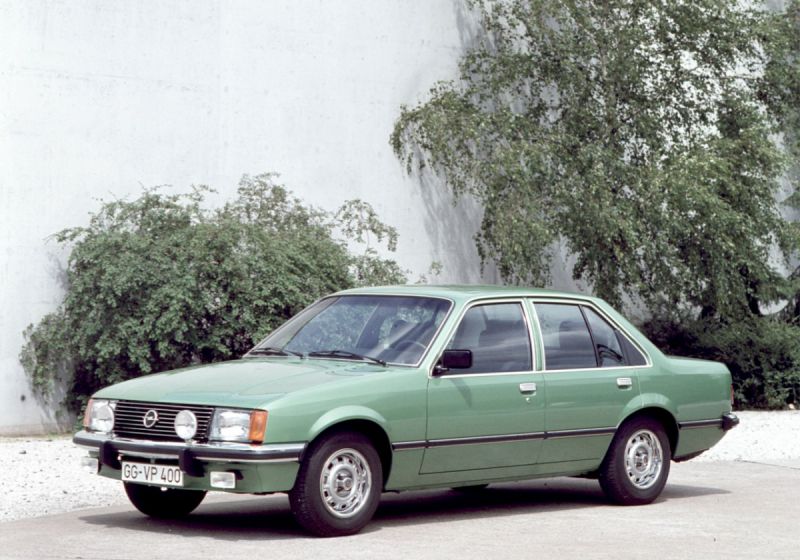
The Opel Rekord E 2.0 E Automatic, produced between 1977 and 1982, represented a mid-range offering within the broader Rekord E lineup. Positioned above the base 1.7L models and below the more powerful 2.1L and diesel variants, the 2.0 E Automatic aimed to provide a balance of performance, comfort, and fuel economy for family buyers. The Rekord E itself was a significant model for Opel, built on the H-platform (internally designated as 1HX0/A3) and representing a substantial redesign over its predecessor, the Rekord D. This generation focused on improved safety, comfort, and a more modern aesthetic, making it a popular choice in the European market.
The 2.0 E Automatic: A Mid-Range Offering
The 2.0 E Automatic trim was designed to appeal to drivers seeking a comfortable and refined driving experience without the higher price tag of the top-of-the-line models. It was a popular choice for families and those who frequently undertook long journeys, where the convenience of an automatic transmission was highly valued. While not a performance-oriented variant, the 2.0 E offered adequate power for everyday driving and highway cruising. It occupied a sweet spot in the Rekord E range, providing a step up in refinement and power compared to the entry-level models, while remaining more accessible than the larger-displacement engines.
Powertrain & Engine Architecture
At the heart of the Rekord E 2.0 E Automatic lay the 20E engine, a 1,979 cc (120.77 cubic inches) inline-four cylinder gasoline engine. This engine featured a single overhead camshaft (SOHC) valvetrain with two valves per cylinder. The 20E utilized Bosch multi-port manifold fuel injection, a significant advancement over the carburetors found in earlier Rekord models, contributing to improved fuel efficiency and smoother operation. The engine produced 110 horsepower (hp) at 5,400 rpm and 159 Newton-meters (117.27 lb-ft) of torque at 3,000 rpm. The compression ratio was set at 9.4:1. Engine oil capacity was 3.8 liters (4.02 US quarts / 3.34 UK quarts) and the cooling system held 9.1 liters (9.62 US quarts / 8.01 UK quarts).
The engine was mated to a three-speed automatic transmission. While not known for its sporting character, this transmission provided smooth and effortless gear changes, enhancing the car’s comfort. The automatic transmission’s gear ratios were optimized for fuel economy and relaxed cruising, rather than rapid acceleration. Specific details regarding the automatic transmission’s internal construction are limited, but it was a conventional hydraulic automatic of the era.
Driving Characteristics
The driving experience in the Rekord E 2.0 E Automatic was characterized by comfort and ease of use. Acceleration from 0 to 100 km/h (0-62 mph) took approximately 13.5 seconds, and 0 to 60 mph was achieved in around 12.8 seconds. The top speed was rated at 174 km/h (108.12 mph). Compared to the manual transmission versions of the 2.0 E, the automatic suffered a slight performance penalty due to the inherent efficiency losses within the torque converter and transmission. However, the convenience of the automatic more than compensated for this in the eyes of many buyers.
The automatic transmission’s shift points were programmed for smooth transitions, prioritizing comfort over aggressive downshifts. The engine delivered its peak torque at 3,000 rpm, providing adequate pulling power for overtaking maneuvers and climbing hills. The overall driving experience was best described as relaxed and refined, making it well-suited for long-distance travel. Compared to the more powerful 2.1L Rekord E, the 2.0 E Automatic felt noticeably less responsive, but it offered a more economical and manageable driving experience.
Equipment & Trim Levels
The Rekord E 2.0 E Automatic typically came equipped with a reasonable level of standard features. Interior upholstery was generally cloth, with options for upgraded velour or leather available at extra cost. The dashboard featured a straightforward layout with analog gauges for speed, fuel level, coolant temperature, and battery voltage. Power steering was often included as standard equipment, enhancing maneuverability. Other common features included a radio (often a basic AM/FM unit), heated rear window, and front and rear windscreen wipers.
Optional extras included a sunroof, upgraded sound system, air conditioning, and tinted glass. Higher trim levels, often denoted by suffixes like “GL” or “SE,” added features such as electric windows, central locking, and more luxurious interior trim. The 2.0 E Automatic could be ordered in a variety of exterior colors, with metallic paints typically costing extra.
Chassis & Braking
The Rekord E 2.0 E Automatic featured a conventional rear-wheel-drive chassis with independent front suspension and a solid rear axle. The front suspension utilized MacPherson struts with stabilizer bar, while the rear suspension employed leaf springs. The braking system consisted of ventilated disc brakes at the front and drum brakes at the rear. The braking system was adequate for the car’s weight and performance, but lacked the stopping power of more modern systems. The kerb weight of the 2.0 E Automatic was approximately 1,120 kg (2,469.18 lbs), with a maximum permissible weight of 1,600 kg (3,527.4 lbs). The front track measured 1,435 mm (56.5 in) and the rear track 1,412 mm (55.59 in).
Market Reception & Comparison
The Opel Rekord E 2.0 E Automatic was generally well-received by automotive critics as a practical and comfortable family car. It was praised for its smooth ride, spacious interior, and relatively fuel-efficient engine. Fuel consumption was rated at 10.1 liters per 100 kilometers (23.3 US mpg / 28 UK mpg / 9.9 km/l). However, some critics noted its lack of sporting character and the somewhat dated design of the interior. Compared to the 1.7L Rekord E, the 2.0 E Automatic offered a noticeable improvement in performance and refinement. Compared to the 2.1L models, it was less powerful but more economical to run. Reliability was generally good, although the automatic transmission could be prone to issues if not properly maintained.
Technical Specifications
| Brand | Opel |
| Model | Rekord |
| Generation | Rekord E |
| Type | 2.0 E (110 Hp) Automatic |
| Start of production | 1977 |
| End of production | 1982 |
| Engine Model/Code | 20E |
| Engine displacement | 1,979 cm3 (120.77 cu. in.) |
| Number of cylinders | 4 |
| Engine configuration | Inline |
| Cylinder Bore | 95 mm (3.74 in.) |
| Piston Stroke | 69.8 mm (2.75 in.) |
| Compression ratio | 9.4:1 |
| Number of valves per cylinder | 2 |
| Fuel injection system | Multi-port manifold injection |
| Engine aspiration | Naturally aspirated |
| Valvetrain | SOHC |
| Power | 110 Hp @ 5400 rpm |
| Torque | 159 Nm @ 3000 rpm (117.27 lb.-ft. @ 3000 rpm) |
| Fuel consumption (combined) | 10.1 l/100 km (23.3 US mpg / 28 UK mpg / 9.9 km/l) |
| Acceleration 0 – 100 km/h | 13.5 sec |
| Acceleration 0 – 62 mph | 13.5 sec |
| Acceleration 0 – 60 mph | 12.8 sec |
| Maximum speed | 174 km/h (108.12 mph) |
| Kerb Weight | 1120 kg (2469.18 lbs.) |
| Max. weight | 1600 kg (3527.4 lbs.) |
| Fuel tank capacity | 65 l (17.17 US gal / 14.3 UK gal) |
| Transmission | 3-speed automatic |
Legacy
The Opel Rekord E 2.0 E Automatic, while not a particularly rare or collectible model today, remains a popular choice among classic car enthusiasts. The 20E engine is known for its durability and relative simplicity, making it relatively easy to maintain. However, finding parts for the automatic transmission can sometimes be challenging. Well-maintained examples of the 2.0 E Automatic can still provide comfortable and reliable transportation, offering a nostalgic glimpse into the automotive landscape of the late 1970s and early 1980s. The Rekord E, in general, is remembered as a solid and dependable family car that played a significant role in Opel’s success during that era.