
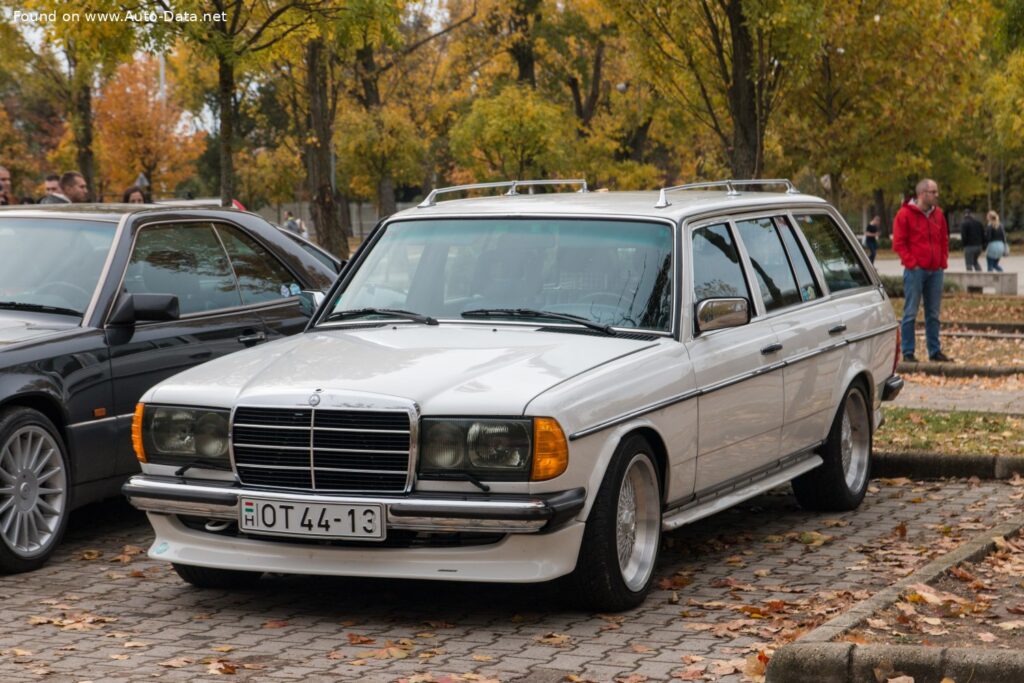
The Mercedes-Benz S123 300 TD, produced from September 1979 to January 1986, represents a significant iteration within the W123 series, specifically the T-Modell (estate/station wagon) body style. This variant was powered by the OM617 diesel engine, producing 88 horsepower, and was typically equipped with a four-speed manual transmission. The 300 TD occupied a middle ground within the S123 lineup, offering a balance between fuel efficiency, practicality, and a more affordable entry point compared to the gasoline-powered models or the higher-output diesel versions. It was designed to appeal to buyers needing a robust, reliable vehicle for family duties, long-distance travel, and light commercial use.
The 300 TD: Positioning within the W123 Range
The W123 series, launched in 1976, was a pivotal model for Mercedes-Benz, establishing a new standard for safety, build quality, and passenger comfort in the mid-size executive car segment. The S123 T-Modell, introduced in 1978, further expanded the range with a practical and stylish estate version. The 300 TD, with its 88 hp diesel engine and manual transmission, was positioned as a sensible alternative to the more expensive 300D Automatic and the performance-oriented 280E gasoline models. While the 300D offered greater convenience with its automatic gearbox, the 300 TD appealed to drivers who preferred more control and potentially better fuel economy. Compared to the base 240D, the 300 TD provided a noticeable power increase, making it more capable for highway driving and carrying heavier loads.
Powertrain & Engine Architecture
The heart of the S123 300 TD is the OM617 D 30 engine, a 2,998 cc (182.95 cu. in.) inline-five cylinder diesel engine. This engine is renowned for its durability and longevity. The OM617 utilizes precombustion chamber injection, a system where fuel is injected into a small precombustion chamber connected to the main cylinder, promoting more complete combustion and reducing engine noise. The engine code 617.912 specifically denotes the 88 hp version. The engine features a single overhead camshaft (SOHC) valvetrain with two valves per cylinder. Bore and stroke dimensions are 90.9 mm (3.58 in) and 92.4 mm (3.64 in) respectively, resulting in a compression ratio of 21.5:1. Engine oil capacity is 8 liters (8.45 US qt | 7.04 UK qt), and coolant capacity is 11 liters (11.62 US qt | 9.68 UK qt). The four-speed manual transmission provided a direct connection between the engine and the rear wheels, offering drivers greater control over gear selection and engine braking.
Driving Characteristics
The 300 TD’s driving experience is characterized by its robust torque delivery and relaxed cruising ability. While the 88 horsepower output doesn’t translate to rapid acceleration – 0-60 mph takes approximately 18 seconds, and 0-100 km/h is achieved in 18.9 seconds – the 172 Nm (126.86 lb.-ft.) of torque available at 2400 rpm provides ample pulling power for everyday driving and towing. The manual transmission allows drivers to keep the engine within its optimal torque band, making it surprisingly capable on inclines and when fully loaded. The gear ratios are tailored for fuel efficiency and comfortable highway cruising. Compared to the automatic version, the manual transmission offers a more engaging driving experience and potentially slightly improved fuel economy. However, it requires more driver involvement and may not be as convenient in stop-and-go traffic.
Equipment & Trim Levels
The S123 300 TD, even in its base form, was well-equipped for its time. Standard features typically included cloth upholstery, a wood-trimmed dashboard, and basic instrumentation. Power steering was a common inclusion. Optional extras included air conditioning, a sunroof, upgraded audio systems, and leather upholstery. The level of trim could vary depending on the market and individual customer preferences. The interior design prioritized functionality and durability, with a focus on providing a comfortable and practical space for passengers and cargo. The T-Modell’s rear cargo area was particularly spacious and versatile, with folding rear seats to accommodate larger items.
Chassis & Braking
The S123 300 TD utilizes a robust chassis designed to handle the weight of the vehicle and its occupants, as well as the demands of carrying cargo. The front suspension features a double wishbone design, providing a comfortable ride and good handling characteristics. The rear suspension employs a trailing arm setup, which contributes to the vehicle’s stability and load-carrying capacity. Braking duties are handled by disc brakes on all four wheels, offering reliable stopping power. The steering system is a cone worm with recirculation balls, providing a relatively direct and precise steering feel. Tire size was typically 195/70 R14 for both front and rear wheels, mounted on 6J x 14 inch rims. The curb weight of the 300 TD is 1570 kg (3461.26 lbs), with a maximum permissible weight of 2190 kg (4828.12 lbs), allowing for a substantial payload of 620 kg (1366.87 lbs).
Market Reception & Comparison
The S123 300 TD was generally well-received by automotive critics and buyers alike. It was praised for its fuel efficiency, reliability, and practicality. While its acceleration was not a strong point, its robust torque and comfortable ride made it a capable long-distance cruiser. Compared to other trims in the W123 lineup, the 300 TD offered a compelling value proposition for buyers seeking a diesel-powered estate car. Fuel consumption figures were approximately 9.7 l/100 km (24.2 US mpg / 29.1 UK mpg / 10.3 km/l) in urban conditions and 7.8 l/100 km (30.2 US mpg / 36.2 UK mpg / 12.8 km/l) on the open road. The 300 TD’s diesel engine, while durable, required regular maintenance, including oil changes and filter replacements. However, the overall reliability of the OM617 engine was exceptional, contributing to the vehicle’s long-term appeal.
Technical Specifications
| Brand | Mercedes-Benz |
| Model | W123 |
| Generation | S123 |
| Type | 300 TD (88 Hp) Manual 4-speed |
| Start of production | September, 1979 |
| End of production | January, 1986 |
| Engine Model/Code | OM 617 D 30 / 617.912 |
| Engine displacement | 2998 cm3 (182.95 cu. in.) |
| Number of cylinders | 5 |
| Power | 88 Hp @ 4400 rpm |
| Torque | 172 Nm @ 2400 rpm (126.86 lb.-ft. @ 2400 rpm) |
| Fuel Type | Diesel |
| Acceleration 0 – 100 km/h | 18.9 sec |
| Acceleration 0 – 62 mph | 18.9 sec |
| Maximum speed | 155 km/h (96.31 mph) |
| Kerb Weight | 1570 kg (3461.26 lbs) |
| Max. weight | 2190 kg (4828.12 lbs) |
| Fuel tank capacity | 70 l (18.49 US gal | 15.4 UK gal) |
| Length | 4725 mm (186.02 in) |
| Width | 1786 mm (70.31 in) |
| Height | 1470 mm (57.87 in) |
| Wheelbase | 2795 mm (110.04 in) |
| Number of gears and type of gearbox | 4 gears, manual transmission |
Legacy
The Mercedes-Benz S123 300 TD, particularly the manual transmission variant, has earned a reputation as a remarkably durable and reliable vehicle. The OM617 engine is known to withstand high mileage with proper maintenance. Today, these vehicles are sought after by enthusiasts and collectors who appreciate their classic styling, robust construction, and fuel efficiency. While finding well-maintained examples can be challenging, the 300 TD remains a viable option for those seeking a classic Mercedes-Benz estate car. Parts availability is generally good, although some specific trim pieces may be difficult to source. The 300 TD’s enduring appeal is a testament to the engineering excellence and build quality that characterized the W123 series.
