
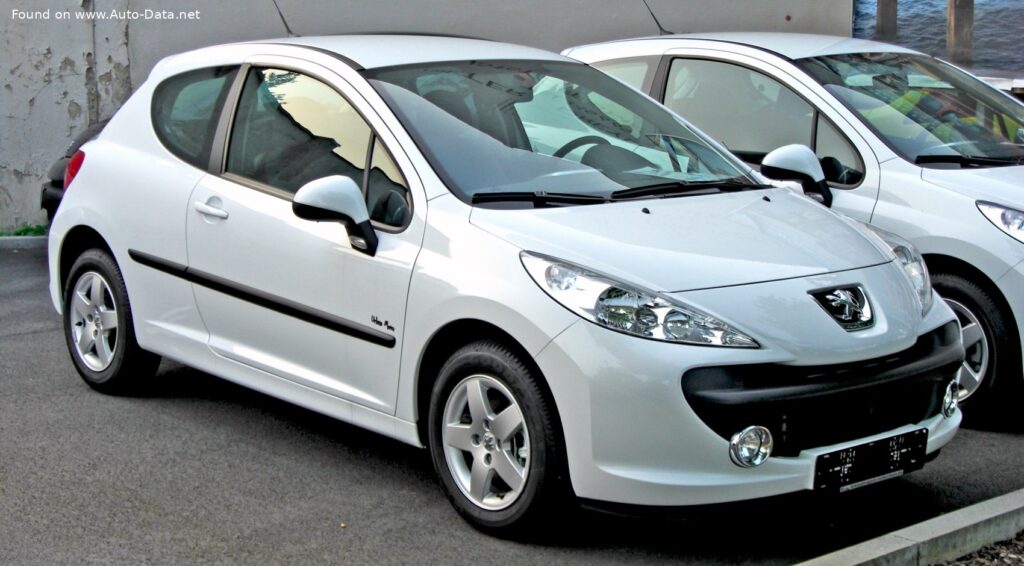
The Peugeot 207 1.4 i 16V (90 hp) was a popular entry-level variant of the 207 hatchback, produced between 2006 and 2009. Part of the second-generation 207 series (A8 chassis), this model served as a core offering within the Peugeot lineup, providing affordable and efficient transportation. It was positioned as the base engine option, appealing to buyers prioritizing economy and practicality over outright performance. The 207 itself was designed as a replacement for the Peugeot 206, aiming to improve upon its predecessor in terms of interior space, safety, and overall refinement.
Peugeot 207 1.4 i 16V: An Overview
The 1.4 i 16V version of the Peugeot 207 was characterized by its naturally aspirated four-cylinder engine, delivering 90 horsepower. This engine was paired with a five-speed manual transmission, although an optional four-speed automatic transmission was also available, impacting the vehicle’s performance characteristics. The 207 was available in both three-door and five-door body styles, catering to different customer preferences. This particular trim level was aimed at budget-conscious buyers, young drivers, and those seeking a reliable city car.
Powertrain & Engine Architecture
At the heart of the Peugeot 207 1.4 i 16V lies the KFU (ET3J4) engine, a 1360cc (82.99 cu. in.) inline-four cylinder gasoline engine. This engine utilizes a multi-port fuel injection system, delivering fuel directly into the intake manifold. The engine features a double overhead camshaft (DOHC) valvetrain with four valves per cylinder, contributing to improved breathing and efficiency. The compression ratio is set at 10.5:1. Engine oil capacity is 3.25 liters (3.43 US qt / 2.86 UK qt), and the recommended coolant capacity is 5.7 liters (6.02 US qt / 5.02 UK qt). The engine is transversely mounted at the front of the vehicle, driving the front wheels.
Driving Characteristics
The 1.4 i 16V engine, producing 90 hp at 5250 rpm and 98 Nm (72.28 lb-ft) of torque at 3250 rpm, provided adequate, though not exhilarating, performance. Acceleration from 0 to 100 km/h (0-62 mph) took approximately 12.7 seconds, while 0-60 mph was achieved in around 12.1 seconds. The top speed was limited to 180 km/h (111.85 mph). Compared to the more powerful 1.6L and 2.0L variants, the 1.4L engine offered a more relaxed driving experience, prioritizing fuel efficiency over rapid acceleration. The five-speed manual transmission provided reasonable control, while the optional four-speed automatic, while convenient, resulted in slightly slower acceleration and increased fuel consumption. The gear ratios were optimized for everyday driving, with a focus on maximizing fuel economy in urban and highway conditions.
Equipment & Trim Levels
The Peugeot 207 1.4 i 16V typically came equipped with a range of standard features, including power steering, central locking, electric front windows, and an audio system. Safety features included ABS (Anti-lock Braking System) and driver and passenger airbags. Interior upholstery was typically cloth, with a functional and durable design. Optional extras included air conditioning, alloy wheels, a CD player, and parking sensors. Higher trim levels, such as the ‘Sport’ or ‘S’ variants, added features like sport seats, upgraded audio systems, and exterior styling enhancements. The dashboard layout was relatively simple and user-friendly, with clearly labeled controls.
Chassis & Braking
The Peugeot 207 1.4 i 16V utilized an independent McPherson strut suspension system at the front, providing a comfortable ride and responsive handling. The rear suspension employed a semi-independent elastic beam setup, which was cost-effective and provided adequate stability. Front brakes were ventilated discs, offering good stopping power, while rear brakes were drums. This configuration was typical for vehicles in this weight class and price range. The steering system was a rack and pinion type, providing precise and predictable steering feel. Standard tire size was 185/65 R15 or 195/55 R16, depending on the trim level and wheel size (15 or 16 inch rims).
Market Reception & Comparison
The Peugeot 207 1.4 i 16V was generally well-received by automotive critics as a practical and affordable hatchback. It was praised for its fuel efficiency, comfortable ride, and relatively low running costs. However, some critics noted that the engine lacked power, particularly when fully loaded or driving on inclines. Compared to other trims in the 207 lineup, such as the 1.6L 16V, the 1.4L offered significantly lower performance but superior fuel economy. Fuel consumption figures were approximately 8.5 l/100 km (27.7 US mpg / 33.2 UK mpg) in urban conditions, 5.2 l/100 km (45.2 US mpg / 54.3 UK mpg) on the extra-urban cycle, and 6.4 l/100 km (36.8 US mpg / 44.1 UK mpg) combined. In comparison to competitors like the Ford Fiesta and Volkswagen Polo, the 207 1.4 i 16V offered a competitive package in terms of price, features, and fuel efficiency.
Technical Specifications
| Brand | Peugeot |
| Model | 207 |
| Type (Engine) | 1.4 i 16V (90 Hp) |
| Start of production | 2006 |
| End of production | 2009 |
| Body type | Hatchback |
| Seats | 5 |
| Doors | 3-5 |
| Fuel consumption (urban) | 8.5 l/100 km (27.7 US mpg / 33.2 UK mpg) |
| Fuel consumption (extra urban) | 5.2 l/100 km (45.2 US mpg / 54.3 UK mpg) |
| Fuel consumption (combined) | 6.4 l/100 km (36.8 US mpg / 44.1 UK mpg) |
| Fuel Type | Petrol (Gasoline) |
| Acceleration 0-100 km/h | 12.7 sec |
| Acceleration 0-62 mph | 12.7 sec |
| Acceleration 0-60 mph | 12.1 sec |
| Maximum speed | 180 km/h (111.85 mph) |
| Power | 90 Hp @ 5250 rpm |
| Torque | 98 Nm @ 3250 rpm (72.28 lb.-ft. @ 3250 rpm) |
| Engine layout | Front, Transverse |
| Engine displacement | 1360 cm3 (82.99 cu. in.) |
| Number of cylinders | 4 |
| Cylinder Bore | 75 mm (2.95 in.) |
| Piston Stroke | 77 mm (3.03 in.) |
| Compression ratio | 10.5:1 |
| Kerb Weight | 1148 kg (2530.91 lbs.) |
| Max. weight | 1640 kg (3615.58 lbs.) |
| Trunk (boot) space (min) | 270 l (9.53 cu. ft.) |
| Trunk (boot) space (max) | 923 l (32.6 cu. ft.) |
| Fuel tank capacity | 50 l (13.21 US gal / 11 UK gal) |
| Length | 4030 mm (158.66 in.) |
| Width | 1720 mm (67.72 in.) |
Legacy
The Peugeot 207 1.4 i 16V powertrain has proven to be relatively reliable, with few major issues reported. The KFU engine is known for its durability and relatively low maintenance costs. In the used car market, these models are often sought after by buyers looking for an affordable and economical city car. While not particularly powerful, the 1.4L engine provides sufficient performance for everyday driving, and its fuel efficiency makes it an attractive option for those seeking to minimize running costs. Parts availability is generally good, and the relatively simple engine design makes it accessible for DIY maintenance. Overall, the Peugeot 207 1.4 i 16V remains a viable and practical choice in the used car market.
