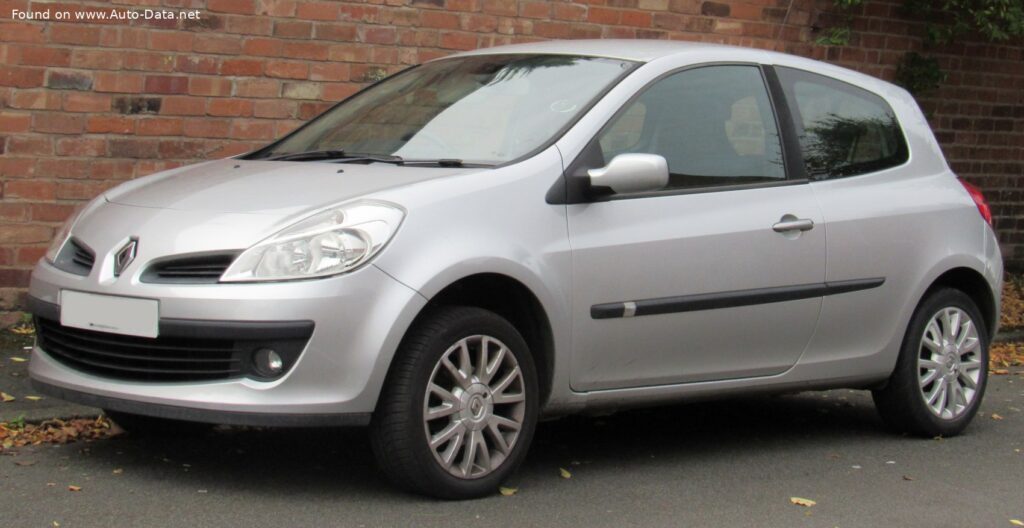
The Renault Clio III (Phase I) 3-door 1.6 16V Automatic, produced from 2005 to 2009, represented a significant evolution in Renault’s highly successful Clio lineage. As a cornerstone of the European supermini or subcompact segment, the Clio III built upon the strong foundation of its predecessors, aiming to deliver enhanced comfort, safety, and a more refined driving experience. This particular variant, equipped with a 1.6-liter 16-valve engine and an automatic transmission, offered a blend of practicality and ease of use, making it a popular choice for urban dwellers and those seeking a versatile compact vehicle in its primary European market.
The Clio III: A New Generation
The Clio series, first introduced in 1990, has consistently been one of Europe’s best-selling cars, often competing fiercely with rivals like the Volkswagen Polo and Ford Fiesta. The third-generation model, launched in 2005, brought a more mature and sophisticated design, moving away from the “bubble car” aesthetics of the Clio II. It quickly garnered critical acclaim, including being crowned European Car of the Year in 2006, a testament to its comprehensive improvements in ride quality, interior space, and overall build quality. The 3-door hatchback configuration, combined with the automatic powertrain, presented a compelling package for a segment focused on efficiency and maneuverability. This variant occupied a middle ground in the Clio III lineup, offering more convenience than the base models but lacking the sporty pretensions of the Renaultsport versions.
Powertrain & Engine Architecture
Powering this specific variant of the Renault Clio III (Phase I) 3-door 1.6 16V Automatic was Renault’s well-regarded K4M 801 engine. This naturally aspirated, inline-four gasoline (petrol) engine featured a dual overhead camshaft (DOHC) valvetrain with 16 valves, ensuring efficient breathing and a responsive power delivery for its class. With an engine displacement of 1598 cubic centimeters (97.52 cubic inches), it produced a respectable 112 horsepower at 6000 rpm, translating to a power-per-liter rating of 70.1 HP/l. Torque output stood at 151 Nm (111.37 lb.-ft.) at 4250 rpm, providing adequate pulling power for city driving and highway cruising.
The K4M engine utilizes a multi-point fuel injection system, delivering fuel directly to each intake port. The engine block is constructed from cast iron, known for its durability, while the cylinder head is made of aluminum alloy, contributing to weight reduction. The 4-speed automatic transmission, designated as DP0, was a common choice for Renault vehicles of this era. It’s a hydraulically controlled unit, offering smooth shifts but lacking the efficiency and responsiveness of more modern transmissions with a greater number of gears. The transmission’s gear ratios are optimized for everyday driving, prioritizing comfort and fuel economy over outright acceleration. First gear is relatively short for quick take-offs, while the higher gears are geared for relaxed highway cruising.
Driving Characteristics
The Clio III 1.6 16V Automatic offered a comfortable and predictable driving experience. While not particularly sporty, it provided sufficient power for most everyday driving situations. Acceleration from 0 to 60 mph took approximately 11.6 seconds (0-100 km/h in 12.2 seconds), and the top speed was around 115.58 mph (186 km/h). Compared to the manual transmission version of the same engine, the automatic suffered a slight performance penalty due to the transmission’s inherent inefficiencies. However, the convenience of the automatic gearbox was a significant draw for many buyers.
The automatic transmission’s shift points were programmed for smooth transitions, but could sometimes feel hesitant during quick acceleration or when attempting to overtake. The gear ratios were spaced to provide adequate power throughout the rev range, but the lack of a fourth gear meant that engine speeds could be relatively high at highway speeds, potentially impacting fuel economy. Compared to the higher-output 2.0-liter 16V engine available in some Clio III models, the 1.6-liter automatic felt noticeably less powerful, particularly when fully loaded or driving uphill. However, the 1.6L offered a better balance of performance and fuel efficiency for typical urban and suburban driving.
Equipment & Trim Levels
The 1.6 16V Automatic trim level typically included features such as air conditioning, power windows, central locking, and an audio system with CD player. Safety features included ABS brakes, front airbags, and seatbelt pretensioners. Interior upholstery was typically cloth, with options for upgraded materials available. The dashboard layout was functional and well-designed, with easy-to-read instrumentation. Optional extras included alloy wheels, a sunroof, and a more advanced audio system with steering wheel-mounted controls. The Clio III offered a range of customization options, allowing buyers to tailor the vehicle to their specific needs and preferences.
This trim level generally sat in the mid-range of the Clio III lineup. Base models offered fewer features and a smaller engine, while higher-end trims included more luxurious appointments and potentially a more powerful engine. The automatic transmission itself was often an optional extra on lower trims, making the 1.6 16V Automatic a popular choice for those seeking a balance of features and convenience.
Chassis & Braking
The Clio III featured an independent McPherson strut front suspension with coil springs and an anti-roll bar, providing a comfortable ride and competent handling. The rear suspension utilized a torsion beam setup, which was a cost-effective and space-efficient solution. This combination provided a good balance between ride comfort and handling stability. Braking duties were handled by ventilated discs at the front (260 mm) and solid discs at the rear (240 mm), complemented by an Anti-lock Braking System (ABS) for enhanced safety during emergency stops. The electric power steering system offered light and precise control, particularly beneficial in urban environments.
The suspension was tuned for comfort, prioritizing a smooth ride over sporty handling. The anti-roll bar helped to reduce body roll during cornering, improving stability. The braking system provided adequate stopping power for everyday driving, but lacked the performance of more advanced braking systems found on higher-end vehicles. Standard tire sizes included 185/60 R15 or 195/50 R16, mounted on 6J x 15 or 6.5J x 16 wheel rims, respectively.
Market Reception & Comparison
Critics generally praised the Renault Clio III for its comfortable ride, spacious interior, and attractive styling. The 1.6 16V Automatic variant was viewed as a practical and convenient option, particularly for urban drivers. However, some critics noted that the automatic transmission felt somewhat dated compared to more modern units, and that the engine lacked the punch of some of its rivals. Fuel economy was considered to be reasonable, but not class-leading. Reliability was generally good, although some owners reported minor issues with the automatic transmission.
Compared to other trims in the Clio III lineup, the 1.6 16V Automatic offered a good balance of performance and fuel efficiency. The manual transmission version of the same engine provided slightly better fuel economy and acceleration, while the 2.0-liter engine offered more power but at the expense of fuel efficiency. The diesel-powered Clio III models offered even better fuel economy, but were generally more expensive to purchase. Against competitors like the Volkswagen Polo and Ford Fiesta, the Clio III offered a more comfortable ride and a more spacious interior, but lacked the sporty handling of the Fiesta.
Technical Specifications
| Category | Specification |
| General Information | BrandRenault |
| ModelClio | |
| GenerationClio III (Phase I) 3-door | |
| Type (Engine)1.6 16V (112 Hp) Automatic | |
| Start of Production2005 year | |
| End of Production2009 year | |
| Powertrain ArchitectureInternal Combustion engine | |
| Body typeHatchback | |
| Seats5 | |
| Doors3 | |
| Performance Specs | Fuel consumption (economy) – urban (NEDC)10 l/100 km / 23.5 US mpg |
| Fuel consumption (economy) – extra urban (NEDC)6.1 l/100 km / 38.6 US mpg | |
| Fuel consumption (economy) – combined (NEDC)7.5 l/100 km / 31.4 US mpg | |
| CO2 emissions (NEDC)179 g/km | |
| Fuel TypePetrol (Gasoline) | |
| Acceleration 0 – 60 mph11.6 sec | |
| Acceleration 0 – 100 km/h12.2 sec | |
| Maximum speed186 km/h / 115.58 mph | |
| Emission standardEuro 4 | |
| Weight-to-power ratio10.5 kg/Hp (94.9 Hp/tonne) | |
| Weight-to-torque ratio7.8 kg/Nm (128 Nm/tonne) | |
| Engine Specs | Power112 Hp @ 6000 rpm |
| Power per liter70.1 Hp/l | |
| Torque151 Nm @ 4250 rpm / 111.37 lb.-ft. @ 4250 rpm | |
| Engine layoutFront, Transverse | |
| Engine Model/CodeK4M 801 | |
| Engine displacement1598 cm3 / 97.52 cu. in. | |
| Number of cylinders4 | |
| Engine configurationInline | |
| Cylinder Bore79.5 mm / 3.13 in. | |
| Piston Stroke80.5 mm / 3.17 in. | |
| Compression ratio9.8:1 | |
| Number of valves per cylinder4 | |
| Fuel injection systemMulti-port manifold injection | |
| Engine aspirationNaturally aspirated engine | |
| ValvetrainDOHC | |
| Engine oil capacity5 l / 5.28 US qt | |
| Coolant6.5 l / 6.87 US qt | |
| Space, Volume and Weights | Kerb Weight1180 kg / 2601.45 lbs. |
| Max. weight1670 kg / 3681.72 lbs. | |
| Max load490 kg / 1080.27 lbs. | |
| Trunk (boot) space – minimum288 l / 10.17 cu. ft. | |
| Trunk (boot) space – maximum1028 l / 36.3 cu. ft. | |
| Fuel tank capacity55 l / 14.53 US gal | |
| Max. roof load80 kg / 176.37 lbs. | |
| Permitted trailer load with brakes (12%)1200 kg / 2645.55 lbs. | |
| Permitted trailer load without brakes535 kg / 1179.47 lbs. | |
| Permitted towbar download75 kg / 165.35 lbs. | |
| Dimensions | Length3986 mm / 156.93 in. |
| Width1719 mm / 67.68 in. | |
| Width including mirrors2025 mm / 79.72 in. | |
| Height1495 mm / 58.86 in. | |
| Wheelbase2575 mm / 101.38 in. | |
| Front track1458-1472 mm / 57.4 – 57.95 in. | |
| Rear (Back) track1450-1470 mm / 57.09 – 57.87 in. | |
| Front overhang805 mm / 31.69 in. | |
| Rear overhang606 mm / 23.86 in. | |
| Ride height (ground clearance)120 mm / 4.72 in. | |
| Minimum turning circle (turning diameter)10.7-11.3 m / 35.1 – 37.07 ft. | |
| Drivetrain, Brakes and Suspension Specs | Drivetrain ArchitectureThe Internal combustion engine (ICE) drives the front wheels of the vehicle. |
| Drive wheelFront wheel drive | |
| Number of gears and type of gearbox4 gears, automatic transmission | |
| Front suspensionIndependent, type McPherson with coil spring and anti-roll bar | |
| Rear suspensionCoil spring, Torsion | |
| Front brakesVentilated discs, 260 mm | |
| Rear brakesDisc, 240 mm | |
| Assisting systemsABS (Anti-lock braking system) | |
| Steering typeSteering rack and pinion | |
| Power steeringElectric Steering | |
| Tires size185/60 R15; 195/50 R16 | |
| Wheel rims size6J x 15; 6.5J x 16 |
Legacy
The Renault Clio III (Phase I) was a critical success for the French automaker, solidifying its position as a dominant force in the European subcompact market. Its recognition as European Car of the Year in 2006 underscored its significant advancements in refinement, safety, and interior quality compared to its predecessors and many of its contemporaries. This award, coupled with strong sales figures, demonstrated that Renault had successfully elevated the Clio into a more premium and desirable offering within its highly competitive segment.
In the used car market today, the Clio III 1.6 16V Automatic remains a relatively affordable and practical option. The K4M engine is known for its durability, and parts availability is generally good. However, potential buyers should be aware of the age of the vehicle and the potential for wear and tear on the automatic transmission. Regular maintenance and careful inspection are essential to ensure long-term reliability. Overall, the Clio III 1.6 16V Automatic represents a well-rounded and dependable choice for those seeking a comfortable and convenient subcompact car.