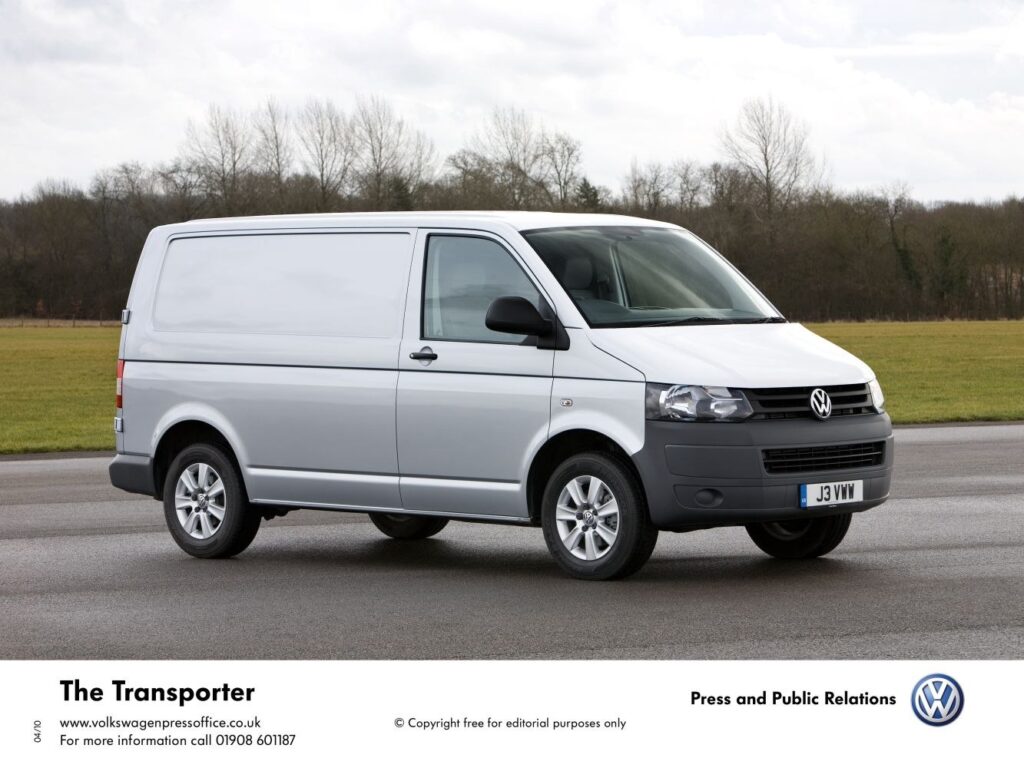
The Volkswagen Transporter (T5, facelift 2009) Panel Van 2.0 TDI (180 Hp) 4MOTION L2H3 represents a significant iteration of Volkswagen’s enduring light commercial vehicle line. Produced from 2009 to 2015, this variant builds upon the T5 generation, introduced in 2003, offering a blend of power, capability, and refinement geared towards European commercial users. Distinguished by its BiTurbo diesel engine, advanced 4MOTION all-wheel-drive system, and long-wheelbase, high-roof (L2H3) configuration, it served as a robust solution for logistical and trade applications. While passenger versions like the Multivan and California are more globally recognized, the Panel Van formed the backbone of countless businesses across Europe, valued for its reliability, load capacity, and sophisticated driving dynamics. This specific model occupied a mid-to-premium position within the T5 lineup, offering a substantial upgrade in performance and all-weather capability compared to lower-powered, front-wheel-drive variants.
Powertrain & Engine Architecture
The heart of the Volkswagen Transporter (T5, facelift 2009) Panel Van is Volkswagen’s EA189 / CFCA 2.0-liter (1968 cm3 or 120.09 cu. in.) TDI diesel engine. This inline four-cylinder powerplant features a DOHC valvetrain with four valves per cylinder and a common rail fuel injection system. The defining characteristic of this variant is its BiTurbo aspiration – employing two turbochargers in sequence to deliver a broad and responsive power band. A variable geometry turbocharger (VGT) is typically used for low-end response, while a fixed-geometry turbocharger provides increased boost at higher engine speeds. This setup, coupled with an intercooler, allows the engine to produce 180 horsepower (Hp) at 4000 rpm.
Critically for a commercial vehicle, the torque output is substantial: 400 Nm (295.02 lb.-ft.) available across a wide and usable range from 1500 to 2000 rpm. This low-end torque is essential for hauling heavy loads, navigating urban environments, and maintaining momentum on inclines. The engine is paired with a precise 6-speed manual transmission, although a 7-speed DSG (Direct-Shift Gearbox) dual-clutch automatic transmission was also available as an option. The 6-speed manual features gear ratios designed to maximize fuel efficiency and provide adequate acceleration. First gear is relatively short for easy starts with heavy loads, while higher gears are spaced to reduce engine speed during highway cruising. The DSG automatic offers quicker shifts and improved fuel economy, but at a higher initial cost and potentially increased maintenance complexity.
Driving Characteristics
The 180 hp 2.0 TDI engine, combined with the 6-speed manual transmission, delivers a surprisingly capable driving experience for a large van. Acceleration from 0 to 60 mph is achieved in approximately 10.3 seconds, with a top speed of 108.12 mph (174 km/h). While not a sports van, these figures are respectable for its size and utility. Compared to the lower-powered 1.9 TDI or 2.5 TDI versions, the 2.0 TDI offers significantly improved acceleration and responsiveness, particularly when fully loaded. The BiTurbo setup minimizes turbo lag, providing a more linear power delivery than single-turbo diesel engines. The 4MOTION all-wheel-drive system further enhances driving confidence, particularly on slippery surfaces. The manual transmission allows for precise control over gear selection, while the optional DSG automatic provides smooth and efficient shifting. However, the DSG can sometimes feel hesitant at low speeds or during stop-and-go traffic.
Equipment & Trim Levels
The Panel Van variant of the T5 prioritized functionality over luxury, but still offered a reasonable level of standard equipment. Typical standard features included power windows, central locking, an adjustable steering column, and a basic audio system. The interior typically featured durable, hard-wearing plastic trim and cloth upholstery. The driver’s seat was often adjustable for height and lumbar support. Optional extras included air conditioning, a more advanced audio system with navigation, parking sensors, heated seats, and upgraded interior trim. The L2H3 configuration provided ample space for customization, with options for shelving, cargo barriers, and specialized storage solutions tailored to specific trades. The dashboard layout was functional and straightforward, with clearly labeled controls and a relatively simple instrument cluster.
Chassis & Braking
The Volkswagen Transporter (T5, facelift 2009) Panel Van utilizes a robust chassis designed to handle heavy loads and demanding conditions. The front suspension features independent McPherson struts with coil springs and an anti-roll bar, providing a comfortable ride and stable handling. The rear suspension employs an independent coil spring setup with a transverse stabilizer and trailing arms. This configuration helps to minimize body roll and improve ride quality, even when the van is loaded. Braking is handled by ventilated discs all around (340×32.5 mm front, 294×22 mm rear), complemented by an Anti-lock Braking System (ABS). Hydraulic power steering ensures ease of maneuverability despite the vehicle’s size, with a minimum turning circle of 13.2 meters (43.31 ft.). The 4MOTION system incorporates an electronically controlled multi-plate clutch that distributes power between the front and rear axles as needed, optimizing traction and stability.
Market Reception & Comparison
Critics generally praised the Volkswagen Transporter (T5, facelift 2009) Panel Van for its robust build quality, refined driving experience, and efficient engine. The 2.0 TDI (180 Hp) 4MOTION variant was particularly well-regarded for its strong performance and all-weather capability. Fuel economy was also a strong point, with combined fuel consumption ranging from 8.4-8.7 l/100 km (27-28 US mpg). Compared to the lower-powered T5 variants, the 180 hp model offered a significant improvement in performance, making it a more suitable choice for drivers who frequently carry heavy loads or travel long distances. However, the higher price tag and potentially more complex maintenance requirements of the BiTurbo engine and 4MOTION system were noted. Compared to rivals like the Mercedes-Benz Vito and Ford Transit Custom, the Transporter often offered a more car-like driving experience and a more refined interior, but at a slightly higher cost.
Technical Specifications
| Category | Specification |
| General Information | |
| Brand | Volkswagen |
| Model | Transporter |
| Generation | Transporter (T5, facelift 2009) Panel Van |
| Type (Engine) | 2.0 TDI (180 Hp) 4MOTION L2H3 |
| Start of production | 2009 year |
| End of production | 2015 year |
| Powertrain Architecture | Internal Combustion engine |
| Body type | Van |
| Seats | 2-3 |
| Doors | 4-5 |
| Performance Specs | |
| Fuel consumption (economy) – urban (NEDC) | 10.2-10.5 l/100 km |
| Fuel consumption (economy) – extra urban (NEDC) | 7.3-7.6 l/100 km |
| Fuel consumption (economy) – combined (NEDC) | 8.4-8.7 l/100 km |
| CO2 emissions (NEDC) | 221-229 g/km |
| Acceleration 0 – 100 km/h | 10.8 sec |
| Maximum speed | 174 km/h |
| Emission standard | Euro 5 |
| Engine Specs | |
| Power | 180 Hp @ 4000 rpm |
| Torque | 400 Nm @ 1500-2000 rpm |
| Engine displacement | 1968 cm3 |
| Number of cylinders | 4 |
| Fuel injection system | Diesel Commonrail |
| Engine aspiration | BiTurbo, Intercooler |
| Valvetrain | DOHC |
| Space, Volume and Weights | |
| Kerb Weight | 1941-2358 kg |
| Max. weight | 3000-3200 kg |
| Max load | 842-1059 kg |
| Trunk (boot) space – maximum | 9300 l |
| Dimensions | |
| Length | 5292 mm |
| Width | 1904 mm |
| Height | 2476 mm |
| Wheelbase | 3400 mm |
Legacy
The Volkswagen Transporter T5, and particularly the 2.0 TDI (180 Hp) 4MOTION L2H3 variant, has proven to be a durable and reliable workhorse. While the EA189 engine series was later subject to scrutiny regarding emissions compliance (Dieselgate), well-maintained examples continue to provide years of service. The 4MOTION system is generally considered robust and reliable, although regular maintenance of the all-wheel-drive components is essential. On the used car market, these vans command a premium compared to lower-powered or front-wheel-drive versions, reflecting their enhanced capability and desirability. The T5 remains a popular choice for businesses and tradespeople seeking a versatile and dependable commercial vehicle, and its influence can be seen in the design and features of subsequent generations of vans.