
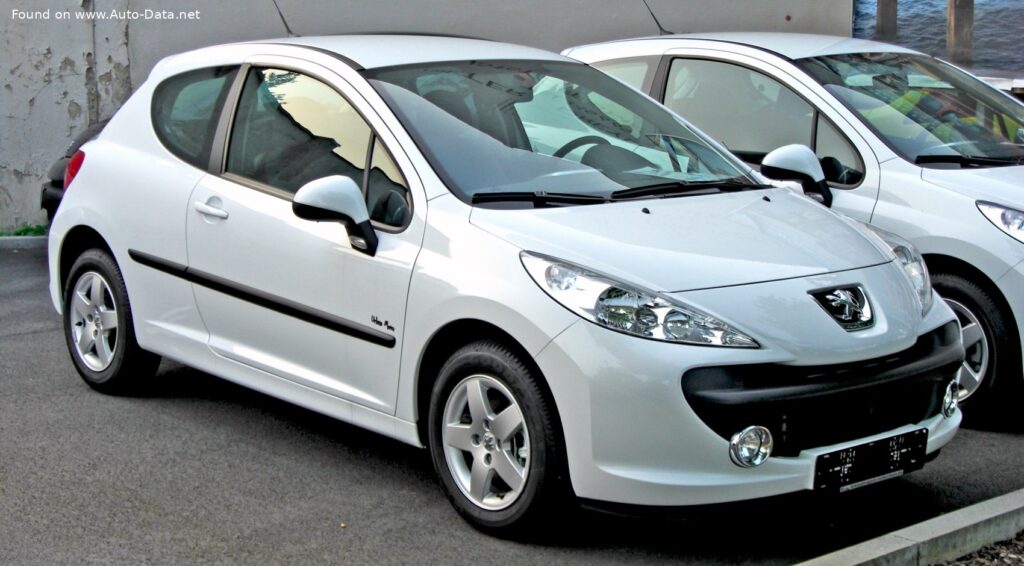
The Peugeot 207 1.4 VTi (95 Hp) was a European B-segment (supermini/subcompact) vehicle produced between 2006 and 2009. It represented a significant update to the highly successful Peugeot 206, aiming to improve refinement, safety, and driving dynamics. While never officially sold in North America, this variant played a crucial role in Peugeot’s global strategy, particularly within key European markets. The 1.4 VTi 95 hp model occupied the entry-level to mid-range position within the 207 lineup, offering a balance of affordability and practicality, appealing to a broad customer base seeking a stylish and economical city car.
Powertrain & Engine Architecture
The Peugeot 207 1.4 VTi (95 Hp) was powered by a naturally aspirated 1.4-liter (1397 cc or 85.25 cubic inches) inline-four cylinder engine, internally designated as the EP3. This engine was part of the “Prince” engine family, a collaborative effort between PSA Peugeot Citroën and BMW. The engine featured a front, transverse engine layout driving the front wheels, a common configuration for vehicles in this class.
The EP3 engine utilized a Double Overhead Camshaft (DOHC) valvetrain with Variable Valve Timing (VVT) on both intake and exhaust camshafts. This VVT system optimized valve lift and duration, improving power delivery and fuel economy across the engine’s operating range. Fuel delivery was managed by multi-point sequential fuel injection. The engine produced 95 horsepower (hp) at 6000 rpm and 100.31 lb-ft of torque at 4000 rpm. The engine’s block was constructed from aluminum alloy, contributing to weight reduction.
The standard transmission paired with the 1.4 VTi engine was a five-speed manual gearbox. While an automated manual transmission (often referred to as a “6-speed Sensodrive” in Peugeot marketing materials) was available as an option, the five-speed manual was the most common configuration. The Sensodrive transmission offered both fully automatic and sequential manual shifting modes, but was often criticized for its slow and jerky shifts compared to traditional automatic transmissions or more refined dual-clutch systems.
Driving Characteristics
The Peugeot 207 1.4 VTi (95 Hp) offered a driving experience geared towards practicality and fuel efficiency rather than outright performance. Acceleration from 0 to 60 mph took approximately 11.2 seconds, with a top speed of around 115 mph. Compared to higher-output versions of the 207, such as those equipped with the 1.6 VTi 120 hp engine, the 1.4 VTi felt noticeably less responsive, particularly during overtaking maneuvers or when climbing hills.
The five-speed manual transmission featured relatively short gear ratios, designed to keep the engine within its optimal power band. However, the engine lacked significant low-end torque, requiring frequent downshifts to maintain momentum. The steering was light and precise, making it easy to maneuver in urban environments. The suspension provided a comfortable ride, absorbing bumps and imperfections in the road surface effectively, although it wasn’t particularly sporty or engaging. The Sensodrive transmission, when equipped, altered the driving experience, offering convenience but sacrificing responsiveness.
Equipment & Trim Levels
The Peugeot 207 1.4 VTi (95 Hp) was available in a range of trim levels, varying by market. Standard equipment typically included power steering, central locking, electric front windows, and an audio system with CD player. Safety features included driver and passenger airbags, ABS brakes, and seatbelt pretensioners. Higher trim levels added features such as air conditioning, alloy wheels, a trip computer, and remote central locking.
Interior upholstery was typically cloth, with a choice of colors and patterns. The dashboard layout was functional and ergonomically designed, with easy-to-read instruments and intuitive controls. Optional extras included a panoramic sunroof, parking sensors, and a navigation system. The 3-door and 5-door body styles offered different levels of practicality, with the 5-door version providing easier access to the rear seats. The overall interior ambiance was considered a step up from the previous 206 model, with improved material quality and a more modern design.
Chassis & Braking
The Peugeot 207 featured an independent MacPherson strut front suspension with an anti-roll bar, providing good handling and stability. The rear suspension utilized a semi-independent torsion beam setup, a cost-effective solution that offered a reasonable balance of ride comfort and handling. The chassis was designed to be lightweight and rigid, contributing to the car’s overall agility.
Braking duties were handled by ventilated disc brakes at the front and drum brakes at the rear. ABS (Anti-lock Braking System) was standard equipment, enhancing braking performance and safety. The 185/65 R15 tires provided adequate grip in most driving conditions. The steering system employed a power-assisted rack and pinion setup, offering precise and responsive steering feel. Stabilizer bars were fitted to both the front and rear axles to reduce body roll during cornering.
Market Reception & Comparison
The Peugeot 207 1.4 VTi (95 Hp) received generally positive reviews from automotive critics. It was praised for its stylish design, comfortable ride, and fuel efficiency. However, some critics noted that the engine lacked power, particularly when fully loaded or driving on steep inclines. Compared to other trims in the 207 lineup, such as the 1.6 VTi, the 1.4 VTi offered a more affordable entry point but sacrificed performance.
In terms of fuel economy, the 1.4 VTi achieved a combined fuel consumption of around 38.6 US mpg (6.1 l/100 km), making it one of the more economical options in the B-segment. Reliability was generally good, although some owners reported minor issues with the Sensodrive transmission. Compared to rivals like the Ford Fiesta and Renault Clio, the 207 offered a slightly more refined driving experience and a more distinctive design, but was often priced slightly higher.
Technical Specifications
| Category | Specification |
| General Information | |
| Brand | Peugeot |
| Model | 207 |
| Type (Engine) | 1.4 VTi (95 Hp) |
| Start of production | 2006 |
| End of production | 2009 |
| Powertrain Architecture | Internal Combustion engine |
| Body type | Hatchback |
| Seats | 5 |
| Doors | 3-5 |
| Performance Specs | |
| Fuel consumption (economy) – urban | 8.1 l/100 km (29 US mpg) |
| Fuel consumption (economy) – extra urban | 5 l/100 km (47 US mpg) |
| Fuel consumption (economy) – combined | 6.1 l/100 km (38.6 US mpg) |
| CO2 emissions | 145 g/km |
| Fuel Type | Petrol (Gasoline) |
| Acceleration 0 – 60 mph (Calculated) | 11.2 sec |
| Maximum speed | 114.95 mph (185 km/h) |
| Emission standard | Euro 4 |
| Engine Specs | |
| Power | 95 Hp @ 6000 rpm |
| Torque | 136 Nm @ 4000 rpm (100.31 lb.-ft. @ 4000 rpm) |
| Engine layout | Front, Transverse |
| Engine Model/Code | 8FS EP3 |
| Engine displacement | 1397 cm3 (85.25 cu. in.) |
| Number of cylinders | 4 |
| Fuel injection system | Multi-port manifold injection |
| Valvetrain | DOHC-VVT |
| Space, Volume and Weights | |
| Kerb Weight | 1165 kg (2568.39 lbs) |
| Trunk (boot) space – minimum | 270 l (9.53 cu. ft.) |
| Trunk (boot) space – maximum | 923 l (32.6 cu. ft.) |
| Fuel tank capacity | 50 l (13.21 US gal) |
| Dimensions | |
| Length | 4030 mm (158.66 in.) |
| Width | 1720 mm (67.72 in.) |
| Height | 1472 mm (57.95 in.) |
Legacy
The Peugeot 207 1.4 VTi (95 Hp) powertrain has proven to be relatively reliable in the long term, with many examples still on the road today. The EP3 engine is known for its durability and relatively low maintenance costs. However, as with any used car, potential buyers should be aware of common issues, such as oil leaks and wear on the timing chain. The Sensodrive transmission, if equipped, may require more frequent servicing and is prone to occasional failures.
In the used car market, the 207 1.4 VTi (95 Hp) represents an affordable and practical option for buyers seeking a small, economical city car. Its stylish design and comfortable ride continue to appeal to a wide range of drivers. While it may not offer the performance of higher-output versions, its fuel efficiency and reliability make it a sensible choice for everyday commuting and urban driving. The 207’s legacy lies in its contribution to Peugeot’s continued success in the competitive European B-segment, bridging the gap between the popular 206 and the more modern 208.
