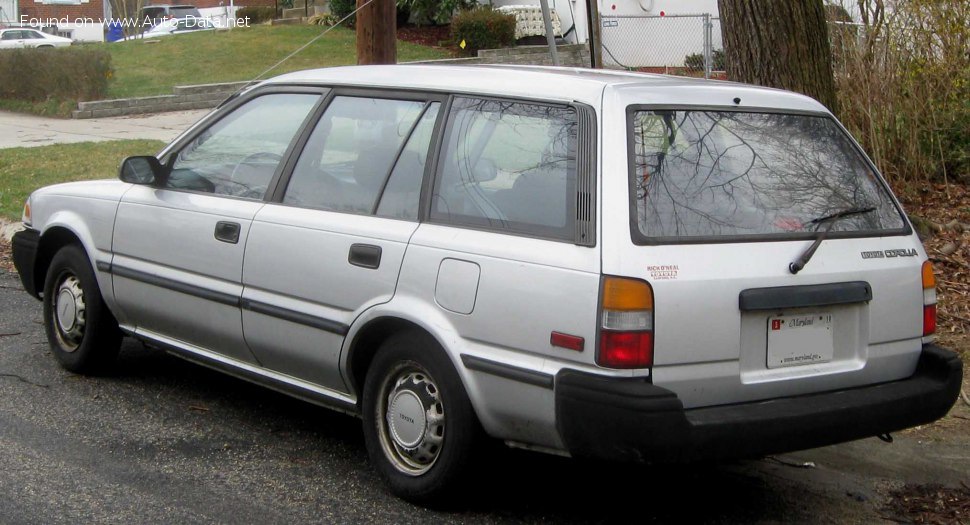
The Toyota Corolla, a name synonymous with automotive ubiquity and dependability, has graced roads worldwide across numerous generations. Among its many iterations, the Sixth Generation, internally designated E90, holds a significant place, particularly in its practical station wagon form. The Toyota Corolla Wagon VI (E90), produced between 1989 and 1992, represented a pivotal moment for Toyota, solidifying its reputation for building robust, economical, and long-lasting vehicles. While gasoline-powered variants were common across most markets, the 1.8 D (CE90) model, with its modest 67 horsepower diesel engine, carved out a niche as an exceptionally frugal and durable option, especially popular in European and Asian markets where diesel power was, and often still is, highly valued for its efficiency and torque characteristics in everyday driving.
The 1.8 D (CE90) Corolla Wagon: Positioning and Philosophy
This particular variant of the E90 Corolla Wagon exemplifies Toyota’s engineering philosophy of the late 1980s and early 1990s: build quality, practicality, and an unwavering focus on reliability. It wasn’t designed to be a performance machine or a luxury cruiser, but rather an honest, no-nonsense family hauler or commercial fleet vehicle, capable of enduring years of demanding service with minimal fuss. Within the E90 lineup, the 1.8 D served as the entry-level offering in many markets, appealing to buyers prioritizing fuel economy and low running costs over outright performance. It sat below the gasoline-powered 1.6L and 2.0L variants, which offered more power but at the expense of efficiency. Its compact dimensions, combined with a surprisingly spacious interior for its class, made it a versatile choice for a wide array of customers, from small businesses needing a reliable delivery vehicle to families seeking an economical and spacious daily driver.
Powertrain & Engine Architecture: The 1C-L Diesel
At the core of the Toyota Corolla Wagon VI (E90) 1.8 D (CE90) lay the venerable 1C-L engine, a naturally aspirated 1.8-liter (1779cc) diesel powerplant. This engine, producing 67 horsepower (50 kW) at 4200 rpm and approximately 86 lb-ft (117 Nm) of torque at 2400 rpm, was not built for blistering acceleration or high-speed thrills. Instead, its design prioritized fuel efficiency, longevity, and low-end torque, making it perfectly suited for the demands of urban commuting and long-distance cruising on less demanding roads. The engine featured indirect injection, a common design for diesel engines of the era, utilizing a pre-combustion chamber to improve combustion efficiency and reduce noise.
The 1C-L was a three-cylinder diesel engine, known for its simplicity and robustness. It employed a single overhead camshaft (SOHC) valvetrain operating two valves per cylinder. The engine block was constructed from cast iron, contributing to its durability, while the cylinder head was made of aluminum alloy. The fuel injection system was a mechanical, inline plunger type, requiring minimal electronic control. The transmission paired with the 1C-L was typically a four-speed automatic transmission, chosen for its ease of use and suitability for everyday driving. This automatic transmission, while not particularly sophisticated by modern standards, was known for its reliability and smooth operation. Manual transmission options were also available in some markets.
Driving Characteristics: Practicality Over Performance
The 1.8L diesel automatic combination in the E90 Corolla Wagon prioritized fuel economy and ease of driving over sporty performance. Acceleration was modest, with 0-60 mph times estimated to be around 14-16 seconds. The four-speed automatic transmission featured relatively tall gear ratios, designed to maximize fuel efficiency at cruising speeds. While the engine lacked the responsiveness of turbocharged diesels or gasoline engines, it provided ample low-end torque, making it capable of handling moderate loads and inclines without excessive strain. Compared to the 1.6L gasoline version, the 1.8 D offered significantly better fuel economy but considerably less power. The manual transmission versions of the 1.8 D offered slightly improved acceleration and driver engagement, but the automatic was the more popular choice for buyers seeking a comfortable and convenient driving experience.
Equipment & Trim Levels: Functional and Durable
The Toyota Corolla Wagon VI (E90) 1.8 D (CE90) was typically offered in a single, well-equipped trim level focused on practicality. Standard features included manual windows, a basic AM/FM radio, and cloth upholstery. Air conditioning was often an optional extra, as were power steering and central locking. Interior materials were chosen for their durability and ease of cleaning, rather than luxury. The dashboard layout was straightforward and functional, with clearly labeled controls. Safety features were rudimentary by today’s standards, consisting primarily of seatbelts and a robust body structure. The emphasis was on providing a dependable and comfortable cabin that could withstand the rigors of daily use. Some regional variations existed, with certain markets offering additional features such as a rear window wiper or upgraded audio systems.
Chassis & Braking: Solid and Reliable
The E90 Corolla Wagon featured a conventional chassis layout with independent front suspension using MacPherson struts and a rear suspension utilizing a torsion beam axle. This setup provided a comfortable ride and predictable handling characteristics. The steering was typically a recirculating ball system, offering adequate precision for everyday driving. Braking systems varied depending on the market. Lower-spec models often featured drum brakes on the rear wheels, while higher-spec models and some export markets received disc brakes all around. Front brakes were typically ventilated discs. Stabilizer bars were fitted to both the front and rear axles to reduce body roll during cornering. The braking system was adequate for the vehicle’s weight and performance, providing reliable stopping power in normal driving conditions.
Market Reception & Comparison
Critics generally praised the Toyota Corolla Wagon VI (E90) 1.8 D (CE90) for its exceptional fuel economy, reliability, and practicality. It was often lauded as a sensible and economical choice for families and businesses. Compared to its rivals, such as the Ford Escort Wagon and Opel Kadett/Astra Wagon, the Corolla Wagon offered a superior reputation for long-term durability and lower maintenance costs. While the diesel engine lacked the refinement and power of some competitors, its fuel efficiency and robustness were significant advantages. The automatic transmission, while not sporty, was appreciated for its ease of use. The Corolla Wagon’s resale values were consistently higher than many of its competitors, reflecting its strong reputation for reliability.
Technical Specifications: Toyota Corolla Wagon VI (E90) 1.8 D (CE90) (67 Hp)
| Category | Specification |
| Brand | Toyota |
| Model | Corolla |
| Generation | Corolla Wagon VI (E90) |
| Engine Type (Specific) | 1.8 D (CE90) (67 Hp) |
| Start of Production | 1989 year |
| End of Production | 1992 year |
| Powertrain Architecture | Internal Combustion engine |
| Body Type | Station wagon (estate) |
| Seats | 5 |
| Doors | 5 |
| Fuel Type | Diesel |
| Power | 67 Hp (50 kW) @ 4200 rpm |
| Torque | 86 lb-ft (117 Nm) @ 2400 rpm |
| Engine Model/Code | 1C-L |
| Engine Aspiration | Naturally aspirated engine |
| Engine Displacement | 1.8 liters (1779 cc) |
| Engine Oil Capacity | 4.3 liters (4.54 US qt) |
| Coolant Capacity | 7.3 liters (7.71 US qt) |
| Fuel Tank Capacity | 50 liters (13.21 US gal) |
| Transmission | 4-speed Automatic (typically) |
Legacy: A Testament to Toyota’s Reliability
The Toyota Corolla Wagon VI (E90) 1.8 D (CE90) played a crucial role in reinforcing Toyota’s global market presence, particularly in regions where practical, economical vehicles were paramount. Its mechanical simplicity and robust construction have resulted in a surprisingly large number of these wagons remaining on the road today, often with very high mileage. The 1C-L diesel engine, while not a powerhouse, is renowned for its longevity and ability to withstand years of hard use. In the used car market, these Corollas are highly sought after by buyers seeking a reliable and affordable vehicle. While parts availability may be becoming more challenging, the engine’s simplicity makes it relatively easy to repair and maintain. The E90 generation, including its diesel variants, continues to be a testament to Toyota’s commitment to building vehicles that stand the test of time, solidifying its reputation as a leader in automotive reliability.