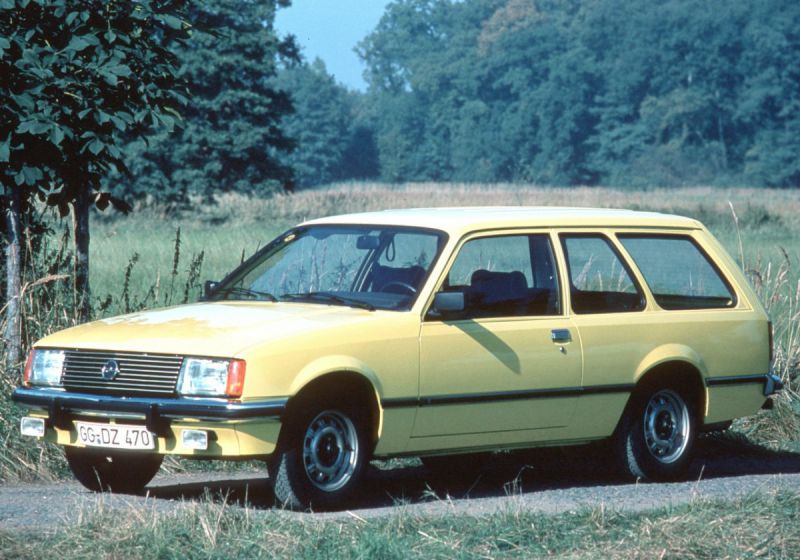
The Opel Rekord E Caravan 2.0 S represents a significant chapter in the history of European family transportation, embodying the practical and robust engineering for which Opel, a German automotive manufacturer then under General Motors ownership, was renowned. Launched in 1977, the Rekord E was the fifth generation of the long-running Rekord series, serving as Opel’s mid-size offering. This particular variant, the 2.0 S with 101 horsepower, was a popular choice within the Rekord E Caravan lineup, providing a capable blend of performance and considerable utility for families and businesses across Europe. While never officially sold in the United States, the Rekord E played a crucial role in its primary European market, competing fiercely in the family sedan and station wagon segments. Its design and mechanical fortitude were quintessential of late 1970s and early 1980s European automotive philosophy, prioritizing durability, space, and straightforward maintenance over extravagant features or cutting-edge technology.
Engineering and Performance of the Opel Rekord E Caravan
Powertrain and Engine Architecture
Under the hood of the Opel Rekord E Caravan 2.0 S lay a dependable 2.0-liter (1979 cm³, or 120.77 cubic inches) inline four-cylinder engine, designated by the code “20S.” This naturally aspirated unit, utilizing a Solex carburetor for fuel delivery, produced a respectable 101 horsepower at 5200 rpm. Torque output was equally solid for its era, peaking at 114.32 lb.-ft. (155 Nm) across a usable band of 3400-3800 rpm. This power delivery, combined with a compression ratio of 9.4:1 and a SOHC (Single Overhead Camshaft) valvetrain with two valves per cylinder, provided the Rekord E Caravan with adequate motivation for daily driving and highway cruising.
The 20S engine featured a cast iron block and an aluminum cylinder head, a common construction for engines of this period. The carburetor, while simpler than fuel injection, was relatively reliable and easy to maintain. The SOHC valvetrain, while not as efficient as a DOHC setup, offered a good balance of performance and simplicity. The engine’s design prioritized durability and low-end torque, making it well-suited for hauling loads and navigating varied terrain.
Power was transmitted to the rear wheels via a robust 4-speed manual transmission, a common configuration for European cars of this period, emphasizing driver engagement and mechanical simplicity. A 3-speed automatic transmission was also available, though less common with the 2.0 S engine. The automatic, a Borg-Warner unit, offered convenience but at the expense of some performance and fuel economy. In terms of outright performance, the Rekord E Caravan 2.0 S could accelerate from 0 to 60 mph in a calculated 12.8 seconds, with a top speed of 105.63 mph (170 km/h). While not a performance car, these figures were competitive for a family station wagon of its class in the late 1970s, making it suitable for both urban environments and longer journeys on the Autobahn.
Fuel efficiency, an increasingly important metric during the energy crises of the 1970s, was rated at a combined 25.3 US mpg (9.3 l/100 km). This was a practical consumption figure for a vehicle of its size and weight, especially considering its carbureted engine. The Rekord E Caravan’s drivetrain architecture, with its internal combustion engine driving the rear wheels, offered predictable handling characteristics and good traction, especially when laden with cargo.
Driving Characteristics
The driving experience in the Rekord E Caravan 2.0 S was characterized by its comfortable ride and predictable handling. The 101 hp engine provided adequate power for most driving situations, but it wasn’t particularly quick. The 4-speed manual transmission allowed for precise control over the engine’s power band, while the optional 3-speed automatic offered a more relaxed driving experience. The rear-wheel-drive layout provided good traction in most conditions, although it could be prone to oversteer in slippery situations.
Compared to the lower-powered 1.6-liter Rekord E Caravan, the 2.0 S offered a noticeable improvement in performance, particularly when fully loaded or traveling uphill. However, it didn’t possess the sporty character of the later Rekord GSi models, which featured more powerful engines and sport-tuned suspensions. The 2.0 S was positioned as a mid-range option, offering a balance of performance, fuel economy, and practicality. The automatic transmission, while convenient, resulted in slightly slower acceleration and reduced fuel economy compared to the manual version.
Design and Features of the Rekord E Caravan
Functional Aesthetics and Practicality
The design of the Opel Rekord E Caravan was a testament to functional German engineering. Its station wagon (or “estate” in European parlance) body style, available in both 3-door and 5-door configurations, prioritized interior volume and cargo capacity. Measuring 181.89 inches (4620 mm) in length, 67.95 inches (1726 mm) in width, and 57.87 inches (1470 mm) in height, the Rekord E Caravan offered substantial interior space for five occupants. The wheelbase of 105.04 inches (2668 mm) contributed to a stable ride and generous legroom.
Visually, the Rekord E adopted a more angular, modern aesthetic compared to its predecessor, aligning with the design trends of the late 1970s. Its clean lines and large glass areas ensured good visibility, a crucial aspect for a family hauler. The vehicle’s kerb weight of 2524.29 lbs (1145 kg) was relatively light for its size, contributing to its fuel economy and handling.
Where the Rekord E Caravan truly excelled was in its utility. With a minimum trunk (boot) space of 31.11 cubic feet (881 liters), it could swallow a considerable amount of luggage or goods, making it an ideal choice for large families, tradespeople, or those requiring significant cargo capability. The maximum permitted trailer load with brakes was a substantial 3306.93 lbs (1500 kg), further underscoring its versatility. Features were primarily functional: front brakes were ventilated discs, while the rear utilized drums, a standard setup for its class. The turning circle of 35.43 feet (10.8 m) ensured reasonable maneuverability despite its length. The drag coefficient (Cd) of 0.48, while not exceptional by modern standards, was typical for a boxy station wagon of the era.
Equipment & Trim Levels
The Rekord E Caravan 2.0 S typically came equipped with features considered standard for a mid-range European car of the time. These included cloth upholstery, a basic AM/FM radio, and manual windows and door locks. Optional extras included a sunroof, upgraded stereo systems, and power windows. The interior was generally functional and durable, with a focus on practicality rather than luxury. The dashboard layout was straightforward, with clearly labeled controls. Higher trim levels offered more luxurious features, such as velour upholstery and woodgrain trim.
Chassis & Braking
The Rekord E Caravan featured a conventional body-on-frame construction, providing a robust and durable chassis. The suspension consisted of independent front suspension with MacPherson struts and a live rear axle with leaf springs. This setup provided a comfortable ride, but it wasn’t particularly sporty. The front brakes were ventilated discs, offering good stopping power, while the rear brakes were drums, which were less effective. The steering was a recirculating ball system, which provided a relatively heavy but precise feel.
Market Reception & Comparison
The Opel Rekord E Caravan 2.0 S was generally well-received by critics and buyers alike. It was praised for its practicality, reliability, and comfortable ride. However, it was also criticized for its somewhat bland styling and lack of performance compared to some of its rivals. Compared to the Volkswagen Passat, the Rekord E Caravan offered more interior space and a more robust construction. However, the Passat was generally considered to be more refined and fuel-efficient. The Ford Granada offered more power and a more luxurious interior, but it was also more expensive. The Rekord E Caravan 2.0 S struck a good balance between these competing factors, making it a popular choice for families and businesses.
Technical Specifications: Opel Rekord E Caravan 2.0 S (101 Hp) (1977-1982)
| Category | Specification |
| General Information | |
| Brand | Opel |
| Model | Rekord E Caravan |
| Type (Engine) | 2.0 S (101 Hp) |
| Start of Production | 1977 year |
| End of Production | 1982 year |
| Powertrain Architecture | Internal Combustion engine |
| Body type | Station wagon (estate) |
| Seats | 5 |
| Doors | 3-5 |
| Performance Specs | |
| Fuel consumption (combined) | 9.3 l/100 km |
| Fuel Type | Petrol (Gasoline) |
| Acceleration 0 – 60 mph | 12.8 sec |
| Maximum speed | 170 km/h |
| Weight-to-power ratio | 11.3 kg/Hp |
| Weight-to-torque ratio | 7.4 kg/Nm |
| Engine Specs | |
| Power | 101 Hp @ 5200 rpm |
| Power per liter | 51 Hp/l |
| Torque | 155 Nm @ 3400-3800 rpm |
| Engine Model/Code | 20S |
| Engine displacement | 1979 cm³ |
| Number of cylinders | 4 |
| Engine configuration | Inline |
| Cylinder Bore | 95 mm |
| Piston Stroke | 69.8 mm |
| Compression ratio | 9.4:1 |
| Number of valves per cylinder | 2 |
| Fuel injection system | Carburetor |
| Engine aspiration | Naturally aspirated engine |
| Valvetrain | SOHC |
| Space, Volume and Weights | |
| Kerb Weight | 1145 kg |
| Max. weight | 1765 kg |
| Max load | 620 kg |
| Trunk (boot) space – minimum | 881 l |
| Fuel tank capacity | 70 l |
| Permitted trailer load with brakes (12%) | 1500 kg |
| Permitted trailer load without brakes | 585 kg |
| Dimensions | |
| Length | 4620 mm |
| Width | 1726 mm |
| Height | 1470 mm |
| Wheelbase | 2668 mm |
| Front track | 1435 mm |
| Rear (Back) track | 1412 mm |
| Drag coefficient (Cd) | 0.48 |
| Minimum turning circle (turning diameter) | 10.8 m |
| Drivetrain, Brakes and Suspension Specs | |
| Drivetrain Architecture | The Internal combustion engine (ICE) drives the rear wheels of the vehicle. |
| Drive wheel | Rear wheel drive |
| Number of gears and type of gearbox | 4 gears, manual transmission |
| Front brakes | Ventilated discs |
| Rear brakes | Drum |
Legacy
The Opel Rekord E, particularly in its Caravan guise, cemented Opel’s reputation as a builder of reliable, no-nonsense family cars and workhorses throughout Europe. While it may not possess the exotic allure of some contemporary sports cars or luxury sedans, its enduring legacy lies in its sheer practicality and accessibility. It was a ubiquitous sight on European roads, serving as police cars, taxis, delivery vehicles, and, most commonly, the reliable family station wagon.
Today, the Opel Rekord E Caravan is increasingly recognized as a classic, appreciated for its straightforward mechanics, durable construction, and its significant role in European automotive history. The 20S engine, while not particularly powerful by modern standards, is known for its reliability and longevity. Parts availability is generally good, making it a relatively easy car to maintain and restore. In the used car market, well-maintained examples of the Rekord E Caravan 2.0 S are becoming increasingly sought after by collectors and enthusiasts, representing a tangible link to a bygone era of European automotive engineering.