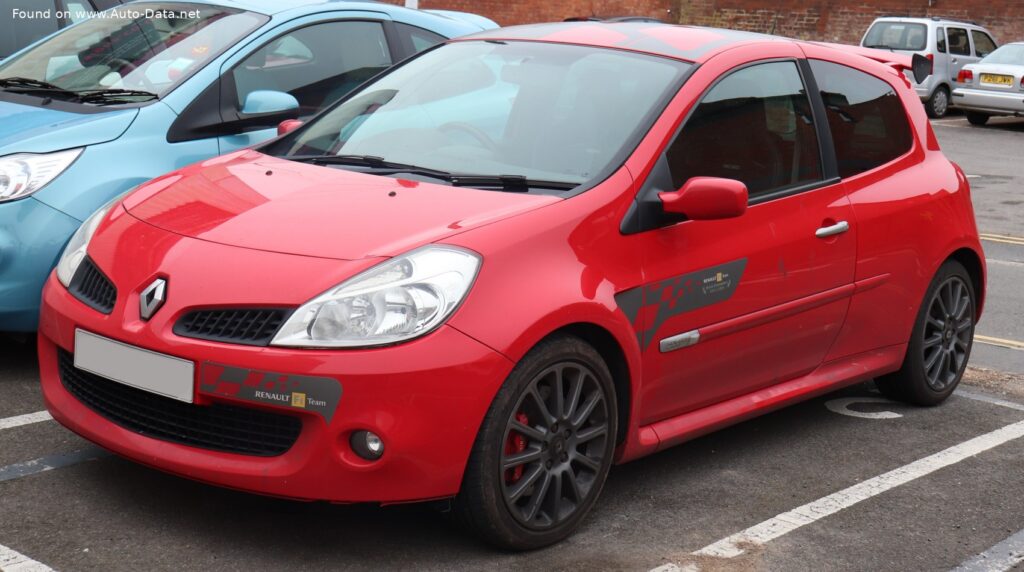
The Renault Clio III (Phase I) 3-door RS 2.0 16V (197 Hp), produced between 2006 and 2009, represented a significant evolution in Renault Sport’s acclaimed hot hatch lineage. The third generation of the popular Clio supermini, this high-performance variant was specifically engineered by Renault Sport, the automaker’s dedicated performance division, to deliver an exhilarating driving experience. While the standard Renault Clio was a staple across European markets, offering practicality and efficiency, the RS version transformed it into a formidable contender in the competitive hot hatch segment, known for its dynamic prowess and engaging character.
Not officially sold in the United States, the Clio RS carved out a formidable reputation in its primary European and other international markets. It was lauded for its pure, naturally aspirated performance, sharp handling, and robust chassis, embodying the spirit of a true driver’s car. This particular model, often referred to simply as the Clio 197 (referencing its metric horsepower output), built upon the successes of its predecessors, the Clio 172 and 182, pushing the boundaries of what a compact front-wheel-drive hatchback could achieve in terms of performance and driver involvement. It was a testament to Renault Sport’s philosophy of prioritizing track-ready dynamics in a street-legal package.
Powertrain & Engine Architecture
At the heart of the Renault Clio III (Phase I) 3-door RS 2.0 16V (197 Hp) lies a potent 2.0-liter (1998 cm3 or 121.93 cubic inches) F4R 830 inline-four engine. This naturally aspirated powerplant, a hallmark of Renault Sport engineering at the time, was meticulously tuned for high-revving performance and immediate throttle response. It delivered a robust 197 horsepower at a peaky 7250 revolutions per minute, showcasing its predisposition for spirited driving and a rewarding power band that encouraged drivers to explore its upper limits.
Torque figures for this spirited engine stood at 158.58 lb.-ft. (215 Nm), arriving at 5550 rpm. While not an overwhelming amount by modern turbocharged standards, the linear delivery and the engine’s willingness to rev made it highly engaging. Power was transmitted to the front wheels via a precise and durable 6-speed manual transmission, a crucial element for driver engagement and control, allowing enthusiasts to fully exploit the engine’s characteristics.
The F4R 830 engine utilized multi-port fuel injection and a double overhead camshaft (DOHC) valvetrain with four valves per cylinder. This configuration maximized airflow and combustion efficiency, contributing to the engine’s high-revving nature. The engine’s block was constructed from cast iron, providing durability, while the cylinder head was made of aluminum to reduce weight. The compression ratio was set at 11.5:1, further enhancing performance. The engine oil capacity was 5.71 US quarts (5.4 liters) and the coolant capacity was 5.28 US quarts (5 liters).
Driving Characteristics
The Clio 197 offered a distinctly engaging driving experience. Compared to the standard Clio, the RS model provided significantly more responsive acceleration and sharper handling. The 6-speed manual transmission was well-matched to the engine’s powerband, allowing drivers to keep the engine in its sweet spot during spirited driving. The gear ratios were closely spaced, promoting frequent shifting and maintaining momentum. While the 197 hp output wasn’t overwhelming, the engine’s willingness to rev to its 7250 rpm redline made it feel faster than the numbers suggest.
Compared to potential higher-output versions (which didn’t exist in Phase I, but were explored in later iterations), the 197 offered a more accessible and balanced driving experience. It wasn’t as brutally fast as some turbocharged rivals, but it provided a more rewarding and predictable driving experience, particularly on winding roads. The car’s relatively light weight (approximately 2700 lbs) contributed to its agility and responsiveness. The steering was direct and communicative, providing excellent feedback to the driver. The suspension, tuned for performance, offered a firm but controlled ride, minimizing body roll and maximizing grip.
Equipment & Trim Levels
The Renault Clio III (Phase I) 3-door RS 2.0 16V (197 Hp) was generally well-equipped for a hot hatch of its era. Standard features included an Anti-lock Braking System (ABS), sport seats providing excellent lateral support, and RS-specific badging throughout the interior and exterior. The interior featured a driver-focused layout with aluminum pedals and a leather-wrapped steering wheel. The dashboard and door panels were typically trimmed with a combination of cloth and leatherette.
Optional extras included air conditioning, a CD stereo system, and alloy wheels. A ‘Cup’ chassis pack was also available, which further stiffened the suspension and included more aggressive tires for enhanced track performance. The interior upholstery was typically dark grey or black, with red stitching providing a sporty accent. The Clio RS did not offer a wide range of customization options, reflecting its focus on performance rather than luxury.
Chassis & Braking
The Clio RS featured a meticulously engineered chassis designed to maximize handling and stability. The front suspension utilized an independent McPherson strut setup with coil springs and an anti-roll bar. The rear suspension employed a coil spring and torsion beam arrangement. This combination provided a good balance between ride comfort and handling precision. The suspension was tuned to be firm, minimizing body roll and maximizing grip.
Braking performance was equally impressive, with large 312×28 mm ventilated discs at the front and 300×11 mm discs at the rear. The ABS system ensured confident braking performance under a variety of conditions. The car’s relatively low weight further enhanced its braking capabilities. The electric power steering provided precise feedback, enhancing the car’s dynamic character. The front track was 53.94 inches (1370 mm) and the rear track was 53.54 inches (1360 mm).
Market Reception & Comparison
Critics generally praised the Renault Clio III (Phase I) 3-door RS 2.0 16V (197 Hp) for its engaging driving experience and sharp handling. It was often lauded as one of the most rewarding front-wheel-drive hot hatches available. Fuel economy was respectable for a performance car, with combined figures ranging from 28-26.4 US mpg (8.4-8.9 l/100 km). Reliability was generally good, although some owners reported minor issues with the engine’s sensors and electrical components.
Compared to other trims in the Clio lineup, the RS model was significantly more expensive and focused on performance. The standard Clio prioritized practicality and fuel efficiency, while the RS model catered to driving enthusiasts. Compared to rivals like the Volkswagen Golf GTI, the Clio RS offered a more raw and visceral driving experience, but lacked the GTI’s refinement and everyday usability. The Clio RS was often seen as a more focused and track-oriented alternative to the more all-around Golf GTI.
Technical Specifications
| Category | Specification |
| Brand | Renault |
| Model | Clio |
| Generation | Clio III (Phase I) 3-door |
| Type (Engine) | RS 2.0 16V (197 Hp) |
| Production Start | 2006 |
| Production End | 2009 |
| Powertrain Architecture | Internal Combustion Engine |
| Body Type | Hatchback |
| Seats | 4 |
| Doors | 3 |
| Fuel Type | Petrol (Gasoline) |
| Acceleration 0-60 mph | 6.6 seconds |
| Acceleration 0-100 km/h | 6.9 seconds |
| Maximum Speed | 133.59 mph (215 km/h) |
| Braking 100 km/h – 0 | 35 m |
| Combined Fuel Economy (US mpg) | 28 – 26.4 US mpg |
| Urban Fuel Economy (US mpg) | 20.3 – 19.3 US mpg |
| Extra Urban Fuel Economy (US mpg) | 36.2 – 33.1 US mpg |
| CO2 Emissions (NEDC) | 199-209 g/km |
| Emission Standard | Euro 4 |
| Power | 197 Hp @ 7250 rpm |
| Power per liter | 98.6 Hp/l |
| Torque | 158.58 lb.-ft. @ 5550 rpm (215 Nm) |
| Engine Layout | Front, Transverse |
| Engine Model/Code | F4R 830 |
| Engine Displacement | 2.0 liters (1998 cm3 / 121.93 cu. in.) |
| Number of Cylinders | 4 |
| Engine Configuration | Inline |
| Cylinder Bore | 3.26 inches (82.7 mm) |
| Piston Stroke | 3.66 inches (93 mm) |
| Compression Ratio | 11.5:1 |
| Valves per Cylinder | 4 |
| Fuel Injection System | Multi-port manifold injection |
| Engine Aspiration | Naturally aspirated engine |
| Valvetrain | DOHC |
| Engine Oil Capacity | 5.71 US qt (5.4 l) |
| Coolant Capacity | 5.28 US qt (5 l) |
| Kerb Weight | 2691.84 – 2777.82 lbs. (1221-1260 kg) |
| Max. Weight (GVWR) | 3725.81 lbs. (1690 kg) |
| Max Load | 947.99 – 1033.97 lbs. (430-469 kg) |
| Trunk (boot) Space – Min. | 10.17 cu. ft. (288 l) |
| Trunk (boot) Space – Max. | 36.3 cu. ft. (1028 l) |
| Fuel Tank Capacity | 14.53 US gal (55 l) |
| Max. Roof Load | 176.37 lbs. (80 kg) |
| Length | 157.13 inches (3991 mm) |
| Width | 69.61 inches (1768 mm) |
| Width including mirrors | 79.72 inches (2025 mm) |
| Height | 58.15 inches (1477 mm) |
| Wheelbase | 101.77 inches (2585 mm) |
| Front Track | 53.94 inches (1370 mm) |
| Rear Track | 53.54 inches (1360 mm) |
| Front Overhang | 31.5 inches (800 mm) |
| Rear Overhang | 23.86 inches (606 mm) |
| Ride Height (Ground Clearance) | 4.45 inches (113 mm) |
| Drag Coefficient (Cd) | 0.35 |
| Minimum Turning Circle | 37.4 ft. (11.4 m) |
| Drivetrain Architecture | Front-wheel drive |
| Drive Wheels | Front wheel drive |
| Number of Gears | 6 |
| Gearbox Type | Manual transmission |
| Front Suspension | Independent, McPherson with coil spring and anti-roll bar |
| Rear Suspension | Coil spring, Torsion |
| Front Brakes | Ventilated discs, 312×28 mm |
| Rear Brakes | Disc, 300×11 mm |
| Assisting Systems | ABS (Anti-lock braking system) |
| Steering Type | Steering rack and pinion |
| Power Steering | Electric Steering |
| Tire Size | 215/45 R17 |
| Wheel Rims Size | 7.5J x 17 |
Legacy
The Renault Clio III (Phase I) 3-door RS 2.0 16V (197 Hp) cemented Renault Sport’s reputation as a leading manufacturer of driver-focused hot hatches. Its legacy is one of uncompromising performance, exceptional chassis dynamics, and a purity of driving experience that is increasingly rare in an era dominated by forced induction and electronic aids. Enthusiasts widely praised the Clio 197 for its communicative steering, tenacious grip, and the visceral thrill of its high-revving naturally aspirated engine. It was a car that demanded to be driven hard to extract its full potential, rewarding skilled drivers with an incredibly engaging and immersive experience.
In the used car market today, the Clio 197 remains a popular choice among enthusiasts. Well-maintained examples command a premium price, reflecting their desirability and rarity. The engine is generally considered reliable, although regular maintenance is essential. Potential buyers should be aware of potential issues with the engine’s sensors and electrical components. Overall, the Clio 197 represents a compelling value proposition for those seeking a rewarding and engaging driving experience in a compact and stylish package.