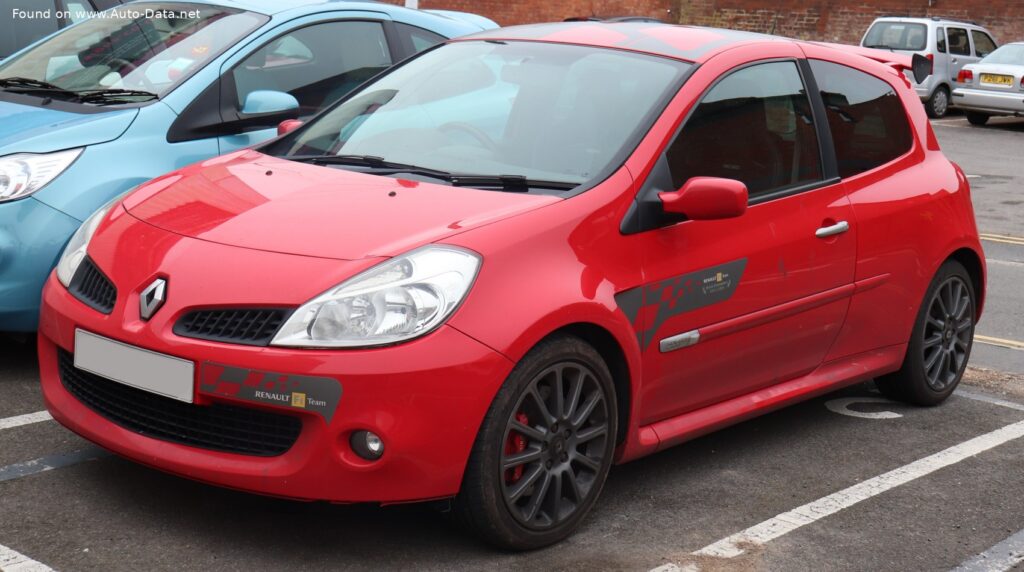
The Renault Clio III (Phase I) 3-door RS 2.0 16V (200 Hp) represents a potent and highly regarded iteration of Renault Sport’s commitment to delivering exhilarating performance in a compact, front-wheel-drive package. Launched in 2008 as part of the Phase I refresh of the third-generation Clio, this particular model quickly cemented its reputation as one of the most engaging hot hatches of its era. While never officially sold in the United States, the Clio RS series, and specifically this 200 Hp variant, played a pivotal role in the European and international performance car markets, embodying the spirit of accessible, track-focused driving dynamics within a practical hatchback body.
Renault, A Legacy of Performance
Renault, a French automotive giant, has a long-standing tradition of infusing its mainstream models with motorsport-derived technology and engineering prowess through its Renault Sport division. The Clio RS line is perhaps the most celebrated manifestation of this philosophy, consistently delivering vehicles that are lauded by enthusiasts and automotive journalists alike for their sharp handling, communicative steering, and high-revving engines. The Clio III RS, building upon the success of its predecessors, brought enhanced refinement, safety, and a more mature design, all while retaining the raw, unadulterated driving pleasure that defined the RS badge.
Powertrain & Engine Architecture
At the core of the Renault Clio III (Phase I) 3-door RS 2.0 16V’s appeal is its naturally aspirated F4R 832 engine. This 2.0-liter (1998 cm3 or 121.93 cu. in.) inline-four powerplant is a testament to the art of extracting significant power without forced induction, a characteristic increasingly rare in modern performance cars. Featuring a DOHC (Double Overhead Camshaft) valvetrain with four valves per cylinder and multi-port manifold injection, this engine delivers an impressive 200 horsepower at a high 7250 revolutions per minute. Its specific power output of 100.1 horsepower per liter highlights its efficiency and engineering sophistication.
The F4R engine family has a long history within Renault, appearing in various models and states of tune. The 832 designation signifies a specific iteration optimized for performance. The engine utilizes a cast iron block with an aluminum cylinder head, balancing durability with weight reduction. The fuel injection system is a Bosch Motronic MP8, managing fuel delivery and ignition timing for optimal performance and emissions control. The valvetrain employs lightweight valves and high-performance camshafts to maximize airflow at high engine speeds.
Power is transmitted to the front wheels through a precise 6-speed manual transmission, a crucial element in the driving experience. This gearbox is known for its short throws and positive engagement, allowing for quick and precise gear changes. The final drive ratio is optimized for both acceleration and top-end speed. The clutch is a single-plate dry clutch, designed to handle the engine’s output without excessive pedal effort.
Driving Characteristics
The Renault Clio III (Phase I) 3-door RS 2.0 16V delivers a driving experience that prioritizes engagement and responsiveness. While its 200 hp and 158.58 lb.-ft. of torque might seem modest by modern standards, the engine’s linear power delivery and willingness to rev to its 7250 rpm redline create a thrilling sensation. The 6-speed manual transmission allows drivers to maintain the engine in its optimal power band, maximizing acceleration. The car accelerates from 0 to 60 mph in a brisk 6.6 seconds (0-100 km/h in 6.9 seconds) and achieves a top speed of 133.59 mph (215 km/h).
Compared to other trims in the Clio III lineup, the RS model offers a significantly more focused driving experience. The standard Clio models, equipped with smaller engines and automatic transmissions, prioritize fuel efficiency and comfort. The RS, on the other hand, is geared towards enthusiasts who value performance and handling. The chassis is stiffer, the suspension is more aggressively tuned, and the steering is more direct, resulting in a car that feels significantly more planted and responsive. Compared to potential turbocharged rivals, the RS offers a more predictable and linear power delivery, rewarding skilled drivers who enjoy maximizing engine performance through precise gear selection.
Equipment & Trim Levels
The Clio III RS came equipped with a range of features designed to enhance the driving experience and provide a sporty aesthetic. Standard equipment included sport seats with enhanced bolstering, a leather-wrapped steering wheel with red stitching, aluminum pedals, and unique instrument cluster graphics. The interior typically featured a dark color scheme with contrasting accents. Air conditioning, power windows, and central locking were also standard.
Optional extras included a panoramic sunroof, Renault Sport Monitor (a performance data display), and upgraded audio systems. Paint options were typically limited to vibrant colors such as Liquid Yellow, Diablo Red, and Pearl White, further emphasizing the car’s sporty character. The interior upholstery could be upgraded to include leather or Alcantara accents. The trim level was largely consistent across markets, with minor variations in standard equipment depending on regional specifications.
Chassis & Braking
The chassis of the Clio III RS was significantly upgraded compared to the standard Clio models. The front suspension utilized a MacPherson strut setup with stiffer springs and dampers, while the rear featured a torsion beam axle, also tuned for enhanced handling. A thicker front stabilizer bar further reduced body roll during cornering. The car’s ride height was lowered to improve stability and reduce aerodynamic drag.
Braking performance was also enhanced, with ventilated discs at the front and solid discs at the rear. The braking system was augmented by an Anti-lock Braking System (ABS) and Electronic Brakeforce Distribution (EBD) for improved safety and control. The steering system was a precise rack and pinion setup, known for its direct feedback and responsiveness. The RS model also featured a more robust power steering pump to provide consistent steering feel even during aggressive maneuvers.
Market Reception & Comparison
Critics generally praised the Renault Clio III (Phase I) 3-door RS 2.0 16V for its exceptional handling, responsive engine, and engaging driving experience. It was often lauded as one of the best front-wheel-drive hot hatches of its era. Fuel economy was reasonable for a performance car, with combined figures around 26.4 US mpg. However, some critics noted that the engine’s lack of low-end torque required drivers to rev the engine aggressively to extract maximum performance.
Compared to other trims in the Clio lineup, the RS model offered a significantly higher level of performance and handling. The base models, with their smaller engines and softer suspensions, were more focused on fuel efficiency and comfort. The RS, on the other hand, was designed for enthusiasts who prioritized driving pleasure. In terms of reliability, the F4R engine is generally considered to be robust and durable, although regular maintenance is essential. The Clio RS’s relatively simple mechanical design also contributes to its ease of maintenance and repair.
Technical Specifications
| Category | Specification |
| Brand | Renault |
| Model | Clio |
| Generation | Clio III (Phase I) 3-door |
| Type (Engine) | RS 2.0 16V (200 Hp) |
| Production Start | 2008 |
| Production End | 2009 |
| Powertrain Architecture | Internal Combustion engine |
| Body Type | Hatchback |
| Seats | 4 |
| Doors | 3 |
| Fuel Consumption (Urban) | 12.2 l/100 km |
| Fuel Consumption (Extra Urban) | 7.1 l/100 km |
| Fuel Consumption (Combined) | 8.9 l/100 km |
| Fuel Type | Petrol (Gasoline) |
| Acceleration 0-60 mph | 6.6 sec |
| Acceleration 0-100 km/h | 6.9 sec |
| Maximum Speed | 215 km/h |
| Weight-to-Power Ratio | 6.2 kg/Hp |
| Engine Specs | |
| Power | 200 Hp @ 7250 rpm |
| Power per liter | 100.1 Hp/l |
| Torque | 215 Nm @ 5500 rpm |
| Engine Layout | Front, Transverse |
| Engine Model/Code | F4R 832 |
| Engine Displacement | 1998 cm3 |
| Number of Cylinders | 4 |
| Engine Configuration | Inline |
| Cylinder Bore | 82.7 mm |
| Piston Stroke | 93 mm |
| Compression Ratio | 11.5:1 |
| Valves per Cylinder | 4 |
| Fuel Injection System | Multi-port manifold injection |
| Engine Aspiration | Naturally aspirated engine |
| Valvetrain | DOHC |
| Engine Oil Capacity | 5.4 l |
| Coolant Capacity | 5 l |
| Kerb Weight | 1240 kg |
| Maximum Weight | 1690 kg |
| Trunk (Boot) Space (Min) | 288 l |
| Trunk (Boot) Space (Max) | 1028 l |
| Fuel Tank Capacity | 55 l |
| Length | 3991 mm |
| Width | 1768 mm |
| Height | 1477 mm |
| Wheelbase | 2585 mm |
| Front Track | 1520 mm |
| Rear Track | 1520 mm |
| Front Suspension | Spring Strut |
| Rear Suspension | Torsion |
| Front Brakes | Ventilated discs |
| Rear Brakes | Disc |
| Assisting Systems | ABS (Anti-lock braking system) |
| Steering Type | Steering rack and pinion |
| Tires Size | 215/45 R17 |
Legacy
The Renault Clio III (Phase I) 3-door RS 2.0 16V carved out a significant niche in the highly competitive European hot hatch segment during its production run from 2008 to 2009. It was lauded for its exceptional chassis balance, direct steering, and the high-revving nature of its naturally aspirated engine, which offered a purer, more mechanical driving experience compared to the growing trend of turbocharged rivals. This combination made it a favorite among driving enthusiasts seeking a car that felt alive and rewarded skilled input, both on winding roads and track days.
In its primary markets, particularly across Europe, the Clio RS competed fiercely with other established players like the Ford Fiesta ST, the Peugeot 207 RC, and the Opel Corsa OPC (known as the Vauxhall Corsa VXR in the UK). While some rivals might have offered more low-end torque or slightly higher straight-line speed due to forced induction, the Clio RS consistently stood out for its superb handling dynamics and the visceral engagement provided by its atmospheric engine. It wasn’t just about raw numbers; it was about the sensation of driving, the progressive build-up of power, and the audible symphony of the engine nearing its redline.
The historical significance of the Clio III RS lies in its role as one of the last bastions of the naturally aspirated hot hatch. As emissions regulations tightened and manufacturers increasingly turned to turbocharging for efficiency and torque delivery, the Clio RS, with its high-strung 2.0-liter engine, represented a glorious swansong for a particular type of performance car. Its reputation for durability and track readiness also contributed to its strong appeal in the aftermarket and enthusiast communities, where it remains a sought-after model for those who appreciate its unadulterated driving character.
For the North American market, the Clio RS remains an intriguing “forbidden fruit.” Renault’s limited presence in the US since the late 1980s meant that iconic models like the Clio RS were never officially imported. This absence means that American enthusiasts often look to this generation of Clio RS with a sense of admiration for its European accolades and a curiosity about its acclaimed driving dynamics. Its legacy is one of a truly driver-focused machine, a testament to Renault Sport’s ability to create a compelling performance package that continues to be celebrated by those who value driving purity above all else.