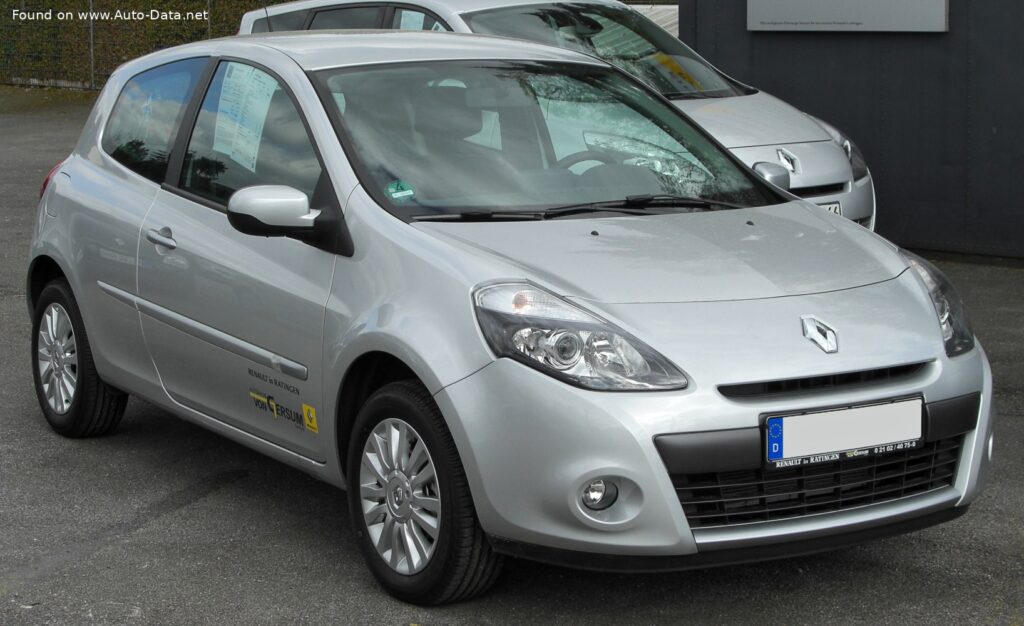
The Renault Clio III, specifically the Phase II variant introduced in 2009, represents a significant evolution in the highly competitive European B-segment, often referred to as the supermini class. As a cornerstone of Renault’s lineup, the Clio has consistently been one of Europe’s best-selling cars, celebrated for its blend of style, practicality, and driving dynamics. The particular model under examination, the Renault Clio III (Phase II, 2009) 3-door 1.2 16V TCe (100 Hp), was produced from May 2009 to April 2010. This iteration brought a refreshed design and powertrain refinements, enhancing its appeal to urban dwellers and young families across the continent. While never officially sold in the United States, the Clio’s success in its primary markets underscores its global impact as a benchmark for compact car design and engineering.
The Renault Clio III Phase II: A Detailed Overview
The Clio III generation, launched in 2005, marked a substantial step up in terms of perceived quality, safety, and sophistication compared to its predecessors. The Phase II facelift further honed these attributes, integrating subtle exterior updates and technological advancements. The 3-door hatchback body style, a popular choice in Europe, offered a sporty aesthetic while maintaining the practicality expected of a compact vehicle. The 1.2-liter TCe engine variant was particularly noteworthy for its early adoption of turbocharging in a small displacement engine, foreshadowing a trend that would become ubiquitous in the automotive industry for balancing performance with fuel efficiency.
Powertrain & Engine Architecture
At the core of this particular Clio III variant is a sophisticated 1.2-liter (1149 cm3 or 70.12 cu. in.) 16-valve TCe (Turbo Control efficiency) inline-four engine, designated with the code D4F 784. This powertrain was a prime example of Renault’s commitment to “rightsizing,” providing performance typically associated with larger naturally aspirated engines while delivering the fuel economy and lower emissions of a smaller unit. The engine’s key feature is its turbocharger, coupled with an intercooler, which boosts power output and torque across a broad RPM range.
Engine Specifications
The D4F 784 engine utilizes multi-port fuel injection and a double overhead camshaft (DOHC) valvetrain. The turbocharger is a relatively small unit, optimized for responsiveness rather than peak power. This design choice contributes to the engine’s strong low-end torque, making it well-suited for urban driving. The engine also features variable valve timing, further enhancing its efficiency and drivability. The compression ratio is set at 9.8:1, a compromise between performance and fuel economy. The engine is transversely mounted at the front of the vehicle, driving the front wheels.
Transmission Details
Power is delivered to the front wheels via a smooth-shifting 5-speed manual transmission. This transmission was a standard offering for the 1.2 TCe engine, providing a balance between cost and performance. The gear ratios are tuned to maximize fuel efficiency and acceleration in typical driving conditions. The transmission is known for its relatively light and precise shift action, contributing to an engaging driving experience.
Driving Characteristics
The Clio III 1.2 TCe offers a sprightly and engaging driving experience, particularly for a vehicle in its class. The 100 horsepower and 106.95 lb.-ft. of torque provide adequate power for both city driving and highway cruising. Acceleration from 0 to 60 mph takes a respectable 10.5 seconds, with a top speed of 114.33 mph. While not a performance-oriented model, the 1.2 TCe offers sufficient power for overtaking maneuvers and maintaining a comfortable pace on the open road.
Compared to other variants in the Clio III lineup, such as the 1.6 16V, the 1.2 TCe offers less outright power but provides superior fuel economy. The 1.2 TCe is also more responsive than the base 1.2 naturally aspirated engine, thanks to the turbocharger. The 5-speed manual transmission allows for precise control over the engine’s power delivery, while the relatively light weight of the vehicle contributes to its nimble handling.
Equipment & Trim Levels
The Renault Clio III (Phase II, 2009) 3-door 1.2 16V TCe was typically offered in several trim levels, each with a different level of standard equipment. Base models generally included features such as power steering, central locking, electric front windows, and an ABS braking system. Higher trim levels added features such as air conditioning, alloy wheels, a CD player with MP3 compatibility, and front fog lights. Interior upholstery was typically cloth, with options for upgraded materials and designs on higher trim levels.
Optional extras available for this trim included a panoramic sunroof, rear parking sensors, and a trip computer. Safety features such as side airbags and curtain airbags were also available as options. The dashboard configuration was relatively simple and functional, with a clear and easy-to-read instrument cluster.
Chassis & Braking
The Clio III utilizes a robust chassis design, providing a comfortable ride and predictable handling. The front suspension consists of independent McPherson struts with coil springs and an anti-roll bar, while the rear suspension employs a torsion beam setup. This combination provides a good balance between ride comfort and handling precision. The steering is electric power-assisted, making it light and easy to use, particularly in urban environments.
The braking system comprises ventilated discs measuring 260×22 mm at the front and reliable 203 mm drums at the rear. The ABS system helps to prevent wheel lockup during emergency braking, enhancing safety and control. Depending on the trim level, the Clio was fitted with 185/60 R15 or 195/50 R16 tires on 6J x 15 or 6.5J x 16 wheel rims, respectively.
Market Reception & Comparison
The Renault Clio III (Phase II, 2009) 3-door 1.2 16V TCe was generally well-received by automotive critics. It was praised for its fuel efficiency, responsive engine, and comfortable ride. However, some critics noted that the interior materials were not as high-quality as those found in some of its rivals. Fuel economy was a strong point, with the combined fuel consumption rated at an impressive 40.6 US mpg (5.8 l/100 km). In terms of reliability, the Clio III is generally considered to be a reliable vehicle, although some owners have reported issues with the turbocharger and the electrical system.
Compared to other trims in the Clio III lineup, the 1.2 TCe offered a good balance between performance and fuel economy. It was more affordable than the higher-powered 1.6 16V and 2.0 16V models, making it an attractive option for budget-conscious buyers. It also offered better fuel economy than the diesel-powered variants, while still providing adequate performance for most driving situations.
Technical Specifications
| Brand | Renault |
| Model | Clio |
| Generation | Clio III (Phase II, 2009) 3-door |
| Type (Engine) | 1.2 16V TCe (100 Hp) |
| Start of Production | May, 2009 year |
| End of Production | April, 2010 year |
| Powertrain Architecture | Internal Combustion engine |
| Body type | Hatchback |
| Seats | 5 |
| Doors | 3 |
| Fuel Consumption (Urban, NEDC) | 7.4 l/100 km (31.8 US mpg) |
| Fuel Consumption (Extra Urban, NEDC) | 4.8 l/100 km (49 US mpg) |
| Fuel Consumption (Combined, NEDC) | 5.8 l/100 km (40.6 US mpg) |
| CO2 Emissions (NEDC) | 137 g/km |
| Fuel Type | Petrol (Gasoline) |
| Acceleration 0 – 60 mph | 10.5 sec |
| Maximum Speed | 184 km/h (114.33 mph) |
| Emission Standard | Euro 4 |
| Power | 100 Hp @ 5500 rpm |
| Torque | 145 Nm @ 3000 rpm (106.95 lb.-ft. @ 3000 rpm) |
| Engine Displacement | 1149 cm3 (70.12 cu. in.) |
| Kerb Weight | 1065-1090 kg (2347.92 – 2403.04 lbs.) |
Legacy
The Renault Clio III, and particularly the 1.2 16V TCe variant, has proven to be a relatively reliable vehicle in the long term. While some owners have reported issues with the turbocharger and electrical system, these are not widespread problems. The engine is generally considered to be durable and capable of handling high mileage with proper maintenance. In the used car market today, the Clio III 1.2 TCe remains a popular choice for budget-conscious buyers seeking a practical and fuel-efficient supermini. Its combination of affordability, reliability, and driving enjoyment makes it a compelling option in its price range. The Clio III’s influence on the automotive industry is also noteworthy, as it helped to popularize the use of small-capacity turbocharged engines, a trend that continues to shape the automotive landscape today.