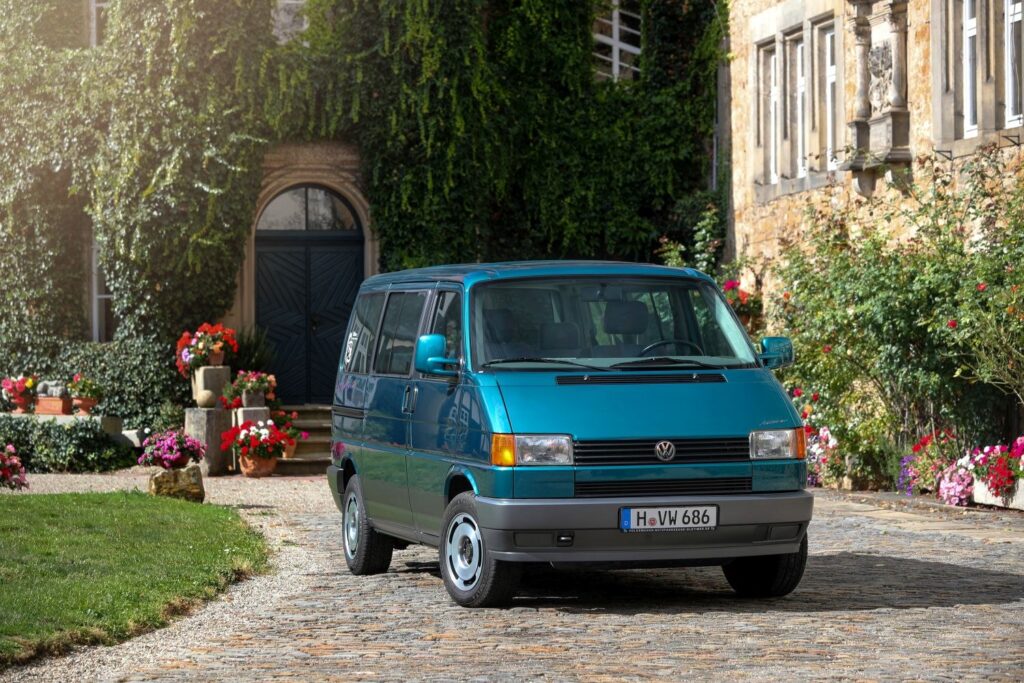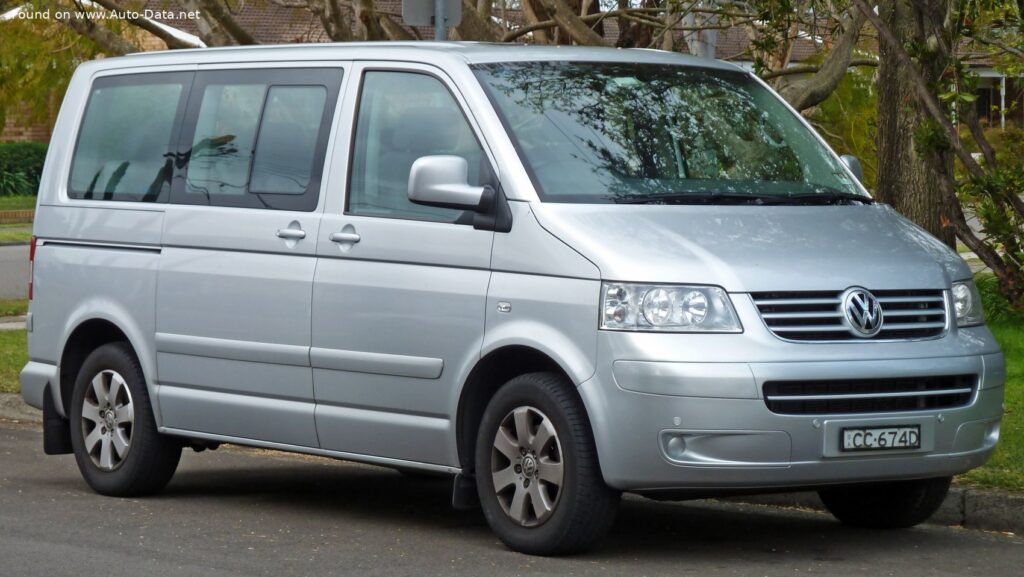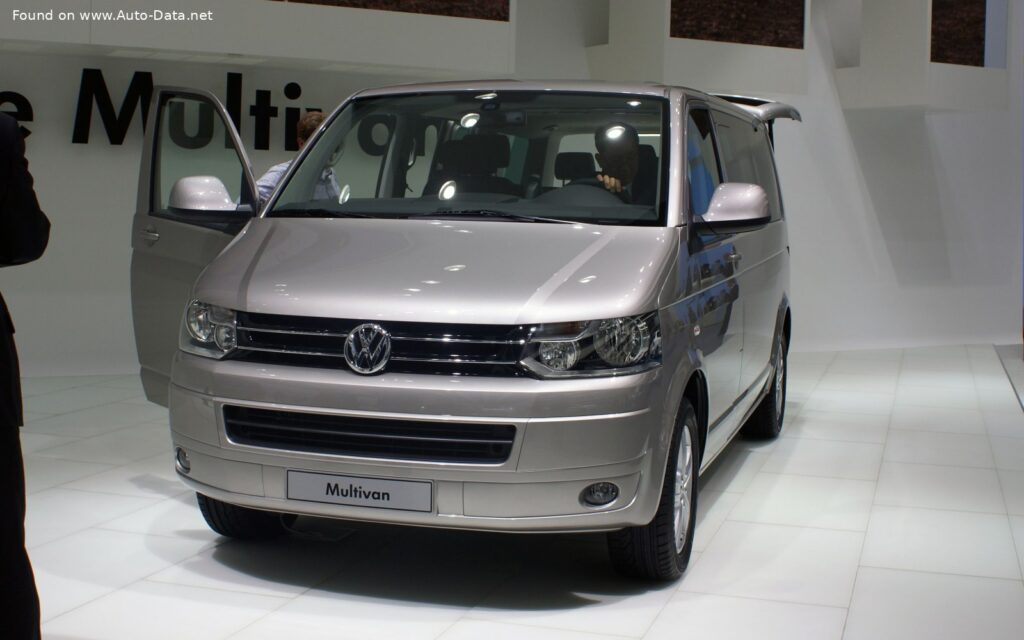
The Volkswagen Multivan (T5, facelift 2009) Long 2.0 TSI (150 Hp) represents a significant iteration of Volkswagen’s venerable T5 generation, a model line deeply rooted in the brand’s heritage of versatile, spacious, and reliable people movers. Primarily targeted at European and international markets, where it serves as a premium alternative to conventional minivans and full-size SUVs, the Multivan T5 is not typically sold in the United States. Its appeal lies in its sophisticated blend of passenger comfort, vast interior flexibility, and car-like driving dynamics, all packaged within a robust, commercial-vehicle derived platform.
Launched in 2009 as a significant mid-cycle refresh for the T5 generation, which originally debuted in 2003, this facelifted model brought a host of updates. These changes encompassed revised styling, enhanced powertrains, and improved interior amenities, solidifying its position as a go-to choice for large families, executive transport, and adventure seekers. The “Long” designation indicates an extended wheelbase version, providing even greater cargo and passenger volume, a critical factor for its target demographic. This particular variant, equipped with the 2.0 TSI (150 Hp) gasoline engine, offered a compelling balance of performance and efficiency for its time, adhering to Euro 4 emission standards.
Powertrain & Engine Architecture
At the heart of this particular Multivan T5 variant is Volkswagen’s well-regarded 2.0-liter TSI (Turbocharged Stratified Injection) gasoline engine, delivering 150 horsepower. This inline four-cylinder powerplant, identified by the engine code CJKB, employs a sophisticated direct injection fuel system combined with a turbocharger and intercooler. This configuration was instrumental in providing a broad torque curve and responsive power delivery, crucial for a vehicle of the Multivan’s size and intended use.
The engine produces its peak power of 150 HP across a wide band, from 3750 to 6000 rpm, ensuring ample power for highway cruising and city driving. More importantly for a large vehicle, the maximum torque output stands at 206.52 lb.-ft., available from a low 1500 rpm all the way up to 3750 rpm. This flat torque curve translates into excellent low-end grunt, making it easier to accelerate from a standstill and handle heavy loads without feeling strained. The engine’s displacement measures 121.07 cubic inches (1984 cm³), with four valves per cylinder, optimizing combustion efficiency.
Power is channeled to the front wheels via a precise 6-speed manual transmission, a common and favored choice in European markets for its direct engagement and fuel efficiency potential. While the Multivan is not built for outright speed, its performance figures are respectable for a vehicle of its class. It can accelerate from 0 to 60 mph in approximately 16.4 seconds, with a top speed of 101.28 mph. These figures underscore its design as a capable people mover rather than a performance vehicle, prioritizing smooth, comfortable travel.
Fuel economy for the 2.0 TSI (150 Hp) variant is rated at an estimated 18.1 US mpg in urban driving, 29.4 US mpg on the highway, and a combined average of 24 US mpg. These figures, while not groundbreaking by today’s standards, were competitive for a large gasoline-powered minivan during its production years (2009-2015). The vehicle’s CO2 emissions are 228 g/km, meeting the Euro 4 emission standard, which was the prevailing benchmark at its introduction. The 21.13 US gallon fuel tank capacity provides a substantial cruising range, a benefit for long-distance family trips or commercial applications.
Driving Characteristics
The 150 hp 2.0 TSI engine, paired with the six-speed manual transmission, provided a driving experience geared towards relaxed cruising and usability rather than outright performance. Compared to the more powerful TSI variants or the diesel options (like the 140 hp TDI), this configuration offered a noticeable difference in acceleration, particularly when fully loaded with passengers and luggage. The lower horsepower and torque figures meant that overtaking maneuvers required more planning, and climbing steep inclines demanded downshifts to maintain speed. However, the broad torque band of the TSI engine mitigated some of these limitations, providing sufficient power for everyday driving situations.
The manual transmission allowed for greater driver control and engagement, offering a more connected feel compared to the optional automatic transmission. Gear ratios were optimized for fuel efficiency and comfortable highway cruising, with a relatively long sixth gear. The front-wheel-drive layout contributed to predictable handling, although it lacked the all-weather capability of the 4Motion all-wheel-drive system available on other T5 models. Overall, the driving experience was characterized by smoothness, refinement, and a focus on passenger comfort, making it well-suited for long journeys.
Equipment & Trim Levels
The Volkswagen Multivan (T5, facelift 2009) Long 2.0 TSI (150 Hp) typically occupied a mid-range position within the T5 lineup. Standard equipment generally included features such as air conditioning, power windows, power mirrors, a CD/radio system, and basic safety features like ABS and driver/passenger airbags. Interior upholstery was typically cloth, although leather options were available as upgrades.
The dashboard configuration was functional and well-laid-out, with clear instrumentation and intuitive controls. Optional extras included features such as a navigation system, parking sensors, upgraded audio systems, heated seats, and a multi-function steering wheel. The modular seating system was a key selling point, allowing for a wide range of configurations to suit different needs. Higher trim levels offered more luxurious appointments, such as leather upholstery, wood trim, and additional comfort features.
Chassis & Braking
The Multivan T5 utilized an independent McPherson strut front suspension and a double wishbone rear suspension, providing a comfortable and controlled ride quality. The long wheelbase of the “Long” variant contributed to improved stability, particularly at highway speeds. Stabilizer bars were fitted to both the front and rear axles to reduce body roll during cornering.
Braking was handled by disc brakes on all four wheels, complemented by an Anti-lock Braking System (ABS) and Electronic Brake-force Distribution (EBD) for enhanced safety. The braking system was generally considered adequate for the vehicle’s weight and intended use, providing reliable stopping power in most conditions. The steering system utilized a responsive rack and pinion setup, offering precise control and a car-like feel.
Market Reception & Comparison
Critics generally praised the Volkswagen Multivan (T5, facelift 2009) Long 2.0 TSI (150 Hp) for its spacious interior, comfortable ride, and versatile seating configurations. The 2.0 TSI engine was considered a good compromise between performance and fuel efficiency, although some reviewers noted that it could feel underpowered when fully loaded. Compared to the more powerful TSI variants, this version offered a more affordable entry point into the Multivan range.
In terms of fuel economy, the 2.0 TSI engine performed competitively with other gasoline-powered minivans of its time. However, the diesel-powered TDI variants offered significantly better fuel efficiency, making them a popular choice for those prioritizing economy. Reliability was generally good, although some owners reported minor issues with the turbocharger and fuel injection system. Overall, the Multivan T5 was well-regarded as a premium people mover that offered a compelling blend of practicality, comfort, and refinement.
Technical Specifications
| Category | Specification |
| General Information | |
| Brand | Volkswagen |
| Model | Multivan |
| Generation | Multivan (T5, facelift 2009) Long |
| Engine Type | 2.0 TSI (150 Hp) |
| Production Start | 2009 |
| Production End | 2015 |
| Body Type | Minivan |
| Seats | 7 |
| Doors | 5 |
| Performance Specs | |
| Fuel Consumption (Urban) | 13 l/100 km |
| Fuel Consumption (Extra Urban) | 8 l/100 km |
| Fuel Consumption (Combined) | 9.8 l/100 km |
| CO2 Emissions | 228 g/km |
| Fuel Type | Petrol (Gasoline) |
| Acceleration 0 – 60 mph | 16.4 seconds |
| Maximum Speed | 163 km/h (101.28 mph) |
| Emission Standard | Euro 4 |
| Weight-to-power ratio | 14.7 kg/Hp |
| Engine Specs | |
| Power | 150 Hp @ 3750-6000 rpm |
| Power per liter | 75.6 Hp/l |
| Torque | 280 Nm @ 1500-3750 rpm (206.52 lb.-ft. @ 1500-3750 rpm) |
| Engine Layout | Front, Transverse |
| Engine Displacement | 1984 cm³ (121.07 cu. in. / 2.0 Liters) |
| Number of Cylinders | 4 Inline |
| Valves per Cylinder | 4 |
| Fuel Injection System | Direct injection |
| Engine Aspiration | Turbocharger, Intercooler |
| Engine Oil Capacity | 5.7 l (6.02 US qt) |
| Space, Volume and Weights | |
| Kerb Weight | 2200 kg (4850.17 lbs.) |
| Max. Weight | 3000 kg (6613.87 lbs.) |
| Max Load | 800 kg (1763.7 lbs.) |
| Fuel Tank Capacity | 80 l (21.13 US gal) |
| Dimensions | |
| Length | 5292 mm (208.35 in.) |
| Width | 1904 mm (74.96 in.) |
| Height | 1990 mm (78.35 in.) |
| Wheelbase | 3400 mm (133.86 in.) |
| Front Track | 1628 mm (64.09 in.) |
| Rear Track | 1628 mm (64.09 in.) |
| Ride Height (Ground Clearance) | 186 mm (7.32 in.) |
| Drivetrain, Brakes and Suspension Specs | |
| Drivetrain Architecture | Front-wheel drive, Internal Combustion Engine |
| Drive Wheel | Front wheel drive |
| Gearbox Type | 6 gears, manual transmission |
| Front Suspension | Independent type McPherson |
| Rear Suspension | Double wishbone |
| Front Brakes | Disc |
| Rear Brakes | Disc |
| Assisting Systems | ABS (Anti-lock braking system) |
| Steering Type | Steering rack and pinion |
| Tire Size | 235/55 R17 |
| Wheel Rims Size | 7J x 17 |
Legacy
The Volkswagen Multivan (T5, facelift 2009) Long 2.0 TSI (150 Hp), like the entire T5 generation, carved out a significant niche in the European and global automotive landscape. Its legacy is one of unwavering practicality, robust engineering, and a reputation for being a highly versatile workhorse that can also double as a comfortable family vehicle. While its direct predecessor, the T4, democratized the modern front-engine, front-wheel-drive van concept, the T5 refined it, pushing boundaries in terms of comfort, safety, and available technology.
In its primary markets, the Multivan T5 faced stiff competition from rivals such as the Mercedes-Benz V-Class (and its commercial counterpart, the Vito), the Ford Transit Custom, and the Renault Trafic. However, Volkswagen’s offering often stood out for its perceived superior build quality, more car-like driving dynamics, and the aspirational appeal of the VW badge, especially in its higher trim levels. The “Long” variant, in particular, was prized by those needing maximum interior volume, whether for large families, executive shuttle services, or specialized conversions.
The T5 generation, including this facelifted Multivan, continued the storied lineage of Volkswagen’s Type 2 ‘Bus’ or ‘Transporter’ series, evolving from a simple utility vehicle into a sophisticated multi-purpose vehicle. Its impact was profound in demonstrating that a van platform could offer premium levels of comfort and refinement, making it acceptable, even desirable, for private ownership beyond purely commercial applications. The 2.0 TSI engine, a staple across much of VW’s passenger car lineup, brought a familiar blend of efficiency and performance to the Multivan, making it a more appealing option for those transitioning from sedans or SUVs.
The absence of the Multivan from the U.S. market is largely due to differing market preferences and regulatory environments. American consumers have historically favored larger, often body-on-frame, SUVs or traditional minivans like the Chrysler Pacifica or Honda Odyssey, which offer different packaging and driving characteristics. However, the Multivan’s enduring popularity elsewhere highlights a global appreciation for well-engineered, highly adaptable vehicles that prioritize space and utility without sacrificing comfort or safety. The T5 generation’s strong resale values and continued presence on roads worldwide years after its production ceased are a testament to its lasting quality and significant market impact.