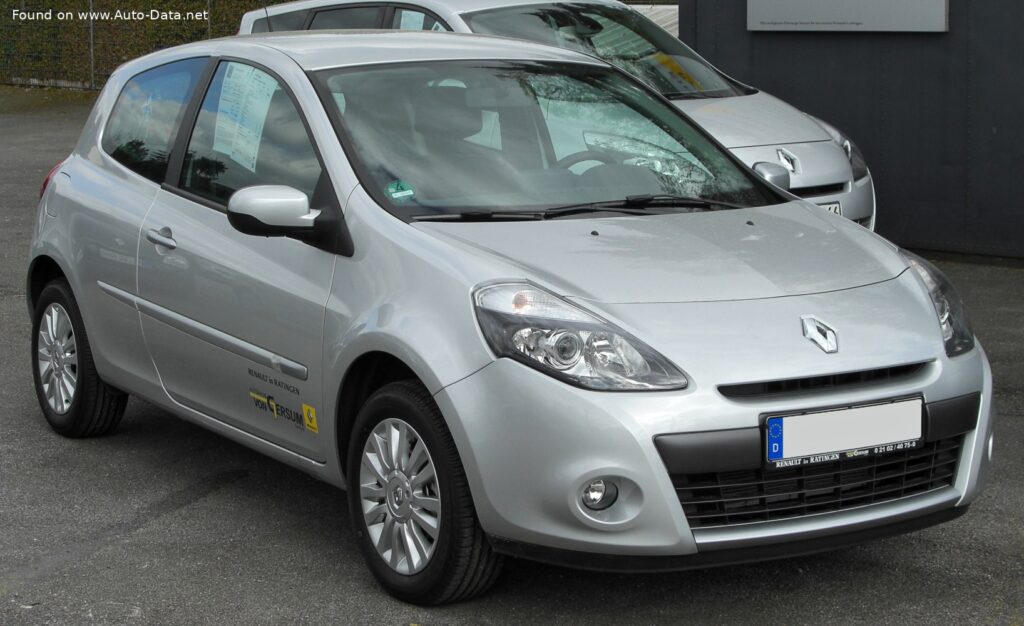
The Renault Clio, a cornerstone of the European supermini segment, has long been celebrated for its blend of style, practicality, and driving dynamics. The third generation, known internally as the Clio III, continued this legacy, and its mid-cycle refresh, or Phase II, introduced in 2009, brought a series of enhancements to maintain its competitive edge. This article specifically delves into the Renault Clio III (Phase II, 2009) 3-door 1.2 16V (75 Hp), a popular variant produced from October 2010 to November 2012. Positioned as an accessible and efficient option within the Clio lineup, this 3-door hatchback catered primarily to urban drivers, young families, and those seeking a compact yet capable daily driver in markets across Europe and beyond. While never officially sold in the United States, the Clio III represents a significant chapter in the global automotive landscape, embodying the design and engineering philosophies prevalent in European compact cars of its era.
The Clio III Phase II built upon the solid foundation of its predecessor, which had already earned the prestigious European Car of the Year award in 2006. The facelift aimed to modernize its aesthetic, improve interior quality, and refine its powertrain options. The 1.2 16V (75 Hp) model, a staple of the Clio range, offered a compelling balance of fuel economy and sufficient performance for its intended purpose, making it a volume seller and a familiar sight on European roads. Its front-wheel-drive architecture and compact dimensions underscored its design as an agile and maneuverable vehicle, perfect for navigating congested city streets and tight parking spaces.
Powertrain & Engine Architecture
At the heart of this particular Renault Clio III (Phase II, 2009) 3-door 1.2 16V (75 Hp) model is a compact yet robust 1.2-liter (1149 cm3 or 70.12 cu. in.) naturally aspirated inline-four gasoline engine. Coded as D4F 706 or D4F 740, this engine is configured with a Double Overhead Camshaft (DOHC) valvetrain and 16 valves (four per cylinder), which is quite sophisticated for a small displacement engine of its time. It employs a multi-port manifold injection fuel system, ensuring efficient fuel delivery and combustion.
This powerplant generates a peak output of 75 horsepower (Hp) at 5500 rpm, translating to a power-per-liter rating of 65.3 Hp/l. Torque stands at 107 Newton-meters (78.92 lb.-ft.) delivered at a relatively accessible 4250 rpm. These figures, while not designed for blistering acceleration, are perfectly adequate for the Clio’s role as an urban commuter and light highway cruiser. The vehicle achieves a 0 to 60 mph acceleration in a respectable 12.7 seconds (0-100 km/h in 13.4 seconds), with a maximum speed of 103.77 mph (167 km/h).
Power is sent to the front wheels via a smooth-shifting 5-speed manual transmission, optimizing driver engagement and control. The engine’s transverse layout and front-wheel-drive architecture contribute to a well-balanced and predictable driving experience. In terms of efficiency, the Clio III 1.2 16V achieved a combined NEDC fuel consumption rating of 5.8 liters per 100 kilometers, which translates to an impressive 40.6 US miles per gallon. Urban consumption was rated at 7.6 l/100 km (30.9 US mpg), while extra-urban driving saw figures as low as 4.9 l/100 km (48 US mpg). With CO2 emissions of 135 g/km, this model met the stringent Euro 5 emission standard, reflecting Renault’s commitment to environmental responsibility even in its entry-level offerings. The engine oil capacity is 4 liters (4.23 US quarts), and the coolant system holds 5 liters (5.28 US quarts).
Driving Characteristics
The 1.2 16V engine in the Clio III Phase II delivers a driving experience geared towards efficiency and ease of use rather than outright performance. Compared to higher-output versions of the Clio III, such as those equipped with the 1.6 16V engine, the 1.2 feels noticeably less powerful, particularly when accelerating onto highways or overtaking. However, within the urban environment, the engine provides sufficient torque for navigating city streets and maintaining a comfortable pace. The 5-speed manual transmission is well-matched to the engine’s characteristics, allowing drivers to keep the engine in its optimal power band. The gear ratios are relatively short, aiding in acceleration from low speeds, but this also means that engine speeds are higher at cruising speeds, potentially contributing to increased noise levels.
Compared to diesel variants like the 1.5 dCi, the 1.2 16V offers a smoother and quieter driving experience, albeit with less low-end torque. The diesel engine excels in fuel economy, but the gasoline engine provides a more responsive and linear power delivery. The overall driving experience is characterized by light steering, a comfortable ride, and predictable handling, making it an ideal choice for novice drivers or those seeking a stress-free commute.
Equipment & Trim Levels
The Renault Clio III (Phase II) 3-door 1.2 16V typically came equipped with a reasonable level of standard features, positioning it as an entry-level to mid-range offering within the Clio lineup. Standard equipment generally included electric front windows, power steering, an adjustable steering column, a basic audio system with CD player, and ABS with Electronic Brakeforce Distribution (EBD). Safety features such as driver and passenger airbags were also standard. Interior upholstery was typically cloth, with a relatively simple dashboard design.
Optional extras available for this trim level included air conditioning, alloy wheels, a trip computer, rear electric windows, and a more advanced audio system with MP3 compatibility. Higher trim levels, such as the Campus or Dynamique, offered additional features like automatic headlights, rain-sensing wipers, and cruise control. The 3-door configuration often appealed to buyers seeking a sportier aesthetic, and it was frequently chosen by younger drivers.
Chassis & Braking
The Clio III 1.2 16V utilizes a front suspension system consisting of independent McPherson struts with coil springs and an anti-roll bar. This setup provides a good balance between ride comfort and handling precision. The rear suspension employs a torsion beam configuration, which is a cost-effective and space-efficient solution commonly found in compact cars. This arrangement contributes to a stable and predictable ride, although it doesn’t offer the same level of sophistication as a fully independent rear suspension.
Braking is handled by 260×22 mm ventilated discs at the front and 203 mm drums at the rear. While the front discs provide adequate stopping power, the rear drums are a cost-saving measure that can exhibit reduced performance in demanding braking situations. The car rode on a choice of tire sizes, including 165/65 R15, 185/60 R15, or 195/50 R16, mounted on wheel rims sized 5.5J x 15, 6J x 15, or 6.5J x 16 respectively. The ABS system helps to prevent wheel lockup during braking, enhancing stability and control.
Market Reception & Comparison
Critics generally viewed the Renault Clio III (Phase II) 1.2 16V as a competent and practical supermini, praising its fuel efficiency, comfortable ride, and attractive styling. However, the engine was often criticized for its lack of outright power, particularly when compared to some of its rivals. Fuel economy was a strong point, consistently achieving figures in line with Renault’s claims. Reliability was generally considered to be good, although some owners reported minor issues with the electrical system.
Compared to other trims in the Clio lineup, the 1.2 16V offered the most affordable entry point, making it an attractive option for budget-conscious buyers. The 1.6 16V provided more performance but came at a higher price. The diesel variants offered superior fuel economy but were typically more expensive to purchase and maintain. Against competitors like the Volkswagen Polo and Ford Fiesta, the Clio III 1.2 16V offered a compelling value proposition, particularly in terms of standard equipment and styling.
Technical Specifications
| Category | Specification |
| General Information | |
| Brand | Renault |
| Model | Clio |
| Generation | Clio III (Phase II, 2009) 3-door |
| Engine Type | 1.2 16V (75 Hp) |
| Production Start | October, 2010 |
| Production End | November, 2012 |
| Powertrain Architecture | Internal Combustion Engine |
| Body Type | Hatchback |
| Seats | 5 |
| Doors | 3 |
| Performance Specifications | |
| Fuel Consumption (Urban, NEDC) | 7.6 l/100 km |
| Fuel Consumption (Extra Urban, NEDC) | 4.9 l/100 km |
| Fuel Consumption (Combined, NEDC) | 5.8 l/100 km |
| CO2 Emissions (NEDC) | 135 g/km |
| Fuel Type | Petrol (Gasoline) |
| Acceleration 0 – 60 mph | 12.7 sec |
| Acceleration 0 – 100 km/h | 13.4 sec |
| Maximum Speed | 167 km/h |
| Emission Standard | Euro 5 |
| Engine Specifications | |
| Power | 75 Hp @ 5500 rpm |
| Power per liter | 65.3 Hp/l |
| Torque | 107 Nm @ 4250 rpm |
| Engine Layout | Front, Transverse |
| Engine Model/Code | D4F 706, D4F 740 |
| Engine Displacement | 1149 cm3 |
| Number of Cylinders | 4 |
| Engine Configuration | Inline |
| Cylinder Bore | 69 mm |
| Piston Stroke | 76.8 mm |
| Compression Ratio | 9.8:1 |
| Valves per Cylinder | 4 |
| Fuel Injection System | Multi-port manifold injection |
| Engine Aspiration | Naturally aspirated |
| Valvetrain | DOHC |
| Engine Oil Capacity | 4 l |
| Coolant Capacity | 5 l |
| Space, Volume and Weights | |
| Kerb Weight | 1055-1057 kg |
| Trunk (Boot) Space – Minimum | 288 l |
| Trunk (Boot) Space – Maximum | 1038 l |
| Fuel Tank Capacity | 55 l |
| Dimensions | |
| Length | 4032 mm |
| Width | 1720 mm |
| Height | 1497 mm |
| Wheelbase | 2575 mm |
| Drivetrain, Brakes and Suspension | |
| Drivetrain Architecture | Front-wheel drive, Internal Combustion Engine |
| Front Brakes | Ventilated discs, 260×22 mm |
| Rear Brakes | Drum, 203 mm |
Legacy
The Renault Clio III (Phase II) 3-door 1.2 16V remains a relatively common sight on European roads, demonstrating its durability and reliability. The D4F engine, while not known for being particularly groundbreaking, is generally considered to be a robust and long-lasting unit, provided it receives regular maintenance. In the used car market, this variant represents an affordable and economical option for buyers seeking a practical and reliable supermini. Its low running costs and readily available spare parts contribute to its continued appeal. While it may not offer the performance or refinement of more modern vehicles, the Clio III 1.2 16V remains a testament to Renault’s ability to produce well-rounded and dependable compact cars.