
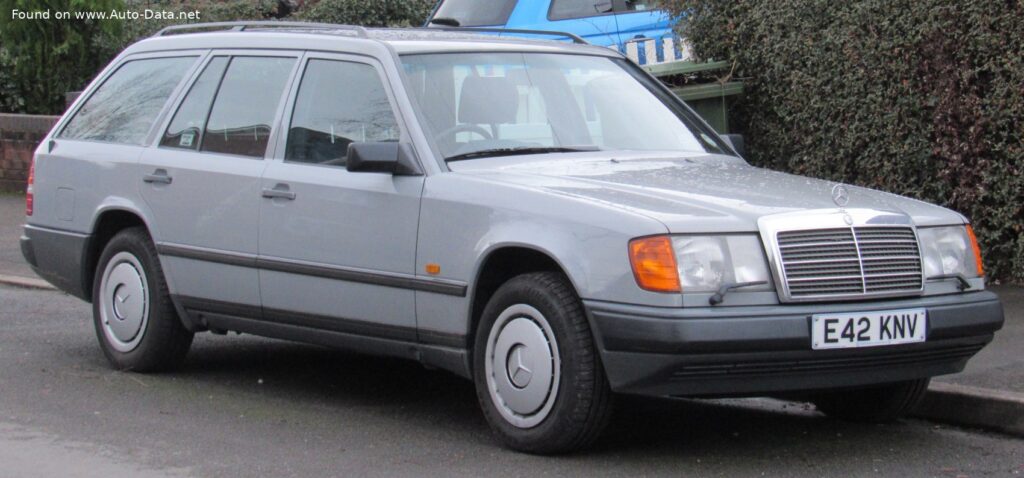
The Mercedes-Benz S124 230 TE (136 Hp) Automatic represents a significant chapter in the history of premium executive automobiles, embodying the renowned build quality and engineering prowess for which the German marque is celebrated. As part of the iconic W124 generation, the S124 chassis code specifically denotes the station wagon (or estate) variant, which commenced production in April 1985 and concluded in August 1989 for this particular iteration. This vehicle quickly established itself as a benchmark in its segment, offering an unparalleled blend of practicality, comfort, safety, and durability.
In its primary European market, the S124 230 TE was a popular choice for discerning families and professionals who required the versatility of a wagon without compromising on luxury or driving refinement. While not as commonly imported to the United States as its sedan counterpart, the S124 generation as a whole gained a formidable reputation globally for its “over-engineered” characteristics, promising longevity and robustness rarely seen in modern vehicles. The 230 TE variant, with its 2.3-liter inline-four engine and automatic transmission, offered a balanced proposition of adequate power for comfortable cruising and reasonable efficiency, making it a highly practical and desirable vehicle for its era.
Powertrain & Engine Architecture
At the heart of the Mercedes-Benz S124 230 TE lies the M 102 E 23 engine, specifically coded as 102.982. This naturally aspirated, 2.3-liter (2299 cm³ or 140.29 cu. in.) inline-four gasoline engine was a stalwart of Mercedes-Benz’s powertrain lineup during the 1980s. Featuring a Single Overhead Camshaft (SOHC) valvetrain with two valves per cylinder, it was designed for smooth operation and reliability. Fuel delivery was managed by a multi-port manifold injection system, ensuring precise fuel metering and combustion efficiency for its time.
The engine produced a respectable 136 horsepower at 5100 rpm, complemented by a solid 151.2 lb.-ft. of torque peaking at 3500 rpm. These figures, while not indicative of a sports car, were more than sufficient to propel the S124 230 TE with composure and confidence. Power was channeled to the rear wheels via a 4-speed automatic transmission, a common and reliable setup for Mercedes-Benz during this period. This drivetrain architecture contributed to the car’s balanced handling characteristics and comfortable ride. The transmission itself was a robust unit, designed for smooth shifts and long-term durability, though it lacked the overdrive gear found in some later automatic transmissions.
Performance figures for the S124 230 TE highlight its character as a competent cruiser. It could accelerate from 0 to 60 mph in a brisk 9.9 seconds and achieve a top speed of 114.95 mph. Fuel economy, while not a primary selling point for luxury vehicles of its time, was reasonable, with an estimated urban consumption of 20.3 US mpg and an extra-urban figure of 29.4 US mpg. The 72-liter (19.02 US gallon) fuel tank provided an ample cruising range, underscoring its capabilities as a long-distance tourer.
Driving Characteristics
The S124 230 TE Automatic offered a distinctly different driving experience compared to its manual transmission counterparts or higher-output siblings like the 260E or 300E. The 4-speed automatic, while providing convenience, resulted in slightly slower acceleration and a less engaging driving feel. The gear ratios were optimized for comfortable cruising rather than spirited performance. The automatic transmission also introduced a slight power loss compared to the manual, as some energy was consumed within the torque converter. However, for drivers prioritizing ease of use and relaxed long-distance travel, the automatic was the preferred choice. Compared to the more powerful 260E or 300E, the 230 TE felt less strained during highway passing maneuvers, but lacked the outright acceleration of those models. The 230 TE’s power delivery was smooth and linear, making it predictable and easy to control in various driving conditions.
Equipment & Trim Levels
The S124 230 TE was positioned as a mid-range offering within the W124 wagon lineup. Standard equipment included power windows, central locking, a sunroof, and a high-quality stereo system. The interior typically featured cloth upholstery, although leather was available as an optional extra. The dashboard layout was classic Mercedes-Benz, with clear analog gauges and logically arranged controls. Optional extras included automatic climate control, heated seats, and a more advanced audio system. The wagon-specific features, such as the self-leveling rear suspension (often included), were highly valued for maintaining a consistent ride height even when the vehicle was heavily loaded. The rear cargo area was typically covered by a retractable parcel shelf and featured tie-down points for securing luggage. A rear-facing jump seat was available, increasing seating capacity to seven, though it was best suited for short journeys.
Chassis & Braking
The S124 230 TE benefited from Mercedes-Benz’s renowned engineering in its chassis and braking systems. The front suspension utilized independent wishbones with coil springs and shock absorbers, providing a comfortable and controlled ride. The rear suspension employed Mercedes-Benz’s pioneering independent multi-link suspension, which minimized body roll and maximized tire contact with the road. This system was a significant advancement over traditional rear suspensions and contributed to the S124’s exceptional handling characteristics. Braking was handled by ventilated discs at the front and solid discs at the rear, offering confident stopping power. Hydraulic power steering with a cone worm and recirculation balls mechanism ensured effortless maneuverability. Stabilizer bars were fitted to both the front and rear axles to further reduce body roll during cornering. The weight distribution was carefully balanced to enhance stability and handling.
Market Reception & Comparison
Critics generally praised the S124 230 TE for its blend of practicality, comfort, and build quality. While the 136 hp engine wasn’t considered particularly powerful, it was deemed adequate for most driving situations. The automatic transmission was appreciated for its smoothness and ease of use, although some reviewers noted that it could feel slightly sluggish at times. Fuel economy was considered reasonable for a vehicle of its size and class. Compared to other trims in the S124 lineup, the 230 TE offered a more affordable entry point into the W124 range, making it attractive to buyers who didn’t require the extra performance of the 260E or 300E. Reliability was a major strength of the 230 TE, with many owners reporting few major mechanical issues even after many years of service. The 230 TE’s relatively simple engine design also made it easier and less expensive to maintain compared to the more complex engines found in higher-end models.
Technical Specifications
| Category | Specification |
| General Information | |
| Brand | Mercedes-Benz |
| Model | W124 |
| Generation | S124 |
| Type (Engine) | 230 TE (136 Hp) Automatic |
| Start of Production | April, 1985 |
| End of Production | August, 1989 |
| Powertrain Architecture | Internal Combustion engine |
| Body Type | Station wagon (estate) |
| Seats | 5 |
| Doors | 5 |
| Performance Specs | |
| Fuel Consumption (Urban) | 11.6 l/100 km (20.3 US mpg) |
| Fuel Consumption (Extra Urban) | 8 l/100 km (29.4 US mpg) |
| Fuel Type | Petrol (Gasoline) |
| Acceleration 0 – 60 mph | 9.9 sec |
| Acceleration 0 – 62 mph (0 – 100 km/h) | 10.4 sec |
| Maximum Speed | 185 km/h (114.95 mph) |
| Weight-to-Power Ratio | 10.3 kg/Hp (97.1 Hp/tonne) |
| Weight-to-Torque Ratio | 6.8 kg/Nm (146.4 Nm/tonne) |
| Engine Specs | |
| Power | 136 Hp @ 5100 rpm |
| Power per Liter | 59.2 Hp/l |
| Torque | 205 Nm @ 3500 rpm (151.2 lb.-ft. @ 3500 rpm) |
| Engine Layout | Front, Longitudinal |
| Engine Model/Code | M 102 E 23 / 102.982 |
| Engine Displacement | 2299 cm³ (2.3 liters / 140.29 cu. in.) |
| Number of Cylinders | 4 |
| Engine Configuration | Inline |
| Cylinder Bore | 95.5 mm (3.76 in.) |
| Piston Stroke | 80.25 mm (3.16 in.) |
| Compression Ratio | 9:1 |
| Number of Valves per Cylinder | 2 |
| Fuel Injection System | Multi-port manifold injection |
| Engine Aspiration | Naturally aspirated engine |
| Valvetrain | SOHC |
| Engine Oil Capacity | 4.5 l (4.76 US qt) |
| Coolant Capacity | 8.5 l (8.98 US qt) |
| Space, Volume and Weights | |
| Kerb Weight | 1400 kg (3086.47 lbs.) |
| Max. Weight (Gross Weight) | 1740 kg (3836.04 lbs.) |
| Max Load | 340 kg (749.57 lbs.) |
| Fuel Tank Capacity | 72 l (19.02 US gal) |
| Dimensions | |
| Length | 4765 mm (187.6 in.) |
| Width | 1740 mm (68.5 in.) |
| Height | 1490 mm (58.66 in.) |
| Wheelbase | 2800 mm (110.24 in.) |
| Front Track | 1497 mm (58.94 in.) |
| Rear (Back) Track | 1488 mm (58.58 in.) |
| Drivetrain, Brakes and Suspension Specs | |
| Drivetrain Architecture | Internal combustion engine (ICE) drives the rear wheels. |
| Drive Wheel | Rear wheel drive |
| Number of Gears and Type of Gearbox | 4 gears, automatic transmission |
| Front Suspension | Wishbone |
| Rear Suspension | Independent multi-link suspension |
| Front Brakes | Ventilated discs |
| Rear Brakes | Disc |
| Steering Type | Cone worm with recirculation balls |
| Power Steering | Hydraulic Steering |
| Tires Size (Front/Rear) | 195/65 R15 |
| Wheel Rims Size (Front/Rear) | 6.5J x 15 |
Legacy
The Mercedes-Benz S124 230 TE, and indeed the entire W124 series, left an indelible mark on the automotive landscape. It is widely regarded as one of the last truly “over-engineered” Mercedes-Benz vehicles, built to an uncompromising standard of quality and durability that has cemented its reputation among enthusiasts and collectors. Its robust construction meant that many examples have withstood the test of time, often accumulating hundreds of thousands of miles with proper maintenance. The M102 engine, in particular, is known for its longevity and relative simplicity.
In the used car market today, the S124 230 TE remains a desirable classic. Well-maintained examples command a premium, and the car’s reputation for reliability ensures continued demand. While parts availability can be a concern for some older Mercedes-Benz models, many components for the W124 are still readily available, making ownership relatively straightforward. The 230 TE’s blend of classic Mercedes-Benz styling, practical utility, and the promise of many more years of service makes it appealing to those who appreciate solid engineering over fleeting trends. Its enduring appeal is a testament to the era when Mercedes-Benz built cars that were designed to last a lifetime, solidifying the Mercedes-Benz S124 230 TE’s place as a cherished classic and a symbol of automotive excellence.
