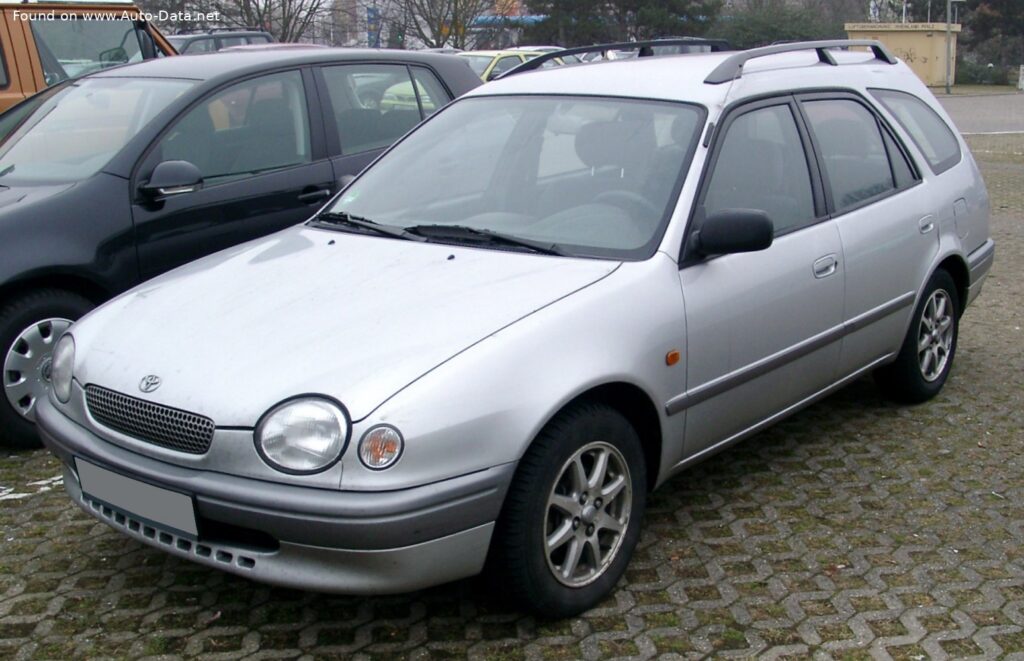
The Toyota Corolla, a name synonymous with reliability and practicality across the globe, entered its eighth generation (E110) in 1995. While many markets, particularly North America, primarily saw the sedan and hatchback variants with gasoline engines, the European and Asian markets benefited from a broader range of body styles and powertrain options, including the highly practical station wagon. This detailed examination focuses on a specific, market-tailored variant: the Toyota Corolla Wagon VIII (E110) 2.0 D (72 Hp). Produced between 1997 and 1999, this model represented Toyota’s commitment to offering efficient and durable diesel power in a compact, family-friendly package, a common and highly valued configuration in its primary markets.
The E110 generation of the Corolla, often referred to as the “G9” in some regions, built upon the solid foundation of its predecessors, emphasizing fuel efficiency, robustness, and a user-friendly driving experience. The 2.0 D variant, with its naturally aspirated diesel engine, was designed not for blistering performance, but for economical daily driving, long-distance comfort, and impressive cargo utility, making it a popular choice for families and businesses alike in regions where diesel fuel was prevalent and economically advantageous. This article will delve into its technical specifications, design philosophy, and its enduring legacy within the global automotive landscape, utilizing American English terminology for clarity.
The Robust 2.0 D Powertrain of the Toyota Corolla Wagon VIII (E110)
At the heart of the Toyota Corolla Wagon VIII (E110) 2.0 D (72 Hp) was the venerable 2C engine, a 1975 cubic centimeter (approximately 2.0-liter) inline-four diesel unit. This engine was a testament to Toyota’s engineering philosophy of durability and straightforward mechanics. As a naturally aspirated engine, it delivered a modest but highly dependable 72 horsepower at 4600 revolutions per minute (rpm). Torque, often a more critical figure for diesel engines, stood at 96.62 pound-feet (131 Nm) available at a relatively low 2600 rpm. This low-end torque characteristic was ideal for city driving and hauling, ensuring that the wagon felt capable even when fully loaded.
The powertrain architecture featured a front, transverse engine layout driving the front wheels through a 5-speed manual transmission. This configuration was standard for compact vehicles of the era, balancing manufacturing cost with efficient packaging and reliable performance. While the acceleration figures might seem leisurely by modern standards—0 to 60 miles per hour in an estimated 13.7 seconds and a top speed of 102.53 mph (165 km/h)—they were perfectly adequate for the vehicle’s intended purpose as an economical family hauler. The focus was squarely on fuel efficiency and longevity.
Fuel economy was a major selling point for this diesel wagon. In urban driving conditions, it achieved approximately 27.4 US miles per gallon (8.6 liters per 100 km), while on the highway, it could reach an impressive 42 US mpg (5.6 liters per 100 km). These figures underscored its economic appeal, especially in European markets where diesel fuel was often cheaper and diesel engines were favored for their efficiency and lower CO2 emissions compared to equivalent gasoline engines of the time. The engine’s precombustion chamber injection system, coupled with an OHC (Overhead Camshaft) valvetrain with four valves per cylinder, contributed to its efficient combustion and relatively smooth operation for a naturally aspirated diesel of its vintage.
Driving Characteristics: A Focus on Economy and Utility
The Toyota Corolla Wagon VIII (E110) 2.0 D (72 Hp) was not designed for spirited driving. Its 72 horsepower and 96.62 lb-ft of torque delivered a predictable, if unexciting, driving experience. Acceleration was modest, and overtaking required careful planning. However, the engine’s low-end torque made it surprisingly capable in everyday driving situations, particularly when carrying a load. The 5-speed manual transmission allowed drivers to keep the engine in its optimal power band, maximizing fuel efficiency and minimizing strain.
Compared to other Corolla variants available at the time, such as the gasoline-powered 1.6L or 1.8L engines, the 2.0 D offered significantly different characteristics. The gasoline engines prioritized responsiveness and higher top speeds, while the diesel focused on fuel economy and low-speed pulling power. The diesel was also noticeably quieter than the gasoline engines at cruising speeds, though it exhibited more typical diesel clatter at idle. Compared to later turbodiesel versions of the Corolla, the 2.0 D lacked the extra surge of power provided by turbocharging, but it also benefited from a simpler, more robust design.
Equipment & Trim Levels: Practicality Over Luxury
The Corolla Wagon VIII (E110) 2.0 D was typically positioned as a mid-range offering within the Corolla wagon lineup. It wasn’t the base model, but it also lacked the premium features found on higher-spec trims. Standard equipment generally included power steering, central locking, electric windows, and an AM/FM radio. Safety features, such as an Anti-lock Braking System (ABS), were becoming increasingly common and were often included as standard or optional equipment.
Interior upholstery was typically a durable cloth material, designed to withstand the rigors of family use. The dashboard layout was functional and straightforward, with clearly labeled controls and a focus on ergonomics. Optional extras available for this trim could include air conditioning, a sunroof, upgraded audio systems, and alloy wheels. However, the emphasis remained on providing a practical and reliable vehicle rather than a luxurious one.
Chassis & Braking: A Solid and Dependable Foundation
The chassis of the Toyota Corolla Wagon VIII (E110) 2.0 D was based on a conventional front-engine, front-wheel-drive layout. The suspension system consisted of coil springs and shock absorbers at all four wheels, providing a comfortable ride quality without being overly soft. The front suspension utilized MacPherson struts, while the rear suspension employed a torsion beam setup. A stabilizer bar was fitted to the front suspension to reduce body roll during cornering.
The braking system utilized ventilated discs at the front and drum brakes at the rear. This configuration was typical for compact cars of the era and provided adequate stopping power for the vehicle’s weight and performance. The inclusion of ABS on many models further enhanced braking performance and safety. The steering system was a rack and pinion setup with hydraulic power assistance, offering a responsive and precise steering feel.
Market Reception & Comparison
Critics generally praised the Toyota Corolla Wagon VIII (E110) 2.0 D for its fuel efficiency, reliability, and practicality. While its performance was not particularly exciting, it was considered adequate for its intended purpose as an economical family hauler. The diesel engine was lauded for its durability and low running costs, making it a popular choice for high-mileage drivers.
Compared to other trims in the Corolla lineup, the 2.0 D offered superior fuel economy and low-speed torque, but it lacked the responsiveness and higher top speeds of the gasoline-powered variants. In terms of reliability, the 2.0 D engine was generally considered to be as dependable as its gasoline counterparts, if not more so, due to its simpler design. Against competitors like the Volkswagen Golf Variant and Ford Focus Wagon, the Corolla often stood out for its reputation for bulletproof reliability and lower long-term ownership costs.
Technical Specifications: Toyota Corolla Wagon VIII (E110) 2.0 D (72 Hp)
| General Information | |
| Brand | Toyota |
| Model | Corolla |
| Generation | Corolla Wagon VIII (E110) |
| Type (Engine) | 2.0 D (72 Hp) |
| Start of Production | 1997 year |
| End of Production | 1999 year |
| Powertrain Architecture | Internal Combustion engine |
| Body Type | Station wagon (estate) |
| Seats | 5 |
| Doors | 5 |
| Performance Specifications | |
| Fuel Consumption (Economy) – Urban | 8.6 l/100 km (27.4 US mpg) |
| Fuel Consumption (Economy) – Extra Urban | 5.6 l/100 km (42 US mpg) |
| Fuel Type | Diesel |
| Acceleration 0 – 60 mph | 13.7 sec (Calculated) |
| Maximum Speed | 102.53 mph (165 km/h) |
| Weight-to-Power Ratio | 16.3 kg/Hp, 61.3 Hp/tonne |
| Weight-to-Torque Ratio | 9 kg/Nm, 111.5 Nm/tonne |
| Engine Specifications | |
| Power | 72 Hp @ 4600 rpm |
| Power per Liter | 36.5 Hp/l |
| Torque | 96.62 lb.-ft. (131 Nm) @ 2600 rpm |
| Engine Layout | Front, Transverse |
| Engine Model/Code | 2C |
| Engine Displacement | 1975 cm3 (120.52 cu. in. / 2.0 l) |
| Number of Cylinders | 4 |
| Engine Configuration | Inline |
| Cylinder Bore | 3.39 in. (86 mm) |
| Piston Stroke | 3.35 in. (85 mm) |
| Compression Ratio | 23:1 |
| Number of Valves per Cylinder | 4 |
| Fuel Injection System | Precombustion chamber injection |
| Engine Aspiration | Naturally aspirated engine |
| Valvetrain | OHC |
| Engine Oil Capacity | 5.1 l (5.39 US qt) |
| Coolant Capacity | 7.3 l (7.71 US qt) |
| Space, Volume, and Weights | |
| Kerb Weight | 2590.43 lbs. (1175 kg) |
| Max. Weight (Gross Vehicle Weight) | 3714.79 lbs. (1685 kg) |
| Max Load Capacity | 1124.36 lbs. (510 kg) |
| Trunk (Boot) Space – Minimum | 10.88 cu. ft. (308 l) |
| Trunk (Boot) Space – Maximum | 43.01 cu. ft. (1218 l) |
| Fuel Tank Capacity | 13.21 US gal (50 l) |
| Dimensions | |
| Length | 170.08 in. (4320 mm) |
| Width | 66.54 in. (1690 mm) |
| Height | 56.89 in. (1445 mm) |
| Wheelbase | 97.05 in. (2465 mm) |
| Front Track | 57.48 in. (1460 mm) |
| Rear (Back) Track | 57.09 in. (1450 mm) |
| Drivetrain, Brakes, and Suspension Specifications | |
| Drivetrain Architecture | The Internal combustion engine (ICE) drives the front wheels of the vehicle. |
| Drive Wheel | Front wheel drive |
| Number of Gears and Type of Gearbox | 5 gears, manual transmission |
| Front Suspension | Coil spring |
| Rear Suspension | Coil spring |
| Front Brakes | Ventilated discs |
| Rear Brakes | Drum |
| Assisting Systems | ABS (Anti-lock braking system) |
| Steering Type | Steering rack and pinion |
| Power Steering | Hydraulic Steering |
| Tires Size | 165/70 R14 |
Legacy
The Toyota Corolla Wagon VIII (E110) 2.0 D (72 Hp) holds a significant place in the history of the Corolla, particularly in markets outside of North America. While the US market largely favored gasoline engines and, eventually, SUVs over station wagons, the diesel-powered E110 wagon was a highly competitive and popular offering in Europe, Asia, and other regions. Its primary appeal stemmed from Toyota’s legendary reputation for reliability and durability, which was further amplified by the robust and long-lasting nature of its 2C diesel engine.
Today, these wagons are increasingly sought after by enthusiasts and collectors who appreciate their simplicity, reliability, and practicality. The 2C diesel engine, while not a powerhouse, is known for its longevity and relatively low maintenance costs. Well-maintained examples can still provide years of reliable service, making them a viable option for those seeking an economical and dependable vehicle. The E110 Corolla Wagon 2.0 D remains a testament to Toyota’s commitment to building cars that simply last.