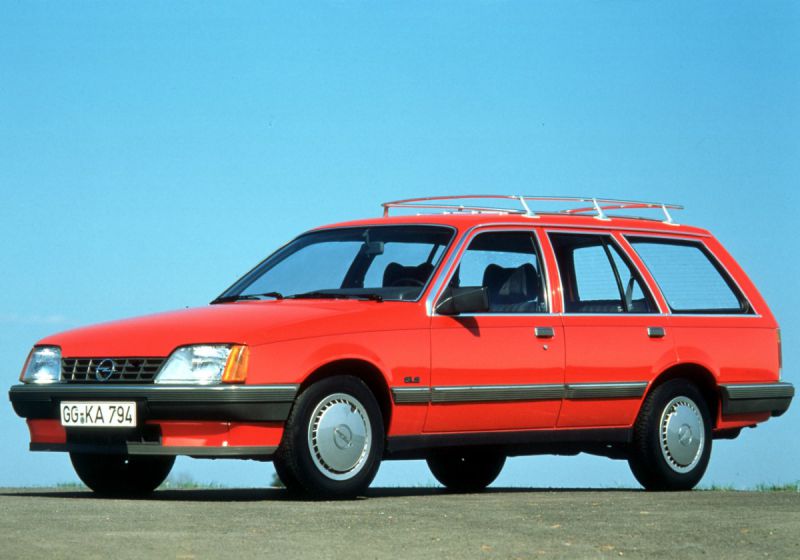
The Opel Rekord E Caravan (facelift 1982) 1.8 E CAT (100 Hp) Automatic represents a significant chapter in European automotive history, embodying the practical and robust mid-size family car ethos of the 1980s. Produced by the German automaker Opel, a subsidiary of General Motors, the Rekord series was a long-standing staple on European roads, known for its reliability, spaciousness, and straightforward engineering. The E generation, launched in 1977, received a notable facelift in 1982, which modernized its aesthetics and brought technical refinements. The specific variant under review, manufactured between August 1985 and August 1986, is powered by a 1.8-liter gasoline engine equipped with a catalytic converter (CAT) and paired with a 3-speed automatic transmission, highlighting Opel’s commitment to evolving emissions standards and driver convenience in its primary European markets.
While the Opel Rekord was never officially sold in the United States under its own badge during this era, its design and engineering principles mirrored those of many contemporary GM vehicles globally. In Europe, the Rekord E Caravan served a crucial role, catering to families, small businesses, and fleet operators who required a dependable, spacious, and economical station wagon. This article delves into the specifics of this particular model, exploring its mechanical underpinnings, design philosophy, performance characteristics, and its enduring legacy as a quintessential European workhorse.
Powertrain & Engine Architecture
Engine Configuration
At the core of this Opel Rekord E Caravan lies the C18NV engine, a 1.8-liter (1796 cm3 or 109.6 cubic inches) inline-four gasoline unit. This naturally aspirated powerplant features a Single Overhead Camshaft (SOHC) valvetrain with two valves per cylinder, a common and reliable configuration for mass-market vehicles of its time. Fuel delivery is managed by a multi-port manifold injection system, a step up from older carburetor designs, offering improved fuel efficiency and smoother operation. The “CAT” in its designation signifies the inclusion of a catalytic converter, a crucial component for reducing harmful exhaust emissions, indicating Opel’s forward-thinking approach to environmental regulations in the mid-1980s.
The engine generates a respectable 100 horsepower at 5800 rpm, translating to a power-per-liter output of 55.7 HP/l. Torque peaks at 140 Newton-meters (103.26 lb.-ft.) at a relatively low 3000 rpm, providing a good amount of pulling power for everyday driving and hauling duties. This torque delivery profile, characteristic of a naturally aspirated engine designed for practicality, ensured sufficient responsiveness without needing to rev the engine excessively.
Transmission and Drivetrain
Power is transmitted to the rear wheels via a 3-speed automatic transmission. While a 3-speed automatic might seem rudimentary by today’s standards, it was a common and convenient option in the 1980s, particularly for family cars and those prioritizing ease of driving over ultimate performance or fuel economy. The rear-wheel-drive architecture, a hallmark of traditional Opel sedans and wagons, contributed to a balanced weight distribution and predictable handling characteristics, especially when carrying heavy loads. This setup also offered robust durability, a key selling point for a vehicle often used for demanding tasks.
Performance Metrics and Fuel Economy
Given its role as a practical family station wagon rather than a sports car, the performance figures for the Opel Rekord E Caravan are entirely adequate for its segment. The vehicle accelerates from 0 to 60 mph in a calculated 14.7 seconds (0-100 km/h in 15.5 seconds), with a top speed of 103.77 mph (167 km/h). These figures reflect its design priority for comfortable cruising and utility.
Fuel economy, an important consideration for European buyers, is rated at 10.1 liters per 100 kilometers in a combined cycle, which translates to approximately 23.3 US miles per gallon. With a generous 18.49 US gallon (70-liter) fuel tank capacity, the Rekord E Caravan offered a commendable cruising range, reducing the frequency of fuel stops during long journeys. The vehicle’s kerb weight of 2601.45 lbs (1180 kg) contributes to a weight-to-power ratio of 11.8 kg/Hp, underscoring its solid, utilitarian build.
Design and Features
Body Type and Dimensions
The Opel Rekord E Caravan is a classic 5-door, 5-seat station wagon (or “estate” in European parlance). This body style was immensely popular in Europe for its versatility, offering the practicality of a large cargo area combined with comfortable seating for five occupants. The facelifted E generation, introduced in 1982, brought subtle but effective styling updates. These typically included revised front grilles, updated headlamp and taillamp designs, and restyled bumpers, all aimed at giving the car a more contemporary appearance while retaining its familiar, conservative lines.
Dimensionally, the Rekord E Caravan measures 184.17 inches (4678 mm) in length, 67.72 inches (1720 mm) in width, and 58.07 inches (1475 mm) in height. Its wheelbase of 105.04 inches (2668 mm) provided a stable ride and contributed significantly to the spacious interior. The considerable rear overhang was specifically designed to maximize cargo volume, a crucial aspect for a station wagon. With a maximum load capacity of 1300.73 lbs (590 kg) and the ability to tow up to 2866.01 lbs (1300 kg) with brakes, the Rekord E Caravan was a true workhorse, capable of handling substantial cargo and trailer duties.
Chassis and Braking
The vehicle featured a conventional chassis setup for its era, designed for comfort and durability. The front brakes were ventilated discs, offering superior stopping power and heat dissipation compared to solid discs, a common feature for the front axle of vehicles in this class. The rear axle utilized drum brakes, a cost-effective and reliable solution for the rear of a family car. This combination provided adequate braking performance for the vehicle’s weight and capabilities. The minimum turning circle of 35.43 feet (10.8 m) indicates decent maneuverability for a car of its size, a practical consideration for urban driving and parking.
Interior features, while not explicitly detailed in the data, would have focused on practicality and durability. Expect robust fabric upholstery, straightforward instrumentation, and functional controls. The station wagon body ensured excellent visibility and ease of access to the cargo area, often featuring a large tailgate for convenient loading and unloading.
Opel Rekord E Caravan 1.8 E CAT Automatic: Variant Positioning
The 1.8 E CAT Automatic variant occupied a mid-range position within the Rekord E lineup. It was positioned above the base models with smaller engines (typically 1.6-liter units) and below the more powerful and often more expensive versions, such as those equipped with the 2.0-liter or 2.2-liter engines. This trim level targeted buyers who desired a balance of performance, fuel economy, and convenience. The automatic transmission was a key feature appealing to drivers prioritizing ease of use, particularly in urban environments. Compared to the manual transmission versions of the 1.8 E CAT, the automatic offered a more relaxed driving experience, albeit with a slight reduction in fuel efficiency and acceleration.
Maintenance on the 1.8 E CAT Automatic was generally straightforward, reflecting the Rekord E’s reputation for robust engineering. The SOHC engine and 3-speed automatic transmission were relatively simple to service, making it an attractive option for owners who preferred to handle basic maintenance themselves or sought lower repair costs. However, the catalytic converter added a layer of complexity and potential expense to exhaust system repairs. Compared to the higher-output engines, the 1.8 E CAT generally required less frequent and less intensive maintenance, making it a cost-effective choice for long-term ownership.
Market Reception & Comparison
Critics generally viewed the 1.8L Automatic Rekord E Caravan as a competent and practical family car. While not lauded for its performance, it was praised for its spaciousness, comfortable ride, and reasonable fuel economy. The automatic transmission was seen as a positive feature for many buyers, enhancing the car’s ease of driving. However, some reviewers noted that the 3-speed automatic could feel somewhat dated compared to more modern transmissions, particularly when accelerating or climbing hills.
In terms of fuel economy, the 1.8 E CAT Automatic offered competitive figures for its time, generally comparable to other mid-size station wagons in its class. Reliability was a strong point, with the Rekord E series known for its durability. However, like many cars of its era, it was susceptible to rust, particularly in regions with harsh winters or coastal environments. Compared to the manual transmission versions, the automatic typically saw slightly lower fuel economy, but the convenience factor often outweighed this drawback for many buyers.
Technical Specifications
| General Information | BrandOpel |
| Model | Rekord |
| Generation | Rekord E Caravan (facelift 1982) |
| Type (Engine) | 1.8 E CAT (100 Hp) Automatic |
| Start of Production | August, 1985 |
| End of Production | August, 1986 |
| Powertrain Architecture | Internal Combustion engine |
| Body type | Station wagon (estate) |
| Seats | 5 |
| Doors | 5 |
| Performance Specs | Fuel consumption (economy) – combined23.3 US mpg (10.1 l/100 km) |
| Fuel Type | Petrol (Gasoline) |
| Acceleration 0 – 60 mph | 14.7 sec |
| Acceleration 0 – 100 km/h | 15.5 sec |
| Maximum speed | 103.77 mph (167 km/h) |
| Weight-to-power ratio | 11.8 kg/Hp, 84.7 Hp/tonne |
| Weight-to-torque ratio | 8.4 kg/Nm, 118.6 Nm/tonne |
| Engine Specs | Power100 Hp @ 5800 rpm. |
| Power per liter | 55.7 Hp/l |
| Torque | 103.26 lb.-ft. (140 Nm) @ 3000 rpm. |
| Engine Model/Code | C18NV |
| Engine displacement | 109.6 cu. in. (1796 cm3) |
| Number of cylinders | 4 |
| Engine configuration | Inline |
| Cylinder Bore | 3.34 in. (84.8 mm) |
| Piston Stroke | 3.13 in. (79.5 mm) |
| Compression ratio | 8.9:1 |
| Number of valves per cylinder | 2 |
| Fuel injection system | Multi-port manifold injection |
| Engine aspiration | Naturally aspirated engine |
| Valvetrain | SOHC |
| Engine oil capacity | 3.17 US qt (3 l) |
| Coolant | 7.93 US qt (7.5 l) |
| Space, Volume and Weights | Kerb Weight2601.45 lbs (1180 kg) |
| Max. weight | 3902.18 lbs (1770 kg) |
| Max load | 1300.73 lbs (590 kg) |
| Fuel tank capacity | 18.49 US gal (70 l) |
| Permitted trailer load with brakes (12%) | 2866.01 lbs (1300 kg) |
| Permitted trailer load without brakes | 1179.47 lbs (535 kg) |
| Dimensions | Length184.17 in. (4678 mm) |
| Width | 67.72 in. (1720 mm) |
| Height | 58.07 in. (1475 mm) |
| Wheelbase | 105.04 in. (2668 mm) |
| Front track | 56.5 in. (1435 mm) |
| Rear (Back) track | 56.38 in. (1432 mm) |
| Ride height (ground clearance) | 5.51 in. (140 mm) |
| Minimum turning circle (turning diameter) | 35.43 ft. (10.8 m) |
| Drivetrain, Brakes and Suspension Specs | Drivetrain ArchitectureThe Internal combustion engine (ICE) drives the rear wheels of the vehicle. |
| Drive wheel | Rear wheel drive |
| Number of gears and type of gearbox | 3 gears, automatic transmission |
| Front brakes | Ventilated discs |
| Rear brakes | Drum |
Legacy
The Opel Rekord E Caravan, particularly the 1.8 E CAT Automatic variant, has proven to be a surprisingly durable vehicle. Many examples are still found today, often well-maintained by enthusiasts who appreciate their simplicity and reliability. The C18NV engine, while not a powerhouse, is known for its longevity and relatively low maintenance requirements. The 3-speed automatic transmission, while dated, is also generally reliable if properly serviced.
In the used car market, these Rekord E Caravans are often sought after by collectors and those looking for a classic European vehicle. Prices vary depending on condition, mileage, and originality, but well-preserved examples can command a reasonable premium. The car’s enduring appeal lies in its representation of a bygone era of automotive engineering, a time when cars were built to last and designed to serve the practical needs of everyday drivers. Its status as a classic continues to grow, ensuring that the Opel Rekord E Caravan will remain a cherished part of automotive history for years to come.