
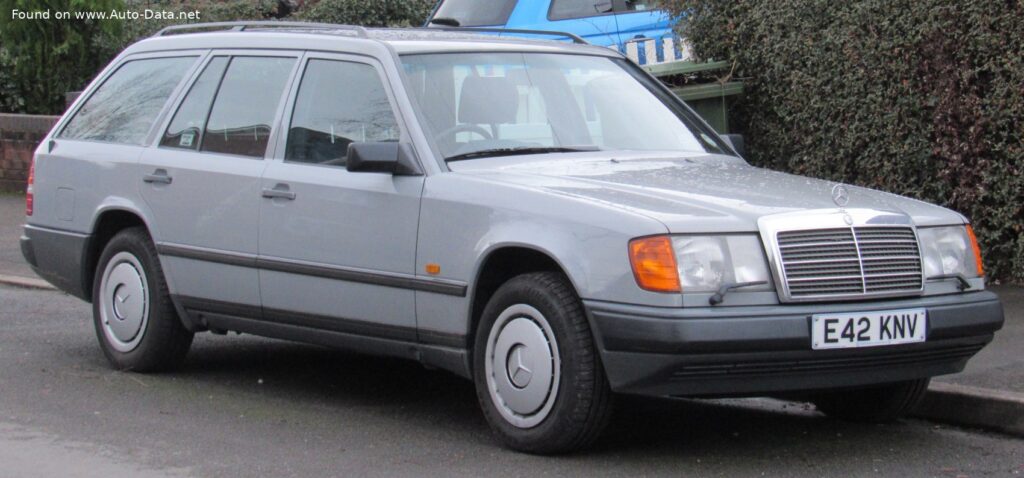
The Mercedes-Benz S124 250 TD (90 Hp) represents a significant chapter in the history of the German automotive giant, particularly within the esteemed W124 generation. Introduced in June 1985, this model was the station wagon (estate) variant of Mercedes-Benz’s executive car lineup, renowned for its exceptional build quality, engineering prowess, and understated elegance. While the W124 series enjoyed global recognition, the S124 250 TD, with its robust diesel powertrain, found its primary market and true calling in Europe, where its efficiency, durability, and practical utility made it an indispensable workhorse and a comfortable family hauler. It quickly established itself as a benchmark for luxury and reliability in the mid-size segment, embodying the brand’s commitment to longevity and driver satisfaction during its production run, which concluded in February 1989.
The W124 Legacy and the Mercedes-Benz S124 250 TD (90 Hp) in its Market Segment
The W124 series, often considered by many enthusiasts and experts as the last “over-engineered” Mercedes-Benz, was a successor to the W123 and set new standards for safety, aerodynamics, and structural integrity. The S124, or ‘T-Modell’ as it was known in Germany, extended these virtues into a highly practical and spacious station wagon form. The Mercedes-Benz S124 250 TD (90 Hp), specifically, was positioned for buyers who valued fuel economy, long-distance comfort, and uncompromising reliability over outright speed. In the competitive European market of the mid-to-late 1980s, it vied for attention against rivals like the BMW 5 Series Touring and the Audi 100 Avant, distinguishing itself with its unique blend of traditional Mercedes-Benz luxury, diesel frugality, and class-leading cargo capacity. Its rear-wheel-drive powertrain architecture, coupled with a sophisticated suspension system, ensured a comfortable and stable ride, a hallmark of the brand.
Powertrain & Engine Architecture
At the heart of the Mercedes-Benz S124 250 TD (90 Hp) lay the legendary OM 602 D 25 diesel engine, an inline five-cylinder, naturally aspirated unit celebrated for its almost indestructible nature. With an engine displacement of 2,497 cubic centimeters (152.38 cu. in.), this powerplant delivered a modest but highly dependable 90 horsepower at 4,600 rpm. Torque output stood at 154 Newton-meters (113.58 lb.-ft.) available at a relatively low 2,800 rpm, providing ample pulling power for everyday driving and heavy loads, a critical attribute for a station wagon.
The OM 602 featured a SOHC (Single Overhead Camshaft) valvetrain and utilized a precombustion chamber injection system, a common and robust diesel technology of the era known for its smooth operation and reliability. With a high compression ratio of 22:1, the engine was designed for maximum efficiency and longevity. The fuel injection system was mechanical, relying on a Bosch inline plunger pump. This system, while not as sophisticated as later electronic diesel injection systems, was known for its simplicity and durability. The engine block was constructed from cast iron, contributing to its exceptional strength and heat dissipation. The 5-speed manual transmission, a common pairing for this engine, was a robust unit designed to handle the diesel torque. An optional 4-speed automatic transmission was also available, though it was less common and generally considered less durable than the manual.
Driving Characteristics
The S124 250 TD with the 90 hp engine and manual transmission wasn’t designed for spirited performance. Acceleration was leisurely, with 0-60 mph taking approximately 16.7 seconds. However, the engine’s torque characteristics made it surprisingly capable for everyday driving, particularly when carrying a load. The gear ratios in the 5-speed manual were well-spaced, allowing the driver to keep the engine in its optimal power band. The automatic transmission, while offering convenience, noticeably dulled performance due to its less efficient torque converter and wider gear spacing. Compared to the higher-output 250E gasoline variant, the 250 TD offered significantly less horsepower but a substantial increase in fuel economy and low-end torque. The 300TD, with its larger six-cylinder diesel, provided more power but at the expense of fuel efficiency and increased complexity. The 250 TD struck a balance between these extremes, appealing to drivers who prioritized practicality and economy.
Equipment & Trim Levels
The S124 250 TD (90 Hp) was generally positioned as a mid-range offering within the W124 estate lineup. Standard equipment included cloth upholstery, power steering, central locking, and a basic radio. Higher trim levels, often denoted by additional options packages, added features such as leather upholstery, electric windows, a sunroof, and upgraded audio systems. Air conditioning was a popular option, particularly in warmer climates. The dashboard layout was typical of Mercedes-Benz at the time, featuring a functional and ergonomic design with clearly labeled controls. Interior color schemes were generally conservative, with shades of gray, beige, and blue being the most common. Optional extras included a rear window wiper, a tow hitch, and various alloy wheel designs.
Chassis & Braking
The S124 250 TD utilized a robust chassis designed for comfort and stability. The front suspension featured independent wishbones with coil springs and shock absorbers, while the rear suspension employed a multi-link independent setup, a significant advancement for its time. This rear suspension design minimized body roll and provided a smooth ride even when the vehicle was heavily loaded. Braking was initially provided by disc brakes on all four wheels, although some earlier models may have featured drum brakes on the rear. Anti-lock brakes (ABS) were available as an option, and became increasingly common as production progressed. The steering system was a hydraulic power-assisted recirculating ball system, offering a balance of precision and ease of use. Stabilizer bars were fitted to both the front and rear axles to further reduce body roll during cornering. The tires were typically 195/65 R15, providing a good compromise between comfort and handling.
Market Reception & Comparison
Critics generally praised the Mercedes-Benz S124 250 TD (90 Hp) for its build quality, reliability, and fuel economy. While its performance was not considered exciting, it was deemed adequate for its intended purpose. The diesel engine’s longevity and low running costs were particularly appreciated. Compared to the gasoline-powered W124 variants, the 250 TD offered significantly better fuel economy, making it a popular choice for long-distance drivers. However, the gasoline engines provided more power and a smoother driving experience. Against competitors like the BMW 5 Series Touring and Audi 100 Avant, the S124 250 TD distinguished itself with its robust diesel engine and reputation for unwavering reliability. The BMW offered a sportier driving experience, while the Audi boasted innovative all-wheel drive technology. However, the Mercedes-Benz consistently ranked highly in reliability surveys and was known for its ability to withstand years of hard use.
Technical Specifications
| General Information | |
| Brand | Mercedes-Benz |
| Model | W124 |
| Generation | S124 |
| Type (Engine) | 250 TD (90 Hp) |
| Start of Production | June, 1985 |
| End of Production | February, 1989 |
| Powertrain Architecture | Internal Combustion engine |
| Body Type | Station wagon (estate) |
| Seats | 5 |
| Doors | 5 |
| Performance Specifications | |
| Fuel Consumption (Urban) | 9.5 l/100 km (24.8 US mpg) |
| Fuel Consumption (Extra Urban) | 5.8 l/100 km (40.6 US mpg) |
| Fuel Type | Diesel |
| Acceleration 0 – 60 mph | 16.7 sec |
| Maximum Speed | 165 km/h (102.53 mph) |
| Weight-to-Power Ratio | 16 kg/Hp (62.5 Hp/tonne) |
| Weight-to-Torque Ratio | 9.4 kg/Nm (106.9 Nm/tonne) |
| Engine Specifications | |
| Power | 90 Hp @ 4600 rpm |
| Power per Liter | 36 Hp/l |
| Torque | 154 Nm @ 2800 rpm (113.58 lb.-ft. @ 2800 rpm) |
| Engine Layout | Front, Longitudinal |
| Engine Model/Code | OM 602 D 25 / 602.912 |
| Engine Displacement | 2497 cm3 (152.38 cu. in.) |
| Number of Cylinders | 5 |
| Engine Configuration | Inline |
| Cylinder Bore | 87 mm (3.43 in.) |
| Piston Stroke | 84 mm (3.31 in.) |
| Compression Ratio | 22:1 |
| Number of Valves per Cylinder | 2 |
| Fuel Injection System | Precombustion chamber injection |
| Engine Aspiration | Naturally aspirated engine |
| Valvetrain | SOHC |
| Engine Oil Capacity | 7 l (7.4 US qt) |
| Coolant Capacity | 9.5 l (10.04 US qt) |
| Space, Volume and Weights | |
| Kerb Weight | 1440 kg (3174.66 lbs.) |
| Max. Weight | 2060 kg (4541.52 lbs.) |
| Max Load | 620 kg (1366.87 lbs.) |
| Fuel Tank Capacity | 72 l (19.02 US gal) |
| Dimensions | |
| Length | 4765 mm (187.6 in.) |
| Width | 1740 mm (68.5 in.) |
| Height | 1490 mm (58.66 in.) |
| Wheelbase | 2800 mm (110.24 in.) |
| Front Track | 1497 mm (58.94 in.) |
| Rear (Back) Track | 1488 mm (58.58 in.) |
| Drivetrain, Brakes and Suspension Specifications | |
| Drivetrain Architecture | The Internal combustion engine (ICE) drives the rear wheels of the vehicle. |
| Drive Wheel | Rear wheel drive |
| Number of Gears and Type of Gearbox | 5 gears, manual transmission |
| Front Suspension | Wishbone |
| Rear Suspension | Independent multi-link suspension |
| Front Brakes | Disc |
| Rear Brakes | Disc |
| Steering Type | Cone worm with recirculation balls |
| Power Steering | Hydraulic Steering |
| Tires Size | Front: 195/65 R15, Rear: 195/65 R15 |
| Wheel Rims Size | Front: 6.5J x 15, Rear: 6.5J x 15 |
Legacy
The Mercedes-Benz S124 250 TD (90 Hp), like the entire W124 range, has achieved legendary status in the automotive world. Its reputation for bulletproof reliability, exceptional build quality, and enduring design has made it a highly sought-after classic, particularly in Europe where many examples continue to serve faithfully today. These vehicles were designed to cover hundreds of thousands of miles with minimal fuss, a testament to Mercedes-Benz’s engineering principles of the era. The OM 602 engine, in particular, is renowned for its longevity, with many examples exceeding 500,000 kilometers (310,000 miles) without major overhaul.
In the used car market today, well-maintained S124 250 TD models command respectable prices, reflecting their increasing rarity and the appreciation for their mechanical honesty and timeless design. While finding a truly pristine example can be challenging, the S124 250 TD remains a compelling choice for enthusiasts and those seeking a durable, comfortable, and economical classic station wagon. Its enduring appeal is a testament to the fact that a well-engineered vehicle, built to last, can continue to provide years of reliable service and enjoyment.
