
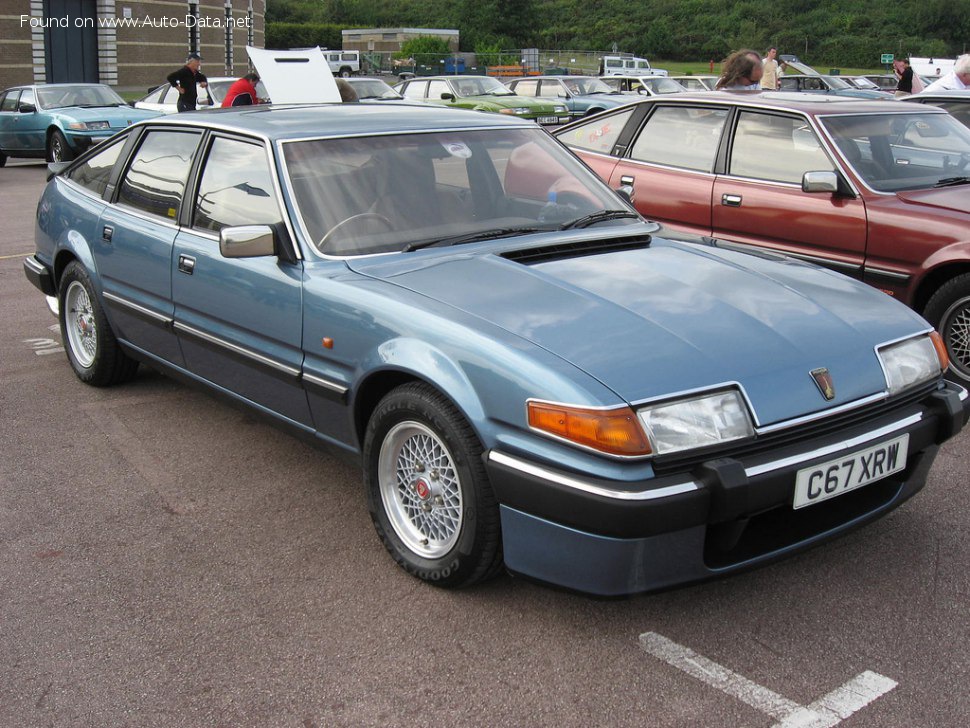
The Rover 2000-3500 Hatchback (SD1) 3500 (156 Hp) represents a pivotal and often controversial chapter in the history of the British automotive industry. Launched in 1976, the SD1 (Specialist Division 1) was Rover’s ambitious attempt to redefine the executive car segment, combining striking Italianate styling with traditional British engineering, most notably the venerable Rover V8 engine. While never officially sold in the United States, the SD1 garnered significant attention in its primary European markets for its bold design and impressive performance, offering a compelling alternative to established German rivals.
Produced from 1976 to 1986, the SD1 was a radical departure for Rover, replacing the more traditional P6 sedan. Its most distinctive feature was its five-door hatchback body style, a highly unusual choice for an executive vehicle at the time, which traditionally favored three-box sedans. This design philosophy aimed to blend the practicality of a hatchback with the luxury and performance expected of a premium car. The 3500 variant, powered by the potent 3.5-liter V8, stood as the flagship model, embodying Rover’s aspirations for performance and sophistication. Despite its innovative design and initial accolades, the SD1’s journey was fraught with challenges, reflecting the turbulent industrial landscape of British Leyland during its production run.
The Rover SD1 3500: Engineering and Performance
At the heart of the Rover 2000-3500 Hatchback (SD1) 3500 was its legendary 3.5-liter (215 cubic inch) V8 engine. This all-aluminum powerplant, originally designed by Buick in the late 1950s, had been acquired and significantly refined by Rover, becoming a cornerstone of their performance models for decades. In its naturally aspirated form for the SD1 3500, it produced a robust 156 horsepower. This output, while not astronomical by today’s standards, was highly competitive for a family-oriented executive car in the mid-1970s.
The V8 engine delivered its power smoothly and with a characteristic burble, providing excellent torque across the rev range. This translated into respectable performance figures for its era: the SD1 3500 could accelerate from 0 to 60 mph in a swift 8.9 seconds and achieve a top speed of 126.14 mph (203 km/h). These numbers placed it firmly in contention with its German counterparts, offering a distinctly British blend of refinement and potency. The engine’s lightweight aluminum construction contributed to a favorable power-to-weight ratio and improved handling dynamics.
The powertrain architecture of the SD1 was conventional for its class, featuring an internal combustion engine mounted longitudinally, driving the rear wheels. This layout provided balanced weight distribution and the classic driving feel favored by enthusiasts. The car’s suspension system, designed for a blend of comfort and handling, allowed the SD1 to cruise effortlessly on highways while maintaining composure on twisty roads. The generous engine oil capacity of 5.5 liters (5.81 US quarts) and a substantial coolant capacity of 11 liters (11.62 US quarts) underscored the engine’s robust design, built for sustained performance.
Transmission and Drivetrain
The SD1 3500 was typically equipped with a Borg-Warner DG automatic transmission, a three-speed unit known for its durability. While not particularly sophisticated by modern standards, it was well-suited to the V8’s torque characteristics, providing smooth and relatively quick shifts. A four-speed manual transmission was also available, but the automatic was by far the more popular choice, particularly in the executive car segment. The rear axle featured a limited-slip differential on some models, enhancing traction and stability during spirited driving. The overall drivetrain was designed for comfortable, long-distance cruising, prioritizing refinement over outright sportiness.
Design & Features: A Visionary Hatchback
The design of the Rover SD1 was arguably its most striking attribute and a major talking point upon its launch. Penned by David Bache, the car’s chief designer, the SD1 drew inspiration from exotic sports cars of the era, most notably the Ferrari Daytona and even elements of the original Range Rover. The result was a sleek, aerodynamic profile that eschewed the boxy designs prevalent in the 1970s. Its clean lines, expansive glasshouse, and distinctive front-end treatment gave it a futuristic appearance that stood out in any parking lot.
The decision to adopt a five-door hatchback body type for an executive car was a bold move by Rover. While common in smaller family cars, it was almost unheard of in the executive segment. This design offered unparalleled practicality, with a large, easily accessible cargo area that rivaled many station wagons, while maintaining a sophisticated silhouette. With seating for five occupants, the SD1 promised both luxury and utility.
Inside, the SD1’s cabin was spacious and driver-focused, though its design was sometimes considered eccentric. The dashboard featured a distinct pod-like instrument binnacle, and early models were notable for a somewhat austere interior finish, which improved over the production run. Features typical for an executive car of the period included comfortable seating, power steering, and often power windows and central locking on higher trims like the 3500. Safety, by 1970s standards, included robust body construction and seatbelts for all occupants, along with disc brakes on the front for effective stopping power. The overall design language, both inside and out, aimed to project an image of modernity and efficiency, setting it apart from its more conservative competitors.
Trim Levels and Equipment
The SD1 3500 typically represented the highest trim level available. Standard features included plush velour upholstery, wood veneer trim on the dashboard and door panels, and a comprehensive instrument cluster. Optional extras included leather upholstery, air conditioning, a sunroof, and a premium sound system. The 3500 also benefited from additional sound insulation and upgraded suspension components compared to lower-spec models. The SD1’s interior, while initially criticized for its somewhat dated design, was gradually refined throughout the production run, with later models featuring improved materials and a more cohesive aesthetic.
Chassis & Braking
The SD1 3500 utilized a conventional body-on-frame construction, which, while robust, contributed to its relatively high weight. The suspension consisted of independent double wishbones at the front and a live axle with trailing arms at the rear. Disc brakes were fitted to the front wheels, while the rear wheels typically featured drum brakes, although some later models received rear discs. Power-assisted steering was standard, providing a light and responsive feel. The chassis was tuned for a balance between comfort and handling, prioritizing a smooth ride over razor-sharp cornering. Stabilizer bars were fitted to both the front and rear axles to reduce body roll.
Market Reception & Comparison
Critics initially lauded the SD1 3500 for its striking design, powerful engine, and spacious interior. It was widely regarded as a worthy competitor to established German rivals such as the BMW 5 Series and Mercedes-Benz W123. However, the SD1’s reputation was quickly tarnished by reports of poor build quality and reliability issues. These problems, stemming from labor disputes and management challenges at British Leyland, led to inconsistent production standards and frequent mechanical failures. Compared to the more reliable German alternatives, the SD1 3500 suffered in terms of long-term ownership costs. Fuel economy, while respectable for a V8-powered car of its era, was also lower than that of its four-cylinder competitors. Despite these shortcomings, the SD1 3500 remained a popular choice for those seeking a stylish and powerful executive car with a distinctly British character.
Technical Specifications
| Category | Specification |
| Brand | Rover |
| Model | 2000-3500 Hatchback |
| Generation | 2000-3500 Hatchback (SD1) |
| Engine Type | 3500 (156 Hp) |
| Start of Production | 1976 |
| End of Production | 1986 |
| Powertrain Architecture | Internal Combustion engine |
| Body type | Hatchback |
| Seats | 5 |
| Doors | 5 |
| Fuel Type | Petrol (Gasoline) |
| Acceleration 0 – 60 mph | 8.9 sec |
| Acceleration 0 – 100 km/h | 9.2 sec |
| Maximum speed | 203 km/h (126.14 mph) |
| Power | 156 Hp |
| Engine aspiration | Naturally aspirated engine |
| Engine oil capacity | 5.5 l (5.81 US qt) |
| Coolant | 11 l (11.62 US qt) |
| Fuel tank capacity | 66 l (17.44 US gal) |
Legacy
The Rover SD1, particularly the 3500 V8 variant, holds a complex and enduring legacy in automotive history. Upon its launch, it was met with widespread critical acclaim, even earning the prestigious European Car of the Year award in 1977. Its innovative design and the performance offered by the V8 engine were genuinely groundbreaking for a car of its class. It challenged the established norms of executive car design and offered a distinct British alternative to the increasingly dominant German luxury sedans.
However, the SD1’s reputation was significantly marred by persistent issues related to build quality and reliability, largely stemming from the industrial unrest and financial woes plaguing British Leyland during its production years. These problems, unfortunately, overshadowed its many positive attributes and contributed to a perception of inconsistency. Despite these challenges, the SD1 remained in production for a decade, a testament to its fundamental appeal and the efforts made to improve it over time.
Today, the Rover SD1 is recognized as a classic, appreciated for its bold, futuristic design and the character of its V8 engine. It represents a fascinating period of British automotive ambition – a car that was ahead of its time in many respects, yet constrained by the industrial realities of its birth. It remains a cherished piece of automotive heritage, a symbol of what could have been, and a testament to a unique approach to the executive car segment. Its influence can still be seen in the subsequent adoption of hatchback or liftback designs by more mainstream executive cars decades later, proving the SD1’s visionary approach to practicality and style. In the used car market, well-maintained SD1 3500s are highly sought after by enthusiasts, commanding premium prices due to their rarity and iconic status. However, potential buyers should be prepared for ongoing maintenance and repair costs, as parts availability can be limited.
