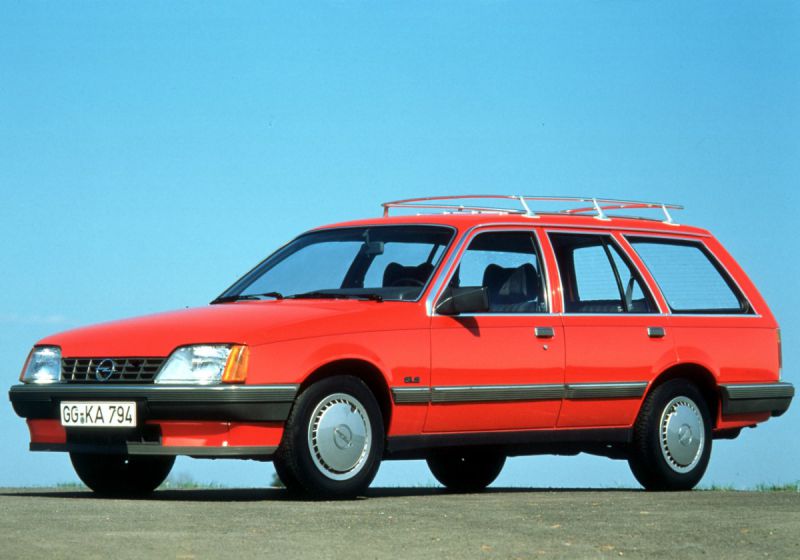
The Opel Rekord E Caravan, specifically the facelifted model introduced in September 1982, represents a significant chapter in European automotive history. As a prominent mid-size family station wagon (known as an “estate” in Europe), the Rekord E served as a dependable workhorse for countless families and businesses across the continent. Produced by the German automaker Opel, a subsidiary of General Motors, the Rekord line was renowned for its robust engineering, practical design, and affordability. The E generation, launched in 1977, received a notable refresh in 1982, bringing updated styling and revised powertrains to keep it competitive in a rapidly evolving market. This particular variant, the 1.8 S with its 90 horsepower engine and automatic transmission, offered a blend of sufficient power for the era and the convenience of an automatic gearbox, making it a popular choice for those prioritizing comfort and ease of driving over outright performance. While never officially sold in the United States, the Rekord E Caravan embodied the quintessential European family car of the early to mid-1980s, emphasizing cargo capacity, reliability, and straightforward mechanics.
The 1.8 S Automatic: Positioning and Role
The 1.8 S Automatic trim occupied a middle ground within the Rekord E Caravan lineup. It wasn’t the base model, which typically featured a smaller, less powerful engine, nor was it the top-of-the-range version with the larger 2.0 or 2.2-liter engines. Instead, it aimed to provide a balance between affordability, reasonable performance, and convenience. It was targeted towards families and individuals who needed a practical vehicle for everyday use, prioritizing comfort and ease of driving over sporty handling or rapid acceleration. The automatic transmission was a key selling point for this trim, appealing to drivers who preferred a less involved driving experience, particularly in congested urban areas.
Powertrain & Engine Architecture
Powering the Rekord E Caravan 1.8 S was the 18S engine, a 1,796 cubic centimeter (109.6 cubic inches) inline four-cylinder gasoline engine. This engine utilized a single overhead camshaft (SOHC) valvetrain with two valves per cylinder – a common and reliable configuration for the period. The engine produced 90 horsepower at 5,400 revolutions per minute and 143 Newton-meters (105.47 lb.-ft.) of torque between 3,000 and 3,400 rpm. Fuel delivery was handled by a two-barrel carburetor, specifically a Solex 32 PHN, which was typical for European vehicles of this era before the widespread adoption of fuel injection. The carburetor’s design focused on providing a consistent air-fuel mixture for reliable operation.
The engine was mated to a three-speed automatic transmission, designated the TH180. This transmission, sourced from General Motors, was known for its durability and relatively smooth operation. It featured a torque converter for smooth engagement and a conventional planetary gearset. The gear ratios were optimized for comfortable cruising and adequate acceleration, though not for outright performance. First gear was geared for initial acceleration, second for mid-range power, and third for highway cruising. The automatic transmission contributed to the Rekord’s ease of use, particularly in stop-and-go traffic.
Driving Characteristics
The driving experience in the Rekord E Caravan 1.8 S Automatic was characterized by comfort and ease. The 90 horsepower engine, while not particularly powerful by modern standards, provided sufficient power for typical driving conditions. Acceleration from 0 to 60 mph took approximately 15.7 seconds, and the top speed was around 100 mph (161 km/h). Compared to the manual transmission versions of the 1.8 S, the automatic offered a smoother, less engaging driving experience, but at the cost of some performance and fuel economy. The automatic transmission’s shift points were calibrated for comfort, resulting in a relaxed driving style. Compared to the higher-output 2.0 or 2.2-liter versions, the 1.8 S Automatic felt noticeably less responsive, particularly when accelerating or overtaking. However, the automatic transmission made it a more convenient option for drivers who prioritized ease of use over sporty performance.
The rear-wheel-drive layout provided predictable handling, although it wasn’t particularly agile. The suspension, consisting of MacPherson struts at the front and a live axle with trailing arms at the rear, offered a comfortable ride, absorbing bumps and imperfections in the road effectively. The steering was relatively light, making it easy to maneuver in urban environments.
Equipment & Trim Levels
The 1.8 S Automatic trim level came with a reasonable level of standard equipment for the early 1980s. Interior features typically included cloth upholstery, a basic instrument cluster with speedometer, fuel gauge, and temperature gauge, and a two-spoke steering wheel. The dashboard layout was functional and straightforward, prioritizing ease of use over aesthetics. Standard features also included a heater and defroster, and manually adjustable seats. Optional extras available for the 1.8 S Automatic included a sunroof, upgraded stereo system, power windows, and central locking. Higher trim levels offered more luxurious features, such as velour upholstery, woodgrain trim, and more advanced audio systems.
Chassis & Braking
The Rekord E Caravan featured a robust chassis designed to handle the demands of family transportation. The body was constructed using a monocoque design, providing a good balance of strength and weight. The front suspension utilized MacPherson struts, offering a comfortable ride and predictable handling. The rear suspension employed a live axle with trailing arms, which was a cost-effective and durable solution. Braking was accomplished via ventilated disc brakes at the front and drum brakes at the rear. This configuration was common for mid-range vehicles of the time. The braking system was hydraulically assisted, providing adequate stopping power for most driving conditions. Stabilizer bars were fitted to both the front and rear axles to reduce body roll during cornering.
Market Reception & Comparison
The Opel Rekord E Caravan 1.8 S Automatic was generally well-received by critics and consumers alike. It was praised for its practicality, reliability, and comfortable ride. However, some critics noted that the 1.8-liter engine was somewhat underpowered, particularly when the vehicle was fully loaded. Compared to the manual transmission versions, the automatic offered less fuel economy and slightly slower acceleration. However, the convenience of the automatic transmission was a significant draw for many buyers. In terms of fuel economy, the 1.8 S Automatic achieved around 26.1 US mpg combined, which was reasonable for a vehicle of its size and age. Reliability was a strong point, with the 18S engine and TH180 transmission proving to be durable and long-lasting.
Technical Specifications
| Category | Specification |
| Brand | Opel |
| Model | Rekord |
| Generation | Rekord E Caravan (facelift 1982) |
| Type (Engine) | 1.8 S (90 Hp) Automatic |
| Start of Production | September, 1982 |
| End of Production | August, 1986 |
| Powertrain Architecture | Internal Combustion engine |
| Body Type | Station wagon (estate) |
| Seats | 5 |
| Doors | 5 |
| Fuel Consumption (Combined) | 9 l/100 km |
| Fuel Type | Petrol (Gasoline) |
| Acceleration 0 – 60 mph | 15.7 sec |
| Maximum Speed | 161 km/h |
| Weight-to-Power Ratio | 12.8 kg/Hp |
| Engine Power | 90 Hp @ 5400 rpm |
| Engine Torque | 143 Nm @ 3000-3400 rpm |
| Engine Displacement | 1796 cm3 |
| Number of Cylinders | 4 |
| Fuel Injection System | Carburetor |
| Kerb Weight | 1150 kg |
| Fuel Tank Capacity | 70 l |
| Front Brakes | Ventilated discs |
| Rear Brakes | Drum |
Legacy
The Opel Rekord E Caravan 1.8 S Automatic has left a lasting legacy as a reliable and practical family car. The 18S engine and TH180 transmission proved to be durable and relatively easy to maintain, meaning many examples remained on the road for years after production ceased. In the used car market today, these vehicles are relatively rare, but well-maintained examples are sought after by enthusiasts and collectors. The Rekord E’s straightforward mechanics make it a relatively easy vehicle to work on for those with some mechanical aptitude. While not a particularly valuable classic car, the Rekord E Caravan 1.8 S Automatic represents a significant piece of European automotive history, embodying the values of practicality, reliability, and affordability that were so important to families in the 1980s.