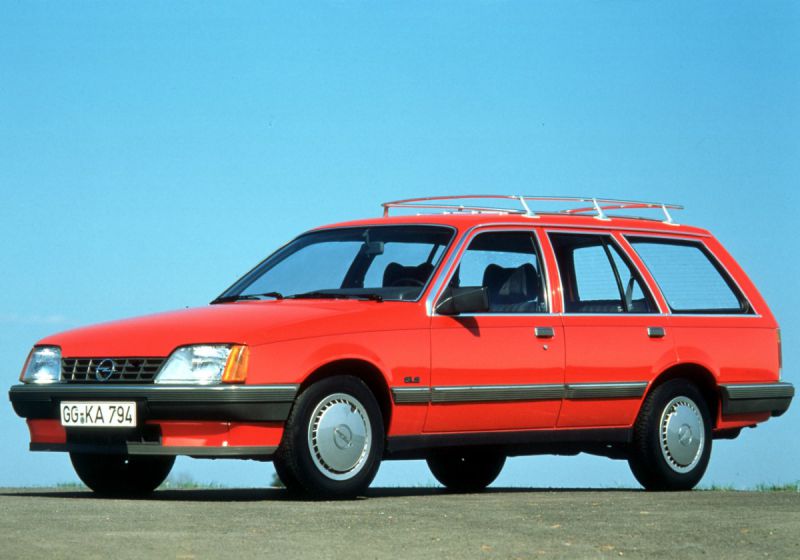
The Opel Rekord E Caravan (facelift 1982) 2.0 E (110 Hp) represents a significant iteration of a vehicle that was a true staple of the European automotive landscape for decades. Produced by the German automaker Opel, a subsidiary of General Motors at the time, the Rekord was a mid-size car that consistently offered practicality, reliability, and value. The E-generation, launched in 1977, received a notable facelift in September 1982, bringing updated styling and mechanical refinements that aimed to keep it competitive in a rapidly evolving market. This particular variant, the 2.0 E Caravan, was a five-door station wagon (often referred to as an “estate” in Europe), designed to cater to families and businesses requiring ample cargo space and robust performance without excessive cost. While never officially sold in the United States, the Rekord E played a crucial role in Opel’s strategy to dominate the European family car segment, providing a sensible and well-engineered alternative to domestic and other imported brands. Its blend of a straightforward, naturally aspirated engine, rear-wheel drive architecture, and functional design made it a common sight on European roads throughout the 1980s.
Powertrain & Engine Architecture
Under the hood of the Opel Rekord E Caravan (facelift 1982) 2.0 E (110 Hp) lay Opel’s venerable 2.0-liter “CIH” (Cam-In-Head) engine, specifically the 20E model. This inline four-cylinder powerplant, with an engine displacement of 1979 cubic centimeters (120.77 cubic inches), was a naturally aspirated unit known for its robust construction and relatively smooth power delivery. It featured a single overhead camshaft (SOHC) valvetrain with two valves per cylinder, a common and reliable configuration for the era.
Fueling was managed by a multi-port manifold injection system, a more advanced setup compared to the carbureted versions, contributing to improved efficiency and responsiveness. This system utilized mechanical fuel injection, a common technology for the time, delivering fuel directly to each intake port. The engine produced a respectable 110 horsepower at 5400 revolutions per minute, yielding a power per liter figure of 55.6 horsepower per liter. Torque output was equally solid for its class, peaking at 119.49 pound-feet (162 Nm) at a relatively low 3000 rpm. This meant that the Rekord offered good pulling power from low engine speeds, ideal for hauling passengers and cargo, or for relaxed cruising.
The 20E engine was known for its durability and relatively simple maintenance requirements. The CIH design, having been in production for many years, had benefited from continuous refinement and was considered a reliable unit. The engine’s compression ratio stood at 9.4:1, indicating a design focused on a balance of performance and compatibility with standard petrol (gasoline) fuels available in Europe. The engine was paired with a four-speed automatic transmission, a three-speed automatic was also available, offering a more convenient driving experience for those who preferred not to operate a manual gearbox.
Driving Characteristics
The Opel Rekord E Caravan 2.0 E with the automatic transmission offered a comfortable and relaxed driving experience. While not a performance-oriented vehicle, the 110 hp engine and automatic gearbox provided adequate power for everyday driving and highway cruising. The automatic transmission, while not offering the responsiveness of a manual, provided smooth gear changes and reduced driver fatigue, particularly in urban traffic. The gear ratios were optimized for fuel efficiency and relaxed cruising, with a relatively tall final drive ratio.
Compared to the manual transmission versions of the 2.0 E, the automatic variant experienced a slight reduction in acceleration due to the inherent power loss within the torque converter. However, this was often considered a worthwhile trade-off for the added convenience. Compared to the higher-output variants, such as the 2.2 E, the 2.0 E automatic felt less spirited, but it offered a better balance of performance and fuel economy. The rear-wheel-drive layout provided balanced handling, although it wasn’t as nimble as front-wheel-drive competitors. The suspension was tuned for comfort, absorbing bumps and providing a stable ride even when fully loaded.
Equipment & Trim Levels
The 2.0 E Caravan trim level sat in the mid-range of the Rekord E lineup. It offered a good balance of features and affordability, appealing to families and businesses seeking a practical and well-equipped vehicle. Standard equipment included cloth upholstery, a basic radio, and heated rear window. The interior featured a functional dashboard layout with clearly marked gauges and controls.
Optional extras available for the 2.0 E Caravan included a more powerful radio with cassette player, power windows, central locking, and a sunroof. Higher-end trim levels, such as the 2.2 E, offered additional features like leather upholstery, air conditioning, and alloy wheels. The Caravan body style itself was a key feature, providing a large cargo area accessible through the rear hatch. The rear seats could be folded down to further increase cargo capacity. The interior trim was generally durable and designed to withstand the rigors of family use.
Chassis & Braking
The Opel Rekord E Caravan 2.0 E featured a traditional body-on-frame construction, providing a robust and durable chassis. The suspension consisted of independent front suspension with MacPherson struts and a live rear axle with trailing arms. This setup provided a comfortable ride and good handling characteristics, although it wasn’t as sophisticated as some of its competitors. The steering was a recirculating ball system, offering a relatively direct feel.
Braking was handled by ventilated discs at the front and drum brakes at the rear. This was a common setup for cars of this era and provided adequate stopping power for most driving conditions. The braking system was not equipped with anti-lock brakes (ABS), which was not yet a widespread feature in the early 1980s. The wheels were typically steel rims with hubcaps, although alloy wheels were available as an optional extra. The stabilizer bar thickness was moderate, providing a balance between comfort and handling.
Market Reception & Comparison
The Opel Rekord E Caravan 2.0 E Automatic received generally positive reviews from automotive critics. It was praised for its practicality, reliability, and comfortable ride. Critics noted that the automatic transmission, while convenient, slightly diminished the car’s performance compared to the manual versions. Fuel economy was considered reasonable for a car of its size and engine displacement, averaging around 26.4 US miles per gallon in combined driving.
Compared to other trims in the Rekord E lineup, the 2.0 E Automatic offered a good balance of price and features. It was more affordable than the higher-output 2.2 E, but offered more power and refinement than the base 1.8 models. Compared to competitors like the Ford Granada and Volkswagen Passat, the Rekord E Caravan was often seen as a more practical and affordable option. Its rear-wheel-drive layout and robust construction were also seen as advantages by some buyers.
Technical Specifications
| Category | Specification |
| Brand | Opel |
| Model | Rekord E Caravan (facelift 1982) |
| Engine Type | 2.0 E (110 Hp) |
| Production Start | September, 1982 |
| Production End | August, 1984 |
| Powertrain Architecture | Internal Combustion Engine |
| Body Type | Station Wagon (Estate) |
| Seats | 5 |
| Doors | 5 |
| Fuel Consumption (Combined) | 8.9 l/100 km |
| Fuel Type | Petrol (Gasoline) |
| Acceleration 0-60 mph | 12.4 sec |
| Acceleration 0-100 km/h | 13 sec |
| Maximum Speed | 181 km/h (112.47 mph) |
| Power | 110 Hp @ 5400 rpm |
| Torque | 162 Nm @ 3000 rpm (119.49 lb.-ft. @ 3000 rpm) |
| Engine Displacement | 1979 cm3 (120.77 cu. in.) |
| Kerb Weight | 1150 kg (2535.32 lbs.) |
| Max. Weight | 1800 kg (3968.32 lbs.) |
| Fuel Tank Capacity | 70 l (18.49 US gal) |
| Minimum Turning Circle | 10.8 m (35.43 ft.) |
| Brakes (Front) | Ventilated discs |
| Brakes (Rear) | Drum |
Legacy
The Opel Rekord E Caravan 2.0 E Automatic, while not a particularly rare or collectible car today, remains a fondly remembered vehicle for those who owned or drove one in the 1980s. Its robust construction and relatively simple mechanicals contribute to its continued reliability, and many examples are still on the road today. The 2.0 E engine, in particular, is known for its durability and relatively low maintenance costs.
In the used car market, the Rekord E Caravan 2.0 E Automatic is typically available at affordable prices, making it an attractive option for those seeking a classic European car. However, finding well-maintained examples can be challenging, as many have suffered from neglect or corrosion over the years. Parts availability is generally good, although some specific trim pieces may be difficult to find. The Rekord E Caravan’s legacy is one of practicality, reliability, and a quiet competence that defined a generation of European family vehicles. It remains a testament to Opel’s engineering prowess and its commitment to providing sensible and well-engineered transportation.