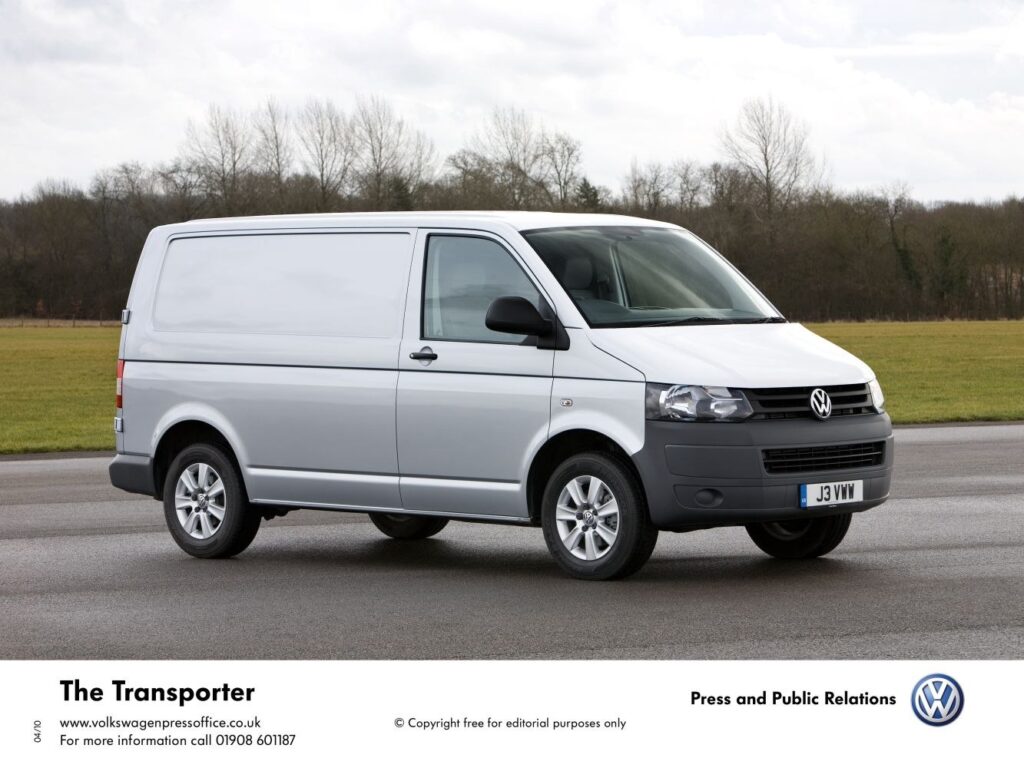
The Volkswagen Transporter (T5, facelift 2009) Panel Van represents a significant iteration of one of the most iconic and enduring commercial vehicle lines in automotive history. Introduced as a mid-cycle refresh for the fifth-generation Transporter (T5), this model, produced from 2009 to 2015, cemented its reputation as a versatile, reliable, and efficient light commercial vehicle across Europe and other international markets. While the Transporter series, known affectionately as the “Bus” or “Microbus” in earlier passenger iterations, has a cult following globally, this particular panel van variant, the 2.0 TDI (84 Hp) L2H1, was specifically engineered for utilitarian duties, prioritizing durability, cargo capacity, and fuel economy for businesses and tradespeople. It was not officially sold as a new vehicle in the United States, where Volkswagen’s commercial offerings differed, but its influence and engineering principles are globally recognized within the automotive industry.
The T5 facelift brought a refreshed aesthetic, enhanced powertrains, and updated interior technologies to an already successful platform. This particular configuration, the L2H1, denotes a long wheelbase (L2) and standard roof height (H1), offering a substantial cargo volume without compromising maneuverability excessively. The 2.0 TDI engine, even in its most modest 84 horsepower tune, was a testament to Volkswagen’s commitment to diesel efficiency and low-end torque, essential for a vehicle frequently loaded with goods and equipment. This article delves into the specifics of this work-oriented model, exploring its mechanical underpinnings, design philosophy, and its lasting impact on the global commercial vehicle landscape.
Powertrain & Engine Architecture
At the core of this particular Volkswagen Transporter (T5, facelift 2009) Panel Van variant lies the EA189 / CAAA 2.0-liter (1968 cm³) inline four-cylinder TDI (Turbocharged Direct Injection) diesel engine. This powerplant, a hallmark of Volkswagen’s engineering prowess in diesel technology, was designed for efficiency and robust, usable torque rather than outright speed. With an output of 84 horsepower at 3500 rpm and a substantial 220 Nm (162.26 lb.-ft.) of torque available across a broad range from 1250 to 2500 rpm, the engine delivers ample pulling power for daily commercial tasks. This low-rev torque characteristic is critical for a panel van, enabling confident acceleration from a standstill, especially when fully loaded, and reducing the need for frequent gear changes in urban driving.
The engine features a DOHC (Double Overhead Camshaft) valvetrain with 4 valves per cylinder, a common rail fuel injection system, and is boosted by a turbocharger and intercooler. This configuration ensures efficient combustion and a responsive power delivery despite the modest peak horsepower figure. Power is sent to the front wheels via a durable 5-speed manual transmission, a choice that underscores the vehicle’s utilitarian focus on driver engagement and cost-effective maintenance. The powertrain architecture is a front, transverse layout, contributing to optimized interior space and balanced weight distribution.
Driving Characteristics
The 84 hp 2.0 TDI engine paired with the 5-speed manual transmission in the T5 Panel Van delivers a driving experience geared towards practicality rather than performance. Acceleration is modest, with a 0-60 mph time of approximately 18.7 seconds, and a top speed of 90.72 mph (146 km/h). Compared to higher-output TDI variants (like the 140 hp or 180 hp versions) or even the gasoline-powered options available on the T5, this configuration feels noticeably slower, particularly when fully loaded. However, the engine’s strength lies in its low-end torque. The broad torque band allows for relaxed cruising and confident overtaking maneuvers once momentum is established. The 5-speed gearbox is well-matched to the engine’s characteristics, providing adequate spacing for efficient operation. The gear ratios are optimized for maximizing fuel economy and minimizing engine strain under load. The manual transmission also provides greater driver control compared to the optional automatic transmission, which was less common in this specific trim level and often criticized for its sluggish shifts.
Equipment & Trim Levels
The 2.0 TDI (84 Hp) L2H1 Panel Van was typically offered as a base-level trim, focusing on essential functionality. Standard equipment generally included a driver’s airbag, ABS (Anti-lock Braking System), hydraulic power steering, and a basic audio system. The interior upholstery was typically hard-wearing cloth, designed for durability rather than luxury. The dashboard layout was functional and straightforward, with logically placed controls. The floor was often covered in durable rubber or a similar material for easy cleaning. Optional extras included air conditioning, electric windows, central locking, a passenger airbag, and upgraded audio systems. Many fleet operators opted for minimal extras to keep costs down, while individual owners might choose to add comfort features as desired. The van typically featured steel wheels with hubcaps, although alloy wheels were available as an upgrade.
Chassis & Braking
The T5 Panel Van’s chassis was engineered to provide a balance of load-carrying capability and driving comfort. The front suspension utilized an independent McPherson strut setup with coil springs and an anti-roll bar, while the rear suspension employed an independent coil spring, transverse stabilizer, and trailing arm configuration. This setup provided a reasonably comfortable ride, even when the vehicle was heavily laden. Braking was handled by ventilated discs on all four wheels (front: 308×29.5 mm, rear: 294×22 mm), offering strong and consistent stopping power. The vehicle rode on 215/65 R16 tires mounted on 6.5J x 16 steel wheel rims, a practical choice for durability and cost. The rear drums were not standard on this configuration, as the ventilated discs were used on all four wheels.
Market Reception & Comparison
Critics generally viewed the 2.0 TDI (84 Hp) L2H1 variant of the T5 Panel Van as a sensible and practical choice for businesses prioritizing efficiency and reliability. While not the most exciting vehicle to drive, it offered a compelling combination of payload capacity, fuel economy (7.2-7.5 liters per 100 km / 31.4-32.7 US mpg), and low running costs. Compared to the higher-output TDI versions, this trim level was more affordable to purchase and maintain, although it sacrificed some performance. The 140 hp TDI, for example, offered significantly quicker acceleration and more effortless cruising, but at a higher price point and with slightly lower fuel economy. Compared to gasoline-powered T5s, the 2.0 TDI offered superior fuel efficiency and torque, making it a more suitable choice for heavy-duty applications. The T5’s reputation for build quality and durability also gave it an edge over some of its competitors, such as the Ford Transit, which was often perceived as being less refined.
Technical Specifications
| Category | Specification |
| General Information | |
| Brand | Volkswagen |
| Model | Transporter |
| Generation | Transporter (T5, facelift 2009) Panel Van |
| Type (Engine) | 2.0 TDI (84 Hp) L2H1 |
| Production Years | 2009 – 2015 |
| Body Type | Van |
| Seats | 2-3 |
| Doors | 4-5 |
| Performance Specs | |
| Fuel Consumption (Urban, NEDC) | 9.4-9.7 l/100 km (24.2 – 25 US mpg) |
| Fuel Consumption (Extra Urban, NEDC) | 6-6.3 l/100 km (37.3 – 39.2 US mpg) |
| Fuel Consumption (Combined, NEDC) | 7.2-7.5 l/100 km (31.4 – 32.7 US mpg) |
| CO2 Emissions (NEDC) | 190-198 g/km |
| Fuel Type | Diesel |
| Acceleration 0-62 mph (0-100 km/h) | 19.7 sec |
| Acceleration 0-60 mph (Calculated) | 18.7 sec |
| Maximum Speed | 146 km/h (90.72 mph) |
| Emission Standard | Euro 5 |
| Engine Specs | |
| Power | 84 Hp @ 3500 rpm |
| Torque | 220 Nm @ 1250-2500 rpm (162.26 lb.-ft. @ 1250-2500 rpm) |
| Engine Layout | Front, Transverse |
| Engine Model/Code | EA189 / CAAA |
| Engine Displacement | 1968 cm³ (120.09 cu. in.) |
| Number of Cylinders | 4 |
| Engine Configuration | Inline |
| Valves per Cylinder | 4 |
| Fuel Injection System | Diesel Commonrail |
| Engine Aspiration | Turbocharger, Intercooler |
| Valvetrain | DOHC |
| Space, Volume and Weights | |
| Kerb Weight | 1738-2182 kg (3831.63 – 4810.49 lbs.) |
| Max. Weight (GVWR) | 2800-3000 kg (6172.94 – 6613.87 lbs.) |
| Max Load | 818-1062 kg (1803.38 – 2341.31 lbs.) |
| Trunk (Boot) Space – Maximum | 6700 l (236.61 cu. ft.) |
| Fuel Tank Capacity | 80 l (21.13 US gal) |
| Dimensions | |
| Length | 5292 mm (208.35 in.) |
| Width | 1904 mm (74.96 in.) |
| Height | 1990 mm (78.35 in.) |
| Wheelbase | 3400 mm (133.86 in.) |
Legacy
The Volkswagen Transporter (T5, facelift 2009) Panel Van, particularly the 2.0 TDI (84 Hp) L2H1 variant, has proven to be a durable and reliable workhorse. The EA189 engine, while subject to some controversy regarding emissions (leading to software updates in some markets), is generally considered to be a robust and long-lasting unit when properly maintained. In the used car market, these vans continue to command reasonable prices, reflecting their enduring practicality and reputation for reliability. They remain popular choices for small businesses, tradespeople, and those seeking a versatile and affordable commercial vehicle. While newer Transporter models offer more advanced features and higher performance, the T5 facelift continues to represent a sweet spot for those prioritizing value, durability, and a proven track record.