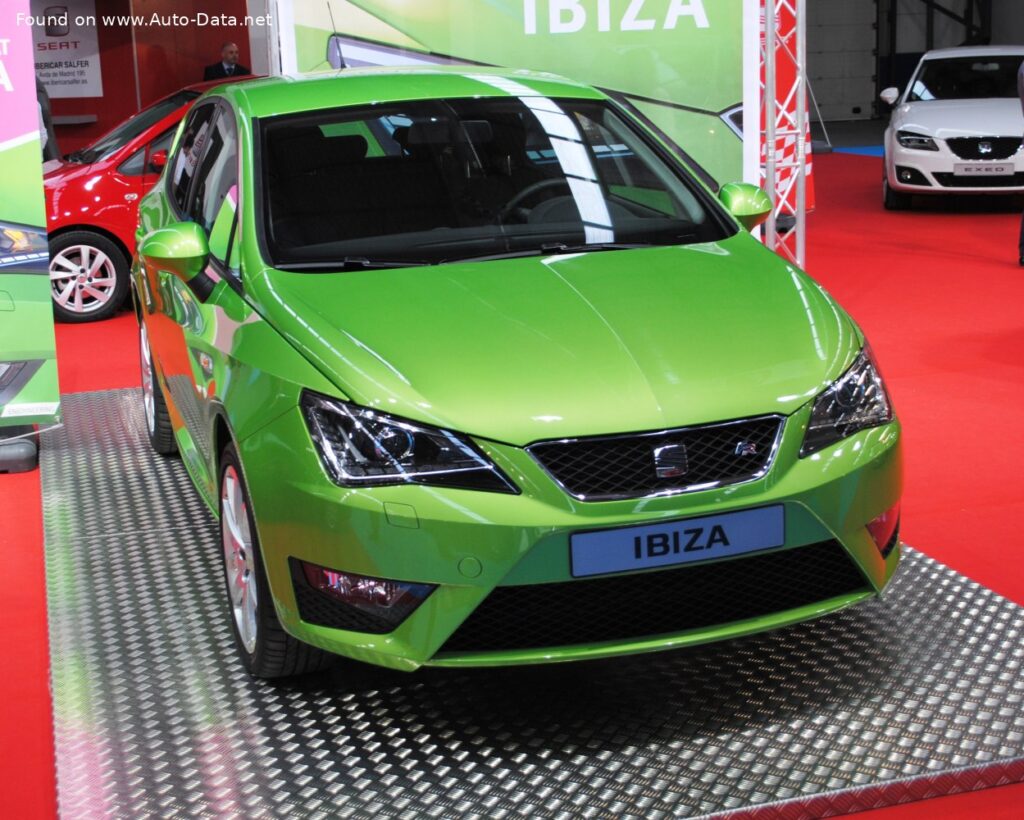
The Seat Ibiza IV (facelift 2012) FR 1.4 TSI (150 Hp) DSG represents a significant chapter in the history of Seat’s highly successful subcompact line, the Ibiza. As a product of the Spanish automotive manufacturer, a subsidiary of the Volkswagen Group, the Ibiza has consistently aimed to inject a sense of youthful dynamism and sporty flair into the supermini segment. The fourth generation, particularly in its post-facelift guise from 2012 to 2015, saw Seat refine its offering, blending sharp styling with advanced powertrain technology, especially in the performance-oriented FR (Formula Racing) trim.
The 1.4 TSI FR: Positioning and Market Context
While the Seat brand is not officially sold in the United States, the Ibiza has been a perennial best-seller for the company across Europe and other international markets. The FR 1.4 TSI (150 Hp) DSG variant was positioned as a warm-to-hot hatch, offering a compelling blend of everyday usability, spirited performance, and impressive fuel efficiency. It directly competed with other established players in the segment like the Volkswagen Polo GTI, Skoda Fabia vRS, and various sporty derivatives of the Ford Fiesta and Renault Clio, often standing out with its distinctive, angular aesthetics and a reputation for agile handling. This particular model, with its sophisticated dual-charged engine and quick-shifting automatic transmission, showcased Seat’s commitment to delivering an engaging driving experience within a practical hatchback package. It sat comfortably above the base Ibiza models in terms of performance and equipment, but below the more focused and often more expensive Polo GTI.
Powertrain & Engine Architecture
At the core of the Seat Ibiza IV (facelift 2012) FR 1.4 TSI (150 Hp) DSG lies one of the Volkswagen Group’s most innovative powertrains of its era: the 1.4-liter TSI engine. This inline four-cylinder gasoline (petrol) engine, identified by codes such as CAVF, CNUB, CTHF, or CTJB, was a marvel of forced induction technology. Unlike conventional turbocharged engines, this unit featured both a supercharger and a turbocharger, operating in tandem to provide a remarkably broad and linear power delivery. The supercharger, mechanically driven, provided instant boost at lower RPMs, effectively eliminating turbo lag, while the turbocharger took over at higher engine speeds, ensuring sustained power output. An intercooler further optimized performance by cooling the compressed intake air.
This sophisticated setup allowed the compact 1.4-liter (84.82 cubic inches) engine to produce a robust 150 horsepower at 5800 rpm, translating to an impressive power-per-liter figure of 107.9 Hp/l. More significantly for real-world driving, the engine delivered a substantial 220 Newton-meters (162.26 lb.-ft.) of torque across an incredibly wide band, from a low 1250 rpm all the way up to 4500 rpm. This flat torque curve meant that the Ibiza FR felt responsive and eager at almost any engine speed, making it both engaging on winding roads and effortless in urban traffic.
Power was sent to the front wheels via a highly acclaimed 7-speed DSG (Direct-Shift Gearbox) automatic transmission. This dual-clutch unit was celebrated for its lightning-fast and seamless gear changes, contributing significantly to both the car’s performance and its efficiency. The combination of the twin-charged engine and the DSG transmission enabled the Ibiza FR to accelerate from 0 to 60 mph in a swift 7.2 seconds, with a top speed of 131.73 mph (212 km/h). The DSG transmission utilizes two separate clutches for odd and even gears, allowing for pre-selection of the next gear and virtually eliminating power interruption during shifts.
Despite its sporty inclinations, the Ibiza FR 1.4 TSI also boasted commendable fuel economy for its performance level. The combined fuel consumption was rated at 39.9 US mpg (5.9 l/100 km), with extra-urban figures reaching 46.1 US mpg (5.1 l/100 km). CO2 emissions stood at 139 g/km, adhering to the Euro 5 emission standard, reflecting a conscious effort by Seat to balance performance with environmental considerations. The engine’s compression ratio was 10:1, with a bore of 3.01 inches and a stroke of 2.98 inches, and featured a direct fuel injection system along with four valves per cylinder, all contributing to its efficiency and power output.
Driving Characteristics
The 1.8L 90 hp Automatic configuration of the Seat Ibiza IV offered a distinctly different driving experience compared to its more powerful siblings. While the FR 1.4 TSI prioritized performance, the 1.8L Automatic was geared towards comfort and ease of use. The 1.8L engine, while less potent, provided adequate power for everyday driving, particularly in urban environments. The automatic transmission, while not as sporty as the DSG, offered smooth and predictable gear changes, making it ideal for drivers who preferred a more relaxed driving style. Compared to the manual versions of the 1.8L, the automatic sacrificed some responsiveness, but gained convenience. The lower power output also meant a more forgiving driving experience, suitable for less experienced drivers.
The gear ratios in the automatic transmission were tuned for fuel efficiency and smooth cruising, rather than outright acceleration. This resulted in a slightly slower 0-60 mph time compared to the FR models, but also contributed to better fuel economy. The 1.8L engine’s torque delivery was more linear than the 1.4 TSI, lacking the immediate punch of the supercharger, but providing a predictable and manageable power curve.
Equipment & Trim Levels
The Ibiza IV (facelift 2012) FR came well-equipped for its class. Standard features typically included air conditioning, power windows, power door locks, and a CD/MP3 stereo system with auxiliary input. The FR trim added sport seats with enhanced bolstering, a flat-bottomed steering wheel, unique alloy wheels, and a more aggressive body kit. Optional extras included a touchscreen infotainment system with navigation, Bluetooth connectivity, and parking sensors. Interior upholstery was typically a combination of cloth and leatherette, with bespoke trim accents to differentiate it from standard Ibiza models. Safety features included ABS, electronic stability control, and multiple airbags.
Chassis & Braking
The Ibiza FR featured a MacPherson strut front suspension with coil springs and an anti-roll bar, providing responsive handling and good ride comfort. The rear suspension utilized a torsion beam axle, a cost-effective and space-efficient solution that offered adequate performance for everyday driving. The FR trim typically featured a slightly stiffer suspension setup compared to the standard Ibiza, enhancing its handling characteristics. Braking performance was assured with ventilated discs at the front and disc brakes at the rear. The car rode on 215/40 R17 tires mounted on 7J x 17-inch alloy wheels, providing a good balance of grip and ride comfort.
Market Reception & Comparison
The Ibiza FR 1.4 TSI (150 Hp) DSG was generally well-received by automotive critics. It was praised for its engaging handling, responsive steering, and the impressive performance delivered by its twin-charged engine. The DSG transmission was also a highlight, offering smooth and quick gear changes. However, some critics noted that the interior quality was not as refined as some of its rivals, and the ride could be a bit firm on rough roads. Compared to the Polo GTI, the Ibiza FR offered a more distinctive and sporty aesthetic, but lacked the Polo’s overall refinement. Compared to the Skoda Fabia vRS, the Ibiza FR was generally considered to be more visually appealing, but the Fabia offered a more practical and spacious interior. Fuel economy was competitive for its class, and reliability was generally good, although the complexity of the twin-charging system did raise some concerns.
Technical Specifications: Seat Ibiza IV (facelift 2012) FR 1.4 TSI (150 Hp) DSG
| Category | Specification |
| General Information | |
| Brand | Seat |
| Model | Ibiza |
| Generation | Ibiza IV (facelift 2012) |
| Type (Engine) | FR 1.4 TSI (150 Hp) DSG |
| Start of Production | 2012 year |
| End of Production | 2015 year |
| Powertrain Architecture | Internal Combustion Engine |
| Body type | Hatchback |
| Seats | 5 |
| Doors | 5 |
| Performance Specifications | |
| Fuel consumption (economy) – urban | 7.5 l/100 km (31.4 US mpg) |
| Fuel consumption (economy) – extra urban | 5.1 l/100 km (46.1 US mpg) |
| Fuel consumption (economy) – combined | 5.9 l/100 km (39.9 US mpg) |
| CO2 emissions | 139 g/km |
| Fuel Type | Petrol (Gasoline) |
| Acceleration 0 – 60 mph | 7.2 sec |
| Acceleration 0 – 100 km/h | 7.6 sec |
| Maximum speed | 212 km/h (131.73 mph) |
| Emission standard | Euro 5 |
| Weight-to-power ratio | 8.4 kg/Hp (119.6 Hp/tonne) |
| Weight-to-torque ratio | 5.7 kg/Nm (175.4 Nm/tonne) |
| Engine Specifications | |
| Power | 150 Hp @ 5800 rpm |
| Power per liter | 107.9 Hp/l |
| Torque | 220 Nm (162.26 lb.-ft.) @ 1250-4500 rpm |
| Engine layout | Front, Transverse |
| Engine Model/Code | CAVF, CNUB, CTHF, CTJB |
| Engine displacement | 1390 cm3 (1.4 liters / 84.82 cu. in.) |
| Number of cylinders | 4 |
| Engine configuration | Inline |
| Cylinder Bore | 76.5 mm (3.01 in.) |
| Piston Stroke | 75.6 mm (2.98 in.) |
| Compression ratio | 10:1 |
| Number of valves per cylinder | 4 |
| Fuel injection system | Direct injection |
| Engine aspiration | Turbocharging and Supercharger, Intercooler |
| Engine oil capacity | 3.6 l (3.8 US qt) |
| Coolant | 5.6 l (5.92 US qt) |
| Space, Volume and Weights | |
| Kerb Weight | 1254 kg (2764.6 lbs.) |
| Max. weight | 1680 kg (3703.77 lbs.) |
| Max load | 426 kg (939.17 lbs.) |
| Trunk (boot) space – minimum | 250 l (8.83 cu. ft.) |
| Fuel tank capacity | 45 l (11.89 US gal) |
| Dimensions | |
| Length | 4082 mm (160.71 in.) |
| Width | 1693 mm (66.65 in.) |
| Height | 1441 mm (56.73 in.) |
| Wheelbase | 2469 mm (97.2 in.) |
| Front track | 1449 mm (57.05 in.) |
| Rear (Back) track | 1441 mm (56.73 in.) |
| Minimum turning circle (turning diameter) | 10.48 m (34.38 ft.) |
| Drivetrain, Brakes and Suspension Specifications | |
| Drivetrain Architecture | The Internal combustion engine (ICE) drives the front wheels of the vehicle. |
| Drive wheel | Front wheel drive |
| Number of gears and type of gearbox | 7 gears, automatic transmission DSG |
| Front suspension | Independent, type McPherson with coil spring and anti-roll bar |
| Rear suspension | Hydraulic elements |
| Front brakes | Ventilated discs |
| Rear brakes | Disc |
| Assisting systems | ABS (Anti-lock braking system) |
| Steering type | Steering rack and pinion |
| Power steering | Electric Steering |
| Tires size | 215/40 R17 |
| Wheel rims size | 7J x 17 |
Legacy
The Seat Ibiza IV (facelift 2012) FR 1.4 TSI (150 Hp) DSG carved out a notable niche in the highly competitive European supermini segment. Its primary market impact stemmed from its ability to offer a more emotionally charged and visually distinctive alternative to its platform-mates, the Volkswagen Polo and Skoda Fabia. While the Polo GTI might have had a slightly more premium feel and the Fabia vRS offered similar performance at a more pragmatic price point, the Ibiza FR consistently appealed to buyers looking for a car with more “flair” and a sportier driving character. In the used car market today, well-maintained examples of the Ibiza FR 1.4 TSI are sought after by enthusiasts who appreciate its unique engine and engaging driving experience. However, potential buyers should be aware of the potential for issues with the twin-charging system and ensure that any prospective purchase has a full service history. The Ibiza continues to be a cornerstone of Seat’s lineup, and this particular FR variant remains a memorable example of a clever, fun, and technologically advanced hot hatch from its era.