
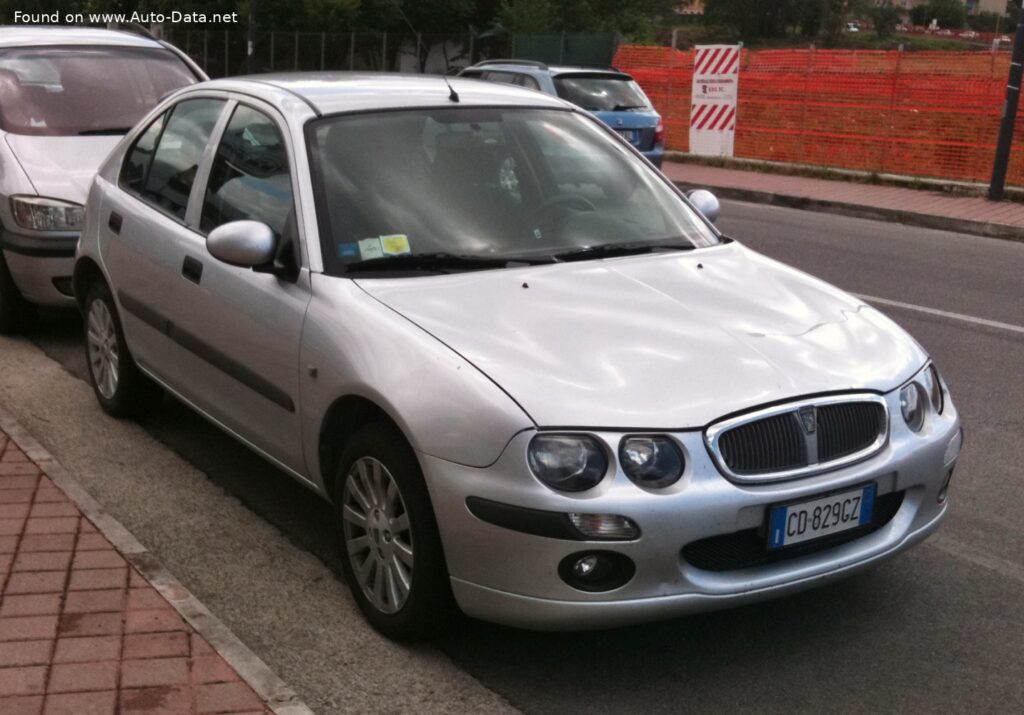
The Rover 25 (RF) 1.1 i 16V (75 Hp) represents a significant chapter in the final years of the British Rover Group, later MG Rover Group. Introduced in 1999 as a substantial facelift and re-branding of the popular Rover 200 (R3), the Rover 25 aimed to revitalize the brand’s presence in the highly competitive European supermini segment. Produced from 2002 to 2005, this specific variant, powered by a modest yet efficient 1.1-liter 16-valve engine delivering 75 horsepower, was positioned as an accessible and economical choice for buyers in its primary markets, predominantly the United Kingdom and continental Europe. While never officially imported or sold in the United States, the Rover 25 played a crucial role in its home market, embodying Rover’s enduring design ethos and engineering principles in a practical, compact package.
Powertrain & Engine Architecture
At the core of the Rover 25 (RF) 1.1 i 16V (75 Hp) lies Rover’s venerable K-Series engine, specifically the 11K4F model. This powerplant, celebrated for its lightweight construction and relatively advanced design for its era, was a staple across much of Rover’s compact and mid-size lineup. In this iteration, the engine is a naturally aspirated, 1.1-liter (1119 cm³ or 68.29 cu. in.) inline-four configuration, featuring a 16-valve cylinder head that promotes efficient breathing and a smoother power delivery compared to its 8-valve predecessors. With a bore of 75 mm (2.95 inches) and a piston stroke of 62.3 mm (2.45 inches), the engine operates with a compression ratio of 9.4:1.
The 1.1-liter engine generates a respectable 75 horsepower at 6000 revolutions per minute (rpm), providing a power-per-liter output of 67 HP/l. Torque peaks at 95 Nm (70.07 lb.-ft.) at a relatively high 5000 rpm, indicating the engine’s preference for higher revs to deliver its full potential. Fueling is managed by a multi-port manifold injection system, ensuring precise fuel delivery and combustion. The engine’s lubrication system requires 4.5 liters (4.76 US quarts) of engine oil, and the cooling system holds 5.5 liters (5.81 US quarts) of coolant, designed to maintain optimal operating temperatures. Power is transmitted to the front wheels via a five-speed manual transmission, a common and reliable setup for compact cars of this period.
Driving Characteristics
The Rover 25 (RF) 1.1 i 16V (75 Hp) offered a driving experience geared towards practicality and economy rather than outright performance. Acceleration from 0 to 60 mph took approximately 12.8 seconds, and 0-100 km/h was achieved in 13.5 seconds. Its maximum speed was rated at 100.04 mph (161 km/h). These figures, while not indicative of a performance car, were competitive for an entry-level supermini focused on economy. The five-speed manual transmission was well-matched to the engine’s characteristics, allowing drivers to keep the engine in its optimal power band. Compared to higher-output versions of the Rover 25, such as those equipped with the 1.8-liter K-Series engine, the 1.1-liter model felt noticeably less responsive, particularly when accelerating or overtaking. However, the lighter engine weight contributed to a more nimble feel in city driving. The gear ratios were optimized for fuel efficiency, resulting in a relatively relaxed cruising experience at highway speeds. Compared to automatic transmission equipped models, the manual transmission offered greater driver control and a more engaging driving experience.
Equipment & Trim Levels
The Rover 25 (RF) 1.1 i 16V (75 Hp) typically served as the entry-level model in the Rover 25 lineup. As such, it came equipped with a relatively basic, yet functional, set of standard features. Interior upholstery was typically cloth, with a durable and practical finish. The dashboard configuration was straightforward, featuring analog gauges for speed, engine temperature, and fuel level. Standard equipment generally included power steering, central locking, and an immobilizer system for security. Optional extras available for this trim included air conditioning, electric front windows, and an upgraded audio system. Higher trim levels, such as the Rover 25 SLi or SE, offered more luxurious appointments, including alloy wheels, upgraded interior trim, and additional features like a sunroof or leather upholstery. The 1.1L model was often seen as a sensible choice for budget-conscious buyers, prioritizing affordability and reliability over luxury features.
Chassis & Braking
The Rover 25 (RF) 1.1 i 16V (75 Hp) utilized a front suspension system with wishbones and a rear suspension employing spring struts, a common setup for front-wheel-drive vehicles of its category, providing a comfortable yet competent ride. Braking performance was handled by ventilated discs at the front and more traditional drum brakes at the rear. Crucially, the vehicle was equipped with an Anti-lock Braking System (ABS), a vital safety feature for its time, improving control during emergency braking. Steering was managed by a rack and pinion system with hydraulic power steering, offering direct feedback and ease of maneuverability. The car rode on 175/65 R14 tires, a standard size for economical compacts. The suspension was tuned for comfort, prioritizing ride quality over sporty handling. The drum brakes on the rear were a cost-saving measure typical of entry-level models, and while adequate for normal driving conditions, they lacked the stopping power of disc brakes.
Market Reception & Comparison
The Rover 25 1.1 i 16V (75 Hp) received mixed reviews from automotive critics. While praised for its comfortable ride, practical interior, and fuel efficiency, it was often criticized for its lack of outright performance and somewhat dated design. Compared to its rivals, such as the Ford Fiesta and Vauxhall Corsa, the Rover 25 offered a more refined driving experience but lacked the technological advancements and sporty handling of some competitors. Fuel economy was a strong point, with urban consumption at 26.7 US mpg (8.8 l/100 km) and extra-urban consumption significantly improving to 42.8 US mpg (5.5 l/100 km). Reliability was generally considered average for the period, with some reports of issues with the K-Series engine’s head gasket, a common problem across many Rover models equipped with this engine. However, routine maintenance and preventative care could mitigate these issues. The 1.1L engine was generally considered more reliable than the higher-output versions, due to its lower stress levels.
Technical Specifications
| Category | Specification |
| General Information | |
| Brand | Rover |
| Model | 25 |
| Generation | 25 (RF) |
| Type (Engine) | 1.1 i 16V (75 Hp) |
| Start of Production | 2002 year |
| End of Production | 2005 year |
| Powertrain Architecture | Internal Combustion engine |
| Body type | Hatchback |
| Seats | 5 |
| Doors | 3-5 |
| Performance Specifications | |
| Fuel consumption (economy) – urban | 8.8 l/100 km / 26.7 US mpg |
| Fuel consumption (economy) – extra urban | 5.5 l/100 km / 42.8 US mpg |
| Fuel Type | Petrol (Gasoline) |
| Acceleration 0 – 100 km/h | 13.5 sec |
| Acceleration 0 – 62 mph | 13.5 sec |
| Acceleration 0 – 60 mph (Calculated) | 12.8 sec |
| Maximum speed | 161 km/h / 100.04 mph |
| Weight-to-power ratio | 13.6 kg/Hp, 73.5 Hp/tonne |
| Weight-to-torque ratio | 10.7 kg/Nm, 93.1 Nm/tonne |
| Engine Specifications | |
| Power | 75 Hp @ 6000 rpm. |
| Power per liter | 67 Hp/l |
| Torque | 95 Nm @ 5000 rpm. / 70.07 lb.-ft. @ 5000 rpm. |
| Engine layout | Front, Transverse |
| Engine Model/Code | 11K4F |
| Engine displacement | 1119 cm³ / 68.29 cu. in. |
| Number of cylinders | 4 |
| Engine configuration | Inline |
| Cylinder Bore | 75 mm / 2.95 in. |
| Piston Stroke | 62.3 mm / 2.45 in. |
| Compression ratio | 9.4:1 |
| Number of valves per cylinder | 4 |
| Fuel injection system | Multi-port manifold injection |
| Engine aspiration | Naturally aspirated engine |
| Engine oil capacity | 4.5 l / 4.76 US qt |
| Coolant | 5.5 l / 5.81 US qt |
| Space, Volume and Weights | |
| Kerb Weight | 1020 kg / 2248.72 lbs. |
| Max. weight (Gross Vehicle Weight Rating) | 1500 kg / 3306.93 lbs. |
| Max load | 480 kg / 1058.22 lbs. |
| Trunk (boot) space – minimum | 304 l / 10.74 cu. ft. |
| Trunk (boot) space – maximum | 1086 l / 38.35 cu. ft. |
| Fuel tank capacity | 50 l / 13.21 US gal |
| Dimensions | |
| Length | 3990 mm / 157.09 in. |
| Width | 1688 mm / 66.46 in. |
| Height | 1417 mm / 55.79 in. |
| Wheelbase | 2500 mm / 98.43 in. |
| Front track | 1473 mm / 57.99 in. |
| Rear track | 1466 mm / 57.72 in. |
| Drivetrain, Brakes and Suspension Specifications | |
| Drivetrain Architecture | The Internal combustion engine (ICE) drives the front wheels of the vehicle. |
| Drive wheel | Front wheel drive |
| Number of gears and type of gearbox | 5 gears, manual transmission |
| Front suspension | Wishbone |
| Rear suspension | Spring Strut |
| Front brakes | Ventilated discs |
| Rear brakes | Drum |
| Assisting systems | ABS (Anti-lock braking system) |
| Steering type | Steering rack and pinion |
| Power steering | Hydraulic Steering |
| Tires size | 175/65 R14 |
Legacy
The Rover 25 (RF) 1.1 i 16V (75 Hp) has become a relatively sought-after classic among Rover enthusiasts, particularly those seeking an affordable and economical example of the marque. While the K-Series engine’s head gasket issues remain a concern, preventative maintenance and careful ownership can mitigate these problems. The car’s simple mechanical design makes it relatively easy to maintain and repair, appealing to DIY mechanics. In the used car market, prices for well-maintained examples remain relatively low, making it an accessible entry point for classic car ownership. The Rover 25, in its various forms, represents a poignant reminder of a bygone era of British automotive manufacturing, and the 1.1-liter variant stands as a testament to Rover’s commitment to providing practical and affordable transportation to a wide range of buyers.
