
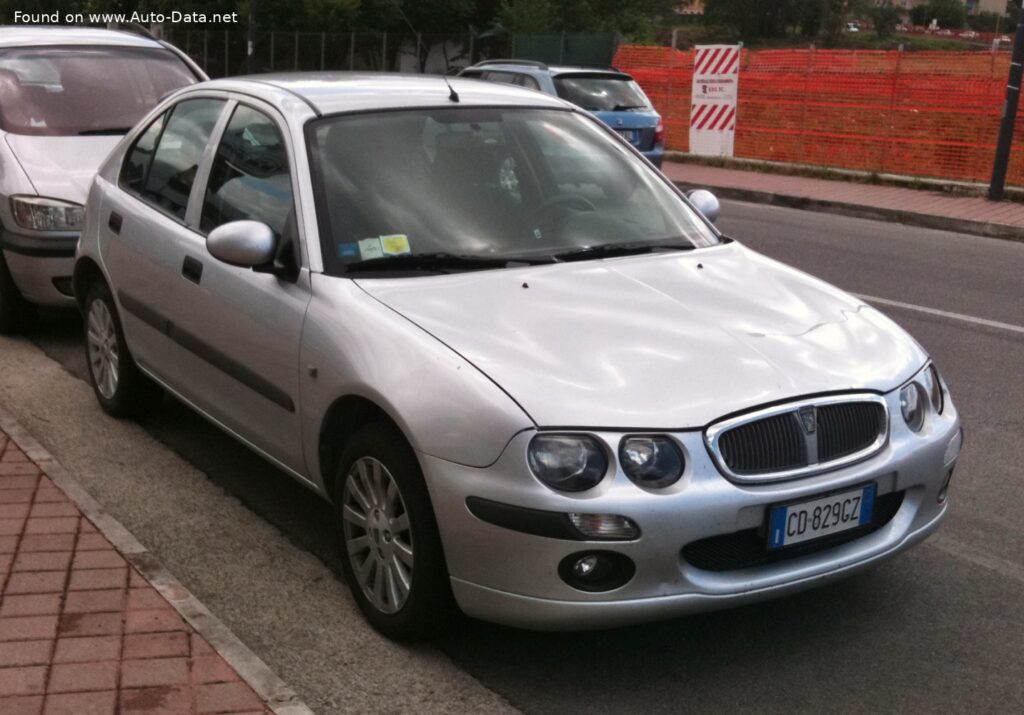
The Rover 25 (RF) 1.4 i 16V (103 Hp) represents a significant chapter in the history of the British automotive industry, serving as a compact hatchback during a transitional period for the Rover brand. Introduced in 1999 as a facelifted and rebadged version of the popular Rover 200 (R3) series, the Rover 25 aimed to revitalize the marque’s presence in the fiercely competitive small car segment. Produced until 2005, this generation of the Rover 25 was designed to offer a blend of traditional British styling cues, practicality, and a spirited driving experience, particularly in the 1.4-liter 16-valve variant. While never officially sold in the United States, the Rover 25 played a crucial role in its home market, embodying Rover’s final efforts to appeal to a broad customer base with an accessible and somewhat upscale compact vehicle. Its design and engineering reflected the trends of late 20th and early 21st-century European compacts, emphasizing efficiency, maneuverability, and a degree of comfort for its class.
Powertrain & Engine Architecture
At the heart of the Rover 25 (RF) 1.4 i 16V (103 Hp) lies Rover’s venerable K-Series engine, a 1.4-liter (1396 cm3 or 85.19 cu. in.) inline-four gasoline unit. This particular iteration of the K-Series was notable for its multi-port manifold injection and a sophisticated 16-valve DOHC (Double Overhead Camshaft) valvetrain, a configuration that allowed for efficient breathing and a commendable power output for its displacement. The engine, designated with the K code, was mounted transversely at the front and drove the front wheels, a standard layout for compact cars of its era, optimizing both interior space and manufacturing efficiency.
This naturally aspirated powerplant delivered a respectable 103 horsepower at a relatively high 6000 rpm, showcasing its free-revving nature. Torque output stood at 90.72 lb.-ft. (123 Nm) arriving at 4500 rpm, providing adequate pulling power for city driving and highway cruising. The 1.4 i 16V variant was typically paired with a 5-speed manual transmission, though a 4-speed automatic transmission was also available. The automatic, while offering convenience, did impact performance slightly. The fuel injection system utilized Bosch Motronic, managing fuel delivery and ignition timing for optimal efficiency and emissions control. The K-Series engine was known for its lightweight construction, contributing to the Rover 25’s overall agility.
Driving Characteristics
The Rover 25 1.4 i 16V with the manual transmission offered a lively, if not overtly powerful, driving experience. Acceleration from 0 to 60 mph was achieved in a brisk 9.7 seconds (0-100 km/h in 10.2 seconds), and the vehicle could reach a maximum speed of 111.85 mph (180 km/h). The automatic transmission version, however, saw a slight decrease in performance, with 0-60 mph times extending to around 11-12 seconds. The gear ratios were tuned for a balance between acceleration and fuel economy, with a relatively tall final drive. The engine’s peak torque arriving at 4500 rpm meant that drivers often needed to rev the engine to access its full potential, especially when overtaking or climbing hills. Compared to the higher-output 1.8-liter versions, the 1.4 felt less strained at higher speeds, but lacked the same level of outright performance. Against the diesel options, like the 2.0 TDI, the 1.4 offered a smoother, quieter driving experience, but with significantly less low-end torque.
Equipment & Trim Levels
The Rover 25 1.4 i 16V was typically offered in several trim levels, including the base ‘1.4’, ‘S’, and ‘SE’. The base model included features such as central locking, power steering, and an adjustable steering column. The ‘S’ trim added features like alloy wheels, electric front windows, and a better-equipped stereo system. The ‘SE’ trim, positioned as the more premium offering, included features like air conditioning, leather upholstery (optional), and upgraded interior trim. Interior upholstery ranged from basic cloth on the base models to more luxurious velour or leather options on the higher trims. The dashboard configuration was relatively simple and functional, with a clear instrument cluster and easy-to-use controls. Optional extras included a sunroof, rear electric windows, and upgraded audio systems. Safety features were relatively standard for the time, including driver and passenger airbags and ABS on some models.
Chassis & Braking
The Rover 25 (RF) utilized a MacPherson strut front suspension and a trailing arm rear suspension. This setup provided a reasonable balance between ride comfort and handling, although it wasn’t particularly sporty. The suspension was tuned to prioritize comfort over outright handling prowess. The braking system consisted of ventilated discs on the front wheels and drum brakes on the rear wheels. ABS (Anti-lock Braking System) was available as an option, and became standard on higher trim levels. The steering was a hydraulic rack and pinion system, providing reasonably direct steering feel. The car rode on 175/65 R14 tires, which were typical for a compact car of its era. Stabilizer bars were fitted to both the front and rear axles to reduce body roll during cornering, although the effect was modest.
Market Reception & Comparison
Critics generally viewed the Rover 25 1.4 i 16V as a competent, if unremarkable, compact car. It was praised for its comfortable ride, relatively spacious interior, and traditional British styling. However, it was often criticized for its aging platform, somewhat dated interior design, and concerns over the long-term reliability of the K-Series engine. Fuel economy was a strong point, with the 1.4-liter engine achieving around 35.6 US mpg (6.6 L/100 km) in combined driving. Compared to the 1.8-liter versions, the 1.4 offered better fuel economy but less performance. The 1.4 was also more affordable to purchase and insure, making it a popular choice for first-time buyers and those seeking a practical and economical city car. Against rivals like the Ford Fiesta and Volkswagen Polo, the Rover 25 offered a more comfortable ride and a more traditional interior, but lacked the same level of refinement and build quality.
Technical Specifications
| Brand | Rover |
| Model | 25 |
| Generation | 25 (RF) |
| Type (Engine) | 1.4 i 16V (103 Hp) |
| Start of Production | 1999 year |
| End of Production | 2005 year |
| Powertrain Architecture | Internal Combustion engine |
| Body Type | Hatchback |
| Seats | 5 |
| Doors | 3-5 |
| Fuel Consumption (Economy) – Urban | 8.8 l/100 km (26.7 US mpg) |
| Fuel Consumption (Economy) – Extra Urban | 5.3 l/100 km (44.4 US mpg) |
| Fuel Consumption (Economy) – Combined | 6.6 l/100 km (35.6 US mpg) |
| Fuel Type | Petrol (Gasoline) |
| Acceleration 0 – 60 mph | 9.7 sec |
| Acceleration 0 – 100 km/h | 10.2 sec |
| Maximum Speed | 180 km/h (111.85 mph) |
| Weight-to-Power Ratio | 10.7 kg/Hp, 93.2 Hp/tonne |
| Weight-to-Torque Ratio | 9 kg/Nm, 111.3 Nm/tonne |
| Power | 103 Hp @ 6000 rpm. |
| Power per Liter | 73.8 Hp/l |
| Torque | 123 Nm @ 4500 rpm (90.72 lb.-ft. @ 4500 rpm) |
| Engine Layout | Front, Transverse |
| Engine Model/Code | K |
| Engine Displacement | 1396 cm3 (85.19 cu. in.) |
| Number of Cylinders | 4 |
| Engine Configuration | Inline |
| Cylinder Bore | 75 mm (2.95 in.) |
| Piston Stroke | 79 mm (3.11 in.) |
| Compression Ratio | 10.5:1 |
| Number of Valves per Cylinder | 4 |
| Fuel Injection System | Multi-port manifold injection |
| Engine Aspiration | Naturally aspirated engine |
| Valvetrain | DOHC |
| Engine Oil Capacity | 4.5 l (4.76 US qt) |
| Coolant Capacity | 4.6 l (4.86 US qt) |
| Kerb Weight | 1105 kg (2436.11 lbs) |
| Maximum Weight | 1500 kg (3306.93 lbs) |
| Maximum Load | 395 kg (870.83 lbs) |
| Trunk (Boot) Space – Minimum | 304 l (10.74 cu. ft.) |
| Trunk (Boot) Space – Maximum | 1086 l (38.35 cu. ft.) |
| Fuel Tank Capacity | 50 l (13.21 US gal) |
| Length | 3990 mm (157.09 in.) |
| Width | 1688 mm (66.46 in.) |
| Height | 1417 mm (55.79 in.) |
| Wheelbase | 2500 mm (98.43 in.) |
| Front Track | 1473 mm (57.99 in.) |
| Rear Track | 1466 mm (57.72 in.) |
| Drivetrain Architecture | The Internal combustion engine (ICE) drives the front wheels of the vehicle. |
| Drive Wheel | Front wheel drive |
| Number of Gears and Type of Gearbox | 5 gears, manual transmission |
| Front Suspension | Wishbone |
| Rear Suspension | Spring Strut |
| Front Brakes | Ventilated discs |
| Rear Brakes | Drum |
| Assisting Systems | ABS (Anti-lock braking system) |
| Steering Type | Steering rack and pinion |
| Power Steering | Hydraulic Steering |
| Tires Size | 175/65 R14 T |
Legacy
The Rover 25 (RF) 1.4 i 16V, while not a groundbreaking vehicle, remains a fondly remembered car for many British motorists. The K-Series engine, despite its potential issues, was a capable and efficient unit. On the used car market today, the Rover 25 1.4 i 16V is relatively affordable, but finding a well-maintained example can be challenging. The biggest concern for potential buyers is the K-Series engine’s head gasket, which may require replacement. However, with careful inspection and regular maintenance, a Rover 25 1.4 can provide reliable and economical transportation. It represents a final chapter in Rover’s history, a reminder of a once-proud British brand that ultimately succumbed to market pressures and internal challenges.
