
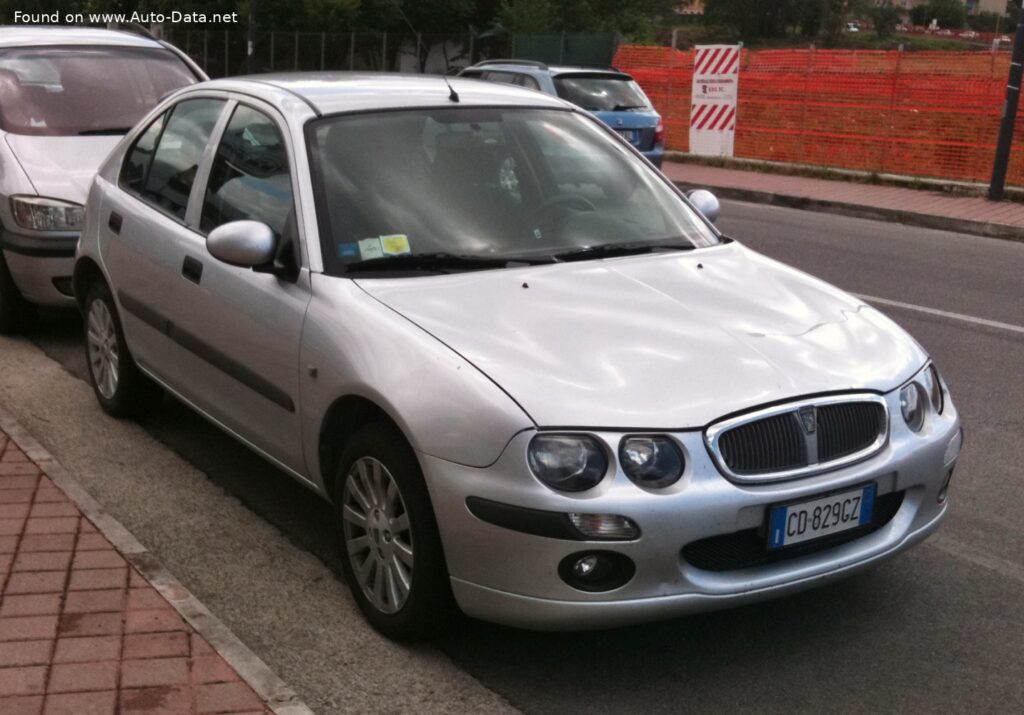
The Rover 25, internally designated RF, represents a significant chapter in the history of the British automotive manufacturer, Rover. Launched in 1999, the Rover 25 was essentially a heavily revised and rebadged version of the popular Rover 200 series (R3), aiming to rejuvenate the brand’s presence in the competitive European supermini segment. This particular variant, the Rover 25 (RF) 1.6 i 16V (109 Hp), stood out as a well-balanced offering, providing a blend of spirited performance, respectable fuel economy, and traditional British comfort. Produced from 1999 until 2005, the Rover 25 was a key model in the company’s lineup during a tumultuous period leading up to the demise of MG Rover Group.
As a vehicle primarily sold in the United Kingdom and continental Europe, the Rover 25 was not officially imported or marketed in the United States. Its role was to compete against established European rivals, offering a more premium feel compared to some of its mass-market competitors, while retaining the compact dimensions suitable for European urban environments. The 1.6-liter engine variant was a popular choice, striking a good balance between everyday usability and the ability to handle longer journeys with ease, embodying Rover’s enduring reputation for refinement in its class.
Powertrain & Engine Architecture
At the core of the Rover 25 (RF) 1.6 i 16V (109 Hp) was Rover’s venerable K-Series engine, a 1.6-liter (1588 cm3 or 96.91 cu. in.) naturally aspirated inline-four powerplant. This engine, known for its lightweight design and free-revving character, featured a Double Overhead Camshaft (DOHC) valvetrain with four valves per cylinder, totaling 16 valves. Fuel delivery was managed by a multi-port manifold injection system, ensuring efficient combustion and responsive throttle input. The K-Series engine, in this configuration, was a mainstay of Rover’s lineup for many years, benefitting from continuous refinement throughout its production run.
The 1.6-liter K-Series engine produced a healthy 109 horsepower (Hp) at 6000 rpm, which was a competitive figure for its class at the turn of the millennium. Torque output stood at 101.78 lb.-ft. (138 Nm) delivered at 4500 rpm, providing adequate pulling power for city driving and highway cruising. The engine’s transverse front-engine layout drove the front wheels through a 5-speed manual transmission, a common and reliable setup for supermini vehicles of this era. While an automatic transmission was offered, the manual was favored by enthusiasts for its more engaging driving experience. This powertrain architecture contributed to the car’s agile handling and efficient packaging.
The K-Series Engine: A Detailed Look
The K-Series engine’s design prioritized minimizing weight and friction. It utilized a thin-walled block and cylinder head, contributing to its responsiveness. The multi-point fuel injection system was crucial for optimizing fuel delivery and reducing emissions. The DOHC valvetrain allowed for precise control of the engine’s breathing, maximizing power output across the rev range. The engine’s relatively small displacement and high-revving nature meant it needed to be worked to extract its full potential, but it rewarded drivers with a lively and engaging driving experience.
Driving Characteristics
The Rover 25 1.6 i 16V, with its 109 hp output and 5-speed manual transmission, offered a respectable driving experience for its class. Acceleration from 0 to 60 mph took approximately 9 seconds, and it could reach a maximum speed of 111.85 mph (180 km/h). These figures were competitive with other superminis of the time, but noticeably slower than higher-performance variants like the Rover 25 V6. Compared to the diesel options, the 1.6-liter petrol engine provided a smoother, more refined power delivery, albeit with slightly less low-end torque.
The gear ratios were well-chosen to provide a balance between acceleration and fuel economy. First gear was relatively short, providing brisk acceleration from a standstill, while fifth gear was geared for comfortable cruising on the highway. The engine felt most at home in the mid-range, offering responsive acceleration for overtaking and merging onto highways. The steering was light and precise, making the car easy to maneuver in urban environments. The suspension provided a comfortable ride, absorbing bumps and imperfections in the road surface effectively.
Equipment & Trim Levels
The Rover 25 1.6 i 16V was typically positioned as a mid-range offering in the Rover 25 lineup. Standard equipment included central locking, power steering, electric front windows, and an RDS stereo. Interior upholstery was typically cloth, with a choice of colors and patterns. Higher trim levels, such as the ‘Style’ and ‘Connoisseur’ variants, added features like alloy wheels, air conditioning, leather upholstery, and upgraded audio systems. Optional extras included a sunroof, rear electric windows, and metallic paint.
The dashboard layout was functional and user-friendly, with clearly labeled controls and a straightforward instrument cluster. The interior design aimed for a comfortable and inviting atmosphere, reflecting Rover’s reputation for creating well-appointed cabins. The 3-door and 5-door body styles offered different levels of practicality, with the 5-door version providing easier access to the rear seats.
Chassis & Braking
The Rover 25 utilized a MacPherson strut front suspension and a torsion beam rear suspension. This setup provided a good balance between ride comfort and handling. The front suspension offered good wheel control, while the rear suspension helped to maintain stability. Braking performance was handled by ventilated discs at the front and drum brakes at the rear, augmented by an Anti-lock Braking System (ABS) for enhanced safety during emergency stops. The ABS system helped to prevent wheel lockup, allowing the driver to maintain steering control during hard braking.
The car rode on 175/65 R14T tires, offering a balance of grip and ride comfort. The steering was a hydraulic rack and pinion system, providing direct feedback to the driver. The chassis was relatively lightweight, contributing to the car’s agile handling. Stabilizer bars were fitted to both the front and rear suspension to reduce body roll during cornering.
Market Reception & Comparison
Critics generally viewed the Rover 25 1.6 i 16V favorably, praising its comfortable ride, refined engine, and attractive styling. However, it was often criticized for its relatively high price compared to some of its rivals, and for its aging design. Fuel economy was considered to be good, with a combined rating of 35.1 US mpg (6.7 l/100 km). Reliability was generally acceptable, but the K-Series engine was known to be susceptible to head gasket failure if not properly maintained.
Compared to the Rover 25 V6, the 1.6-liter variant offered significantly lower performance but better fuel economy and a lower purchase price. Compared to the diesel versions, the 1.6-liter petrol engine provided a smoother, more refined driving experience, but less low-end torque. Against competitors like the Ford Fiesta and Vauxhall Corsa, the Rover 25 offered a more premium feel but was often more expensive.
Technical Specifications
| Category | Specification |
| General Information | |
| Brand | Rover |
| Model | 25 |
| Generation | 25 (RF) |
| Type (Engine) | 1.6 i 16V (109 Hp) |
| Start of production | 1999 year |
| End of production | 2005 year |
| Powertrain Architecture | Internal Combustion engine |
| Body type | Hatchback |
| Seats | 5 |
| Doors | 3-5 |
| Performance Specs | |
| Fuel consumption (economy) – urban | 26.4 US mpg (8.9 l/100 km) |
| Fuel consumption (economy) – extra urban | 44.4 US mpg (5.3 l/100 km) |
| Fuel consumption (economy) – combined | 35.1 US mpg (6.7 l/100 km) |
| Fuel Type | Petrol (Gasoline) |
| Acceleration 0 – 60 mph | 9 sec |
| Acceleration 0 – 100 km/h | 9.5 sec |
| Maximum speed | 111.85 mph (180 km/h) |
| Weight-to-power ratio | 10.1 kg/Hp, 98.6 Hp/tonne |
| Weight-to-torque ratio | 8 kg/Nm, 124.9 Nm/tonne |
| Engine Specs | |
| Power | 109 Hp @ 6000 rpm |
| Power per liter | 68.6 Hp/l |
| Torque | 101.78 lb.-ft. (138 Nm) @ 4500 rpm |
| Engine layout | Front, Transverse |
| Engine Model/Code | K |
| Engine displacement | 1.6 liters (1588 cm3 / 96.91 cu. in.) |
| Number of cylinders | 4 |
| Engine configuration | Inline |
| Cylinder Bore | 3.15 in. (80 mm) |
| Piston Stroke | 3.11 in. (79 mm) |
| Compression ratio | 10.5:1 |
| Number of valves per cylinder | 4 |
| Fuel injection system | Multi-port manifold injection |
| Engine aspiration | Naturally aspirated engine |
| Valvetrain | DOHC |
| Engine oil capacity | 5.28 US qt (5 liters) |
| Engine oil specification | Not specified |
| Coolant capacity | 5.6 US qt (5.3 liters) |
| Space, Volume and Weights | |
| Kerb Weight | 2436.11 lbs. (1105 kg) |
| Max. weight (Gross Vehicle Weight Rating) | 3306.93 lbs. (1500 kg) |
| Max load | 870.83 lbs. (395 kg) |
| Trunk (boot) space – minimum | 10.74 cu. ft. (304 liters) |
| Trunk (boot) space – maximum | 38.35 cu. ft. (1086 liters) |
| Fuel tank capacity | 13.21 US gal (50 liters) |
| Dimensions | |
| Length | 157.09 in. (3990 mm) |
| Width | 66.46 in. (1688 mm) |
| Height | 55.79 in. (1417 mm) |
| Wheelbase | 98.43 in. (2500 mm) |
| Front track | 57.99 in. (1473 mm) |
| Rear (Back) track | 57.72 in. (1466 mm) |
| Drivetrain, Brakes and Suspension Specs | |
| Drivetrain Architecture | The Internal combustion engine (ICE) drives the front wheels of the vehicle. |
| Drive wheel | Front wheel drive |
| Number of gears and type of gearbox | 5 gears, manual transmission |
| Front suspension | Wishbone |
| Rear suspension | Spring Strut |
| Front brakes | Ventilated discs |
| Rear brakes | Drum |
| Assisting systems | ABS (Anti-lock braking system) |
| Steering type | Steering rack and pinion |
| Power steering | Hydraulic Steering |
| Tires size | 175/65 R14T |
Legacy
The Rover 25, and particularly the 1.6 i 16V (109 Hp) variant, remains a relatively common sight on British roads today, despite the demise of MG Rover Group. Its durability and the availability of affordable spare parts have contributed to its longevity. However, the K-Series engine’s susceptibility to head gasket failure remains a concern, requiring regular maintenance and careful monitoring of coolant levels. In the used car market, the Rover 25 1.6 i 16V represents an affordable and practical option for those seeking a comfortable and reliable supermini with a touch of British character. While it may not offer the performance or refinement of more modern vehicles, it provides a unique driving experience and a nostalgic connection to a bygone era of British automotive manufacturing.
