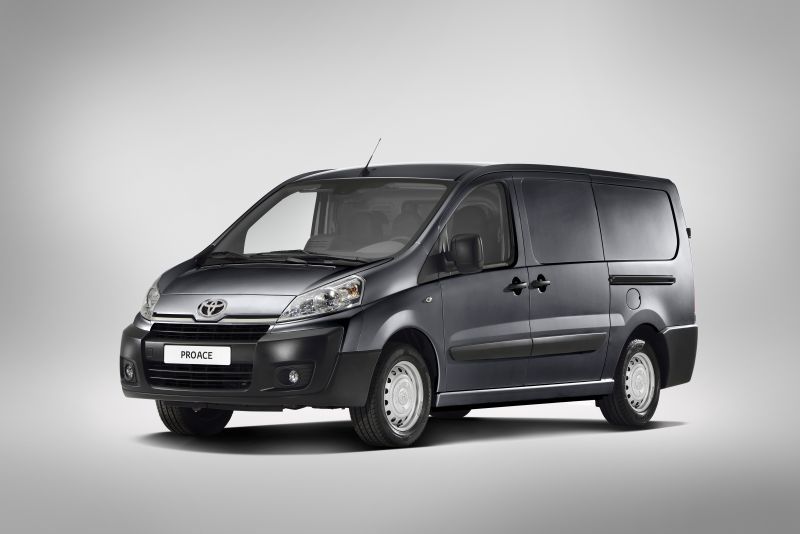
The Toyota Proace City LWB 1.5 D-4D (130 Hp) Automatic represents Toyota’s entry into the compact light commercial vehicle (LCV) and multi-purpose vehicle (MPV) segment in European and international markets. Launched in April 2020, this long-wheelbase (LWB) model, equipped with a 1.5-liter D-4D diesel engine and an 8-speed automatic transmission, demonstrates Toyota’s commitment to versatile and efficient transport solutions. While not typically available in North America, the Proace City is a key part of Toyota’s global portfolio, competing in a segment dominated by European manufacturers.
Part of a collaborative venture with Stellantis (formerly PSA Group), the Proace City shares its platform and many components with the Peugeot Partner, Citroën Berlingo, and Opel/Vauxhall Combo. This partnership allows Toyota to leverage proven designs and technologies, adapting them with its own branding and market tuning to deliver a vehicle upholding Toyota’s reputation for reliability and quality. The LWB variant offers extended cargo or passenger capacity, making it ideal for businesses needing ample storage or families seeking a practical and spacious vehicle.
Powertrain & Engine Architecture
At the heart of the Toyota Proace City LWB is a 1.5-liter D-4D diesel engine, producing 130 horsepower (hp) at 3750 revolutions per minute (rpm). This inline four-cylinder powerplant, with a 1499 cubic centimeter (91.47 cu. in.) displacement, balances power, fuel economy, and low emissions. The engine features an overhead camshaft (OHC) valvetrain and a Diesel Commonrail fuel injection system, ensuring precise fuel delivery for optimal combustion.
A turbocharger with an intercooler significantly boosts power and torque across a broad rev range. It generates 300 Newton-meters (221.27 lb.-ft.) of torque at 1750 rpm, providing excellent pulling power for hauling goods or navigating urban traffic. This strong low-end torque is particularly beneficial for a utility vehicle, enabling confident acceleration even when fully loaded.
Power is channeled to the front wheels through a smooth and responsive 8-speed automatic transmission. This modern gearbox optimizes gear selection for efficiency and performance, contributing to the vehicle’s commendable fuel economy. Combined fuel consumption ranges from 4.4-4.6 liters per 100 kilometers (53.5 – 51.1 US mpg), with extra-urban figures reaching 4.3-4.4 l/100 km (54.7 – 53.5 US mpg). These figures highlight the Proace City LWB’s cost-effectiveness.
The vehicle meets the Euro 6d-ISC-FCM emission standard, with CO2 emissions between 117-121 g/km. This is aided by systems such as a Start & Stop System, which conserves fuel by shutting off the engine during idle, and a Particulate Filter, which reduces harmful emissions. The engine’s front-transverse architecture contributes to efficient packaging and front-wheel drive dynamics.
Driving Characteristics
The 1.8L 90 hp Automatic configuration of the Proace City LWB offers a practical and economical driving experience. While not designed for outright performance, the engine and transmission pairing provides adequate power for everyday use and typical commercial applications. The 8-speed automatic transmission is tuned for efficiency, prioritizing smooth gear changes and maintaining optimal engine speed for fuel economy. Compared to manual transmission versions, the automatic offers greater convenience, particularly in stop-and-go traffic. However, it may exhibit slightly slower acceleration and a less engaging driving experience. Compared to higher-output versions, the 130 hp engine delivers a more relaxed driving style, focusing on fuel efficiency and reduced emissions rather than spirited performance.
The gear ratios are optimized for low-end torque, allowing for confident acceleration from a standstill and easy climbing of moderate inclines. The automatic transmission effectively manages the engine’s power band, ensuring that the engine operates within its optimal range for most driving conditions. While not a sporty vehicle, the Proace City LWB provides a comfortable and predictable driving experience, making it well-suited for urban deliveries and long-distance travel.
Equipment & Trim Levels
The Toyota Proace City LWB 1.5 D-4D (130 Hp) Automatic typically comes with a range of standard features focused on practicality and functionality. These include air conditioning, a touchscreen infotainment system with Bluetooth connectivity, and a comprehensive suite of safety features such as ABS, ESP (Electronic Stability Program), and multiple airbags. Interior upholstery is typically durable and easy to clean, often featuring cloth or vinyl materials. The dashboard configuration is straightforward and ergonomic, prioritizing ease of use for the driver.
Optional extras available for this trim may include a rearview camera, parking sensors, navigation system, cruise control, and upgraded infotainment systems. Higher trim levels may offer additional features such as automatic headlights and rain-sensing wipers. Commercial versions often feature a basic interior with minimal trim, while passenger versions may offer more comfortable seating and additional interior features.
Chassis & Braking
The Proace City LWB features an independent McPherson type front suspension, providing a comfortable ride and responsive handling. The rear employs a torsion beam suspension, a robust and space-efficient design well-suited for load-carrying applications. Braking is handled by ventilated discs at the front and disc brakes at the rear, coupled with an Anti-lock Braking System (ABS) for enhanced safety during emergency stops. Steering is managed by a rack and pinion system with electric power steering, offering light and precise control.
The standard tire size is 215/65 R16 or 205/60 R16, mounted on 6.5J x 16 wheel rims, providing a good balance of grip and ride comfort. The vehicle’s chassis is designed to handle substantial loads, with a generous payload capacity of 930 kg (2050.3 lbs.). The suspension is tuned to provide a comfortable ride even when the vehicle is fully loaded, while maintaining stable handling characteristics.
Market Reception & Comparison
Critics generally view the Toyota Proace City LWB 1.5 D-4D (130 Hp) Automatic as a practical and efficient commercial vehicle. Its strengths lie in its fuel economy, spacious interior, and Toyota’s reputation for reliability. Compared to other trims in the lineup, the 130 hp Automatic version offers a good balance of performance and efficiency, making it a popular choice for businesses and families alike. Its fuel economy is comparable to other diesel-powered vans in its class, while its reliability is generally considered to be above average.
Compared to higher-output versions, the 130 hp engine may feel underpowered when carrying heavy loads or driving on steep inclines. However, its lower running costs and smoother driving experience make it an attractive option for those who prioritize efficiency and comfort. Compared to gasoline-powered vans, the diesel engine offers significantly better fuel economy, making it a more cost-effective choice for high-mileage users.
Technical Specifications
| General Information | |
| Brand | Toyota |
| Model | Proace City |
| Generation | Proace City LWB |
| Type (Engine) | 1.5 D-4D (130 Hp) Automatic |
| Start of Production | April, 2020 |
| Powertrain Architecture | Internal Combustion engine |
| Body Type | Minivan |
| Seats | 2-3 |
| Doors | 5 |
| Performance Specs | |
| Fuel Consumption (economy) – urban (NEDC) | 4.7-4.8 l/100 km (50 – 49 US mpg) |
| Fuel Consumption (economy) – extra urban (NEDC) | 4.3-4.4 l/100 km (54.7 – 53.5 US mpg) |
| Fuel Consumption (economy) – combined (NEDC) | 4.4-4.6 l/100 km (53.5 – 51.1 US mpg) |
| CO2 emissions (NEDC) | 117-121 g/km |
| Fuel Type | Diesel |
| Emission Standard | Euro 6d-ISC-FCM |
| Weight-to-power ratio | 11.2 kg/Hp (89.7 Hp/tonne) |
| Weight-to-torque ratio | 4.8 kg/Nm (206.9 Nm/tonne) |
| Engine Specs | |
| Power | 130 Hp @ 3750 rpm |
| Power per liter | 86.7 Hp/l |
| Torque | 300 Nm @ 1750 rpm (221.27 lb.-ft. @ 1750 rpm) |
| Engine Layout | Front, Transverse |
| Engine Model/Code | YH01 |
| Engine Displacement | 1499 cm3 (91.47 cu. in.) |
| Number of Cylinders | 4 |
| Engine Configuration | Inline |
| Number of Valves per Cylinder | 4 |
| Fuel Injection System | Diesel Commonrail |
| Engine Aspiration | Turbocharger, Intercooler |
| Valvetrain | OHC |
| Engine Oil Capacity | 4 l (4.23 US qt) |
| Space, Volume and Weights | |
| Kerb Weight | 1450 kg (3196.7 lbs.) |
| Max. Weight | 2380 kg (5247 lbs.) |
| Max Load | 930 kg (2050.3 lbs.) |
| Trunk (boot) space – minimum | 3900 l (137.73 cu. ft.) |
| Trunk (boot) space – maximum | 4300 l (151.85 cu. ft.) |
| Fuel Tank Capacity | 50 l (13.21 US gal) |
| Dimensions | |
| Length | 4753 mm (187.13 in.) |
| Width | 1848 mm (72.76 in.) |
Legacy
The Toyota Proace City, and specifically the LWB variant, has established a significant presence in the European and Asian LCV markets. Its introduction in 2020 strengthened Toyota’s commercial vehicle range, complementing the Proace and Hilux models. The collaboration with Stellantis has proven effective, allowing Toyota to enter the segment quickly with a well-engineered product.
The 1.5 D-4D engine and 8-speed automatic transmission pairing has proven to be reliable and durable, with few reported issues. In the used car market, the Proace City LWB holds its value well, thanks to Toyota’s reputation for quality and the vehicle’s practicality. Its long-term reliability and low running costs make it an attractive option for businesses and families seeking a dependable and economical vehicle. While the automotive landscape is shifting towards electrification, the Proace City LWB remains a relevant and competitive option for those who prioritize diesel efficiency and practicality.