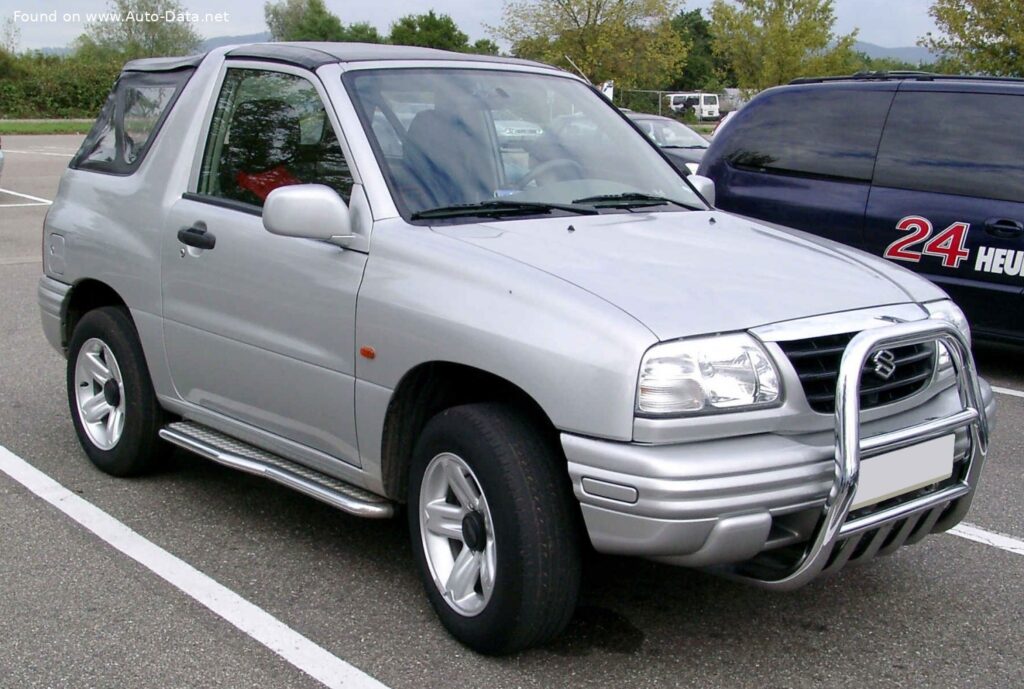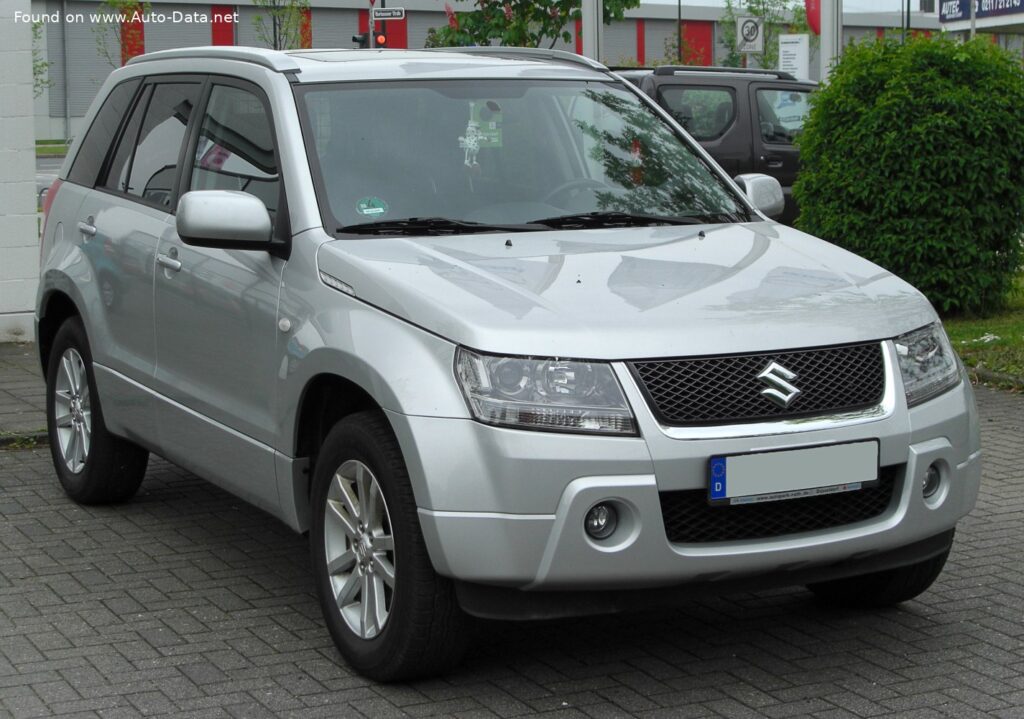
The Suzuki Grand Vitara II 5 Door, specifically the variant equipped with the 2.0-liter 16-valve engine and automatic transmission, represents a significant chapter in Suzuki’s long-standing tradition of producing robust and capable sport utility vehicles. Introduced in 2005 as the second generation of the Grand Vitara nameplate, this model marked a strategic evolution for Suzuki, blending the brand’s renowned off-road prowess with enhanced on-road refinement and modern amenities. Positioned in the highly competitive compact SUV segment, the Grand Vitara II 5 Door aimed to appeal to a broad international audience seeking a versatile vehicle capable of handling both urban commutes and adventurous excursions. While some rivals began to lean towards more car-like “crossover” designs, the Grand Vitara maintained a more traditional, rugged body-on-frame (or integrated ladder frame in this generation) construction, distinguishing it with genuine all-wheel-drive capability and a focus on durability.
Manufactured between 2005 and 2008 for this particular powertrain configuration, the Grand Vitara II 5 Door was a global product, sold across North America, Europe, Asia, and Oceania. In the United States, it offered a compelling alternative to more road-biased SUVs, catering to consumers who valued its blend of compact dimensions, practical interior, and serious off-road credentials. Its five-door configuration provided ample space for five occupants and their gear, making it a practical choice for families and adventurers alike.
Powertrain & Engine Architecture
At the heart of this particular Suzuki Grand Vitara II 5 Door variant lies the J20A engine, a naturally aspirated 2.0-liter (1995 cm³ or 121.74 cu. in.) inline-four gasoline engine. This powerplant was engineered to deliver a balance of usable power and reasonable efficiency for its class. Featuring a Double Overhead Camshaft (DOHC) valvetrain with four valves per cylinder and multi-port manifold fuel injection, the engine produced a respectable 140 horsepower at 6500 rpm. Torque output peaked at 137.19 lb.-ft. (186 Nm) at 4000 rpm, providing adequate pulling power for various driving conditions.
The J20A engine utilized a conventional multi-point fuel injection system, delivering fuel directly to each intake port. This system, while not as sophisticated as direct injection found in some contemporary engines, was known for its reliability and ease of maintenance. The DOHC valvetrain, with its four valves per cylinder, allowed for improved breathing and higher engine speeds, contributing to the engine’s overall performance. The engine block was constructed from cast iron, providing durability and good heat dissipation. The cylinder head was made of aluminum alloy, reducing weight and further enhancing heat management.
Power was delivered to all four wheels via a conventional 4-speed automatic transmission and a robust all-wheel-drive (4×4) system. The 4-speed automatic, while not offering the gear ratios of more modern transmissions, was a proven design known for its smoothness and durability. The all-wheel-drive system typically operated in a part-time mode, allowing the driver to select between 2-wheel drive (for improved fuel economy on paved roads) and 4-wheel drive (for enhanced traction in slippery conditions or off-road). A low-range gear selection was also available for more demanding off-road situations.
Driving Characteristics
The Grand Vitara II 5 Door 2.0 i 16V Automatic offered a driving experience that prioritized practicality and capability over outright performance. The 140 horsepower engine, coupled with the 4-speed automatic transmission, provided adequate acceleration for everyday driving, but it wasn’t particularly quick. Acceleration from 0 to 60 mph took approximately 12.9 seconds, and the top speed was around 106.25 mph (171 km/h). Compared to manual transmission versions or higher-output engines (where available in other markets), the automatic variant felt noticeably less responsive.
The automatic transmission’s gear ratios were optimized for fuel efficiency and smooth cruising, rather than aggressive acceleration. This resulted in a somewhat leisurely pace, particularly when attempting to overtake or climb steep hills. However, the transmission’s smooth shifts and predictable behavior made it easy to drive in a variety of conditions. The all-wheel-drive system provided confident traction on slippery surfaces, and the low-range gear selection allowed for controlled descents and ascents on challenging terrain. The vehicle’s relatively short wheelbase and robust suspension contributed to its agility and stability, both on and off-road.
Compared to the manual transmission versions, the automatic offered a more relaxed and convenient driving experience, particularly in urban traffic. However, it came at the cost of some performance and fuel economy. The automatic was generally preferred by drivers who prioritized ease of use and comfort over sporty driving dynamics.
Equipment & Trim Levels
The Suzuki Grand Vitara II 5 Door 2.0 i 16V Automatic typically came equipped with a range of standard features designed to enhance comfort, convenience, and safety. Standard equipment generally included air conditioning, power windows and locks, a basic audio system (often with a CD player), and alloy wheels. Safety features typically included dual front airbags, side airbags, and an Anti-lock Braking System (ABS). The interior upholstery was typically cloth, with durable and easy-to-clean materials.
Optional extras varied depending on the market, but commonly included features such as a sunroof, upgraded audio system with more speakers and a subwoofer, leather upholstery, heated front seats, and a navigation system. Some models also offered a rear parking sensor system and a roof rack for added versatility. The dashboard configuration was relatively straightforward, with clearly labeled controls and a functional layout. The instrument cluster typically included a speedometer, tachometer, fuel gauge, and temperature gauge. The overall interior design prioritized practicality and durability over luxury.
Chassis & Braking
The chassis of the Grand Vitara II 5 Door was a key element of its robust character. It utilized an integrated ladder frame construction, which combined the strength and durability of a traditional body-on-frame design with the improved rigidity of a unibody structure. This design provided a solid foundation for both on-road handling and off-road capability. The front suspension featured a MacPherson strut design, while the rear suspension utilized a multi-link coil spring setup. This combination provided a comfortable ride and good articulation for off-road conditions.
Braking performance was handled by ventilated discs at the front and drum brakes at the rear. The ventilated discs provided effective stopping power, while the drum brakes offered a cost-effective solution for the rear axle. An Anti-lock Braking System (ABS) was standard equipment, enhancing safety by preventing wheel lockup during hard braking. The steering system utilized a rack and pinion setup, offering precise control and responsive handling. The vehicle rode on 17-inch wheel rims, typically shod with 225/65 R17 tires, balancing on-road grip with sufficient sidewall for off-pavement excursions.
Market Reception & Comparison
Critics generally viewed the Suzuki Grand Vitara II 5 Door 2.0 i 16V Automatic as a competent and capable compact SUV, but not necessarily a class leader in terms of performance or refinement. It was praised for its robust construction, genuine all-wheel-drive capability, and relatively affordable price. However, it was also criticized for its somewhat dated interior, modest engine performance, and the 4-speed automatic transmission, which felt less sophisticated than the 5- or 6-speed automatics offered by some competitors.
Compared to other trims in the Grand Vitara lineup, the 2.0-liter automatic variant was positioned as the entry-level or mid-range option. It offered a good balance of features and affordability, making it an attractive choice for buyers who didn’t need the extra power or luxury of higher-end trims. Fuel economy was competitive for its class, averaging around 25 US mpg combined. Reliability was generally good, with few reported issues with the engine or transmission. However, some owners reported minor problems with the electrical system or interior trim.
Technical Specifications: Suzuki Grand Vitara II 5 Door 2.0 i 16V (140 Hp) Automatic
| General Information | |
| Brand | Suzuki |
| Model | Grand Vitara |
| Generation | Grand Vitara II 5 Door |
| Type (Engine) | 2.0 i 16V (140 Hp) Automatic |
| Start of Production | 2005 year |
| End of Production | 2008 year |
| Powertrain Architecture | Internal Combustion Engine |
| Body Type | SUV |
| Seats | 5 |
| Doors | 5 |
| Performance Specifications | |
| Fuel Consumption (Urban) | 12.1 l/100 km (19.4 US mpg) |
| Fuel Consumption (Extra Urban) | 7.6 l/100 km (30.9 US mpg) |
| Fuel Consumption (Combined) | 9.4 l/100 km (25 US mpg) |
| Fuel Type | Petrol (Gasoline) |
| Acceleration 0 – 60 mph | 12.9 seconds |
| Maximum Speed | 171 km/h (106.25 mph) |
| Emission Standard | Euro 4 |
| Weight-to-Power Ratio | 11.3 kg/Hp (88.6 Hp/tonne) |
| Weight-to-Torque Ratio | 8.5 kg/Nm (117.7 Nm/tonne) |
| Engine Specifications | |
| Power | 140 Hp @ 6500 rpm |
| Power per Liter | 70.2 Hp/l |
| Torque | 186 Nm (137.19 lb.-ft.) @ 4000 rpm |
| Engine Layout | Front, Longitudinal |
| Engine Model/Code | J20A |
| Engine Displacement | 1995 cm³ (121.74 cu. in.) |
| Number of Cylinders | 4 |
| Engine Configuration | Inline |
| Cylinder Bore | 84 mm (3.31 in.) |
| Piston Stroke | 90 mm (3.54 in.) |
| Compression Ratio | 9.7:1 |
| Number of Valves per Cylinder | 4 |
| Fuel Injection System | Multi-port manifold injection |
| Engine Aspiration | Naturally aspirated engine |
| Valvetrain | DOHC |
| Engine Oil Capacity | 4.8 l (5.07 US qt) |
| Engine Oil Specification | Not specified |
| Coolant Capacity | 7.3 l (7.71 US qt) |
| Space, Volume and Weights | |
| Kerb Weight | 1580 kg (3483.3 lbs) |
| Max. Weight | 2070 kg (4563.57 lbs) |
| Max Load | 490 kg (1080.27 lbs) |
| Fuel Tank Capacity | 66 l (17.44 US gal) |
| Dimensions | |
| Length | 4470 mm (175.98 in.) |
| Width | 1810 mm (71.26 in.) |
| Height | 1695 mm (66.73 in.) |
| Wheelbase | 2640 mm (103.94 in.) |
| Front Track | 1540 mm (60.63 in.) |
| Rear Track | 1570 mm (61.81 in.) |
| Drivetrain, Brakes and Suspension Specifications | |
| Drive Wheel | All-wheel drive (4×4) |
| Number of Gears and Type of Gearbox | 4 gears, automatic transmission |
| Front Suspension | Spring Strut |
| Rear Suspension | Coil spring |
| Front Brakes | Ventilated discs |
| Rear Brakes | Drum |
| Assisting Systems | ABS (Anti-lock Braking System) |
| Steering Type | Steering rack and pinion |
| Tires Size | 225/65 R17 |
| Wheel Rims Size | 17 inches |
Legacy
The Suzuki Grand Vitara II 5 Door, including the 2.0-liter automatic variant, has maintained a respectable reputation in the used car market. Its robust construction and relatively simple mechanicals contribute to its long-term reliability. While not without its quirks, the J20A engine and 4-speed automatic transmission are generally considered durable and relatively easy to maintain. Parts availability is generally good, although some specific components may become more difficult to source as the vehicle ages.
Today, these Grand Vitaras are often sought after by enthusiasts and those seeking a capable and affordable off-road vehicle. Their rugged character and genuine four-wheel-drive capability make them well-suited for a variety of applications, from daily commuting to weekend adventures. The 2.0-liter automatic variant, in particular, offers a practical and easy-to-drive option for those who prioritize convenience and reliability over outright performance. As a result, well-maintained examples continue to command reasonable prices in the used car market, solidifying the Grand Vitara II 5 Door’s legacy as a capable and dependable compact SUV.