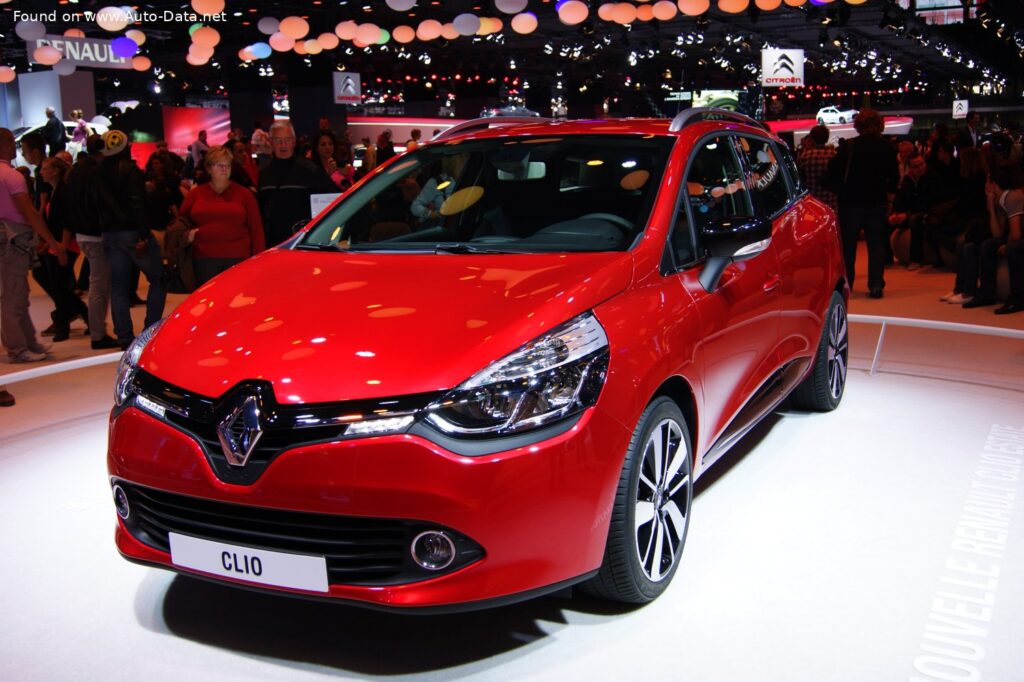
The Renault Clio IV Grandtour (Phase I) 1.5 dCi (75 Hp), produced between 2013 and 2016, represents a significant chapter in the history of Renault’s immensely popular Clio line. While the Clio nameplate is a household name across Europe and other international markets, this particular iteration – especially in its Grandtour (station wagon) guise – was never officially sold in the United States. Instead, it carved out a strong niche in the highly competitive European B-segment (subcompact) market, offering a compelling blend of practicality, style, and exceptional fuel efficiency. This model, part of the fourth generation of the Clio, aimed to deliver a more spacious and versatile option for families and individuals who needed more cargo capacity than the standard hatchback, without the footprint or cost of a larger vehicle.
The Clio IV Grandtour: A New Design Language
The Clio IV marked a bold new design direction for Renault, spearheaded by Laurens van den Acker. It introduced a more emotional and dynamic aesthetic, moving away from the more conservative lines of its predecessors. The Grandtour variant extended this design philosophy, seamlessly integrating a larger rear section to create a stylish yet highly functional estate car. Under the hood, the 1.5 dCi engine, a well-regarded diesel unit from Renault, provided the necessary motivation, prioritizing economy and low emissions – critical factors for European consumers. This specific 75 horsepower variant occupied the entry-level position within the Grandtour lineup, appealing to budget-conscious buyers and those prioritizing fuel efficiency over outright performance.
Powertrain & Engine Architecture: The K9K 628 Diesel
At the heart of the Renault Clio IV Grandtour (Phase I) 1.5 dCi (75 Hp) was the K9K 628 engine, a 1.5-liter (1461 cm³ or 89.16 cu. in.) inline four-cylinder diesel unit. This engine, a staple in Renault’s powertrain lineup for decades, was renowned for its robustness and parsimonious fuel consumption. The K9K engine family is known for its overhead camshaft design, operating two valves per cylinder. The 75 hp version utilized a turbocharger with an intercooler to boost power output, but was deliberately tuned for efficiency rather than peak performance. Fuel delivery was managed by a common rail direct injection system, operating at very high pressures to ensure optimal fuel atomization and complete combustion. This system contributed significantly to the engine’s low emissions and excellent fuel economy.
Power was delivered to the front wheels via a smooth-shifting 5-speed manual transmission, a common setup for B-segment vehicles of its era. This transmission was chosen for its simplicity, reliability, and efficiency. The gear ratios were optimized for fuel economy and drivability in urban conditions, with a relatively tall fifth gear for relaxed highway cruising. Unlike some higher-spec Clio IV models, this variant did not offer an automated manual transmission (AMT) option.
Driving Characteristics: Efficiency Over Excitement
The 1.5 dCi 75 hp engine in the Clio IV Grandtour prioritized fuel efficiency and low-end torque over outright acceleration. While 0 to 60 mph took approximately 13.6 seconds, and the top speed was around 104 mph, the car felt surprisingly responsive in everyday driving situations. The 200 Nm (147.51 lb.-ft.) of torque, available from just 1750 rpm, provided ample pulling power for navigating city streets and overtaking slower traffic. Compared to the 90 hp version of the same engine, the 75 hp variant offered slightly less power, resulting in a marginally slower acceleration, but the difference was not substantial in typical driving conditions. The 5-speed manual transmission, while not offering the sporty feel of a 6-speed gearbox, was precise and easy to use. The overall driving experience was comfortable and refined, with a focus on minimizing driver fatigue.
Compared to the petrol (gasoline) engines available in the Clio IV range, the 1.5 dCi offered significantly better fuel economy and lower running costs. However, it lacked the responsiveness and higher revving nature of the petrol engines. The diesel engine also produced more engine noise and vibration, although Renault made efforts to minimize these characteristics through careful engine mounting and sound insulation.
Equipment & Trim Levels
The 1.5 dCi (75 Hp) Grandtour typically served as the entry point to the Clio Grandtour range. Standard equipment generally included power front windows, central locking, a basic audio system with USB connectivity, and ABS brakes. Safety features such as driver and passenger airbags were also standard. Interior upholstery was typically cloth, with a durable and practical finish. Optional extras included air conditioning, alloy wheels, a more advanced audio system with Bluetooth connectivity, and parking sensors. Higher trim levels, such as the “Expression” or “Dynamique” variants, added features like cruise control, automatic headlights and wipers, and more premium interior materials. The dashboard layout was consistent across the range, featuring a centrally mounted touchscreen display for infotainment functions in higher-spec models.
Chassis & Braking
The Clio IV Grandtour utilized a MacPherson strut front suspension and a torsion beam rear suspension. This setup provided a good balance between ride comfort and handling. The torsion beam rear suspension was a cost-effective solution that minimized weight and complexity. The front suspension featured anti-roll bar to reduce body roll during cornering. Braking was typically accomplished with disc brakes on the front wheels and drum brakes on the rear wheels. This configuration was common for vehicles in this weight class and price range. The steering was a rack and pinion system, providing light and precise steering feel. The 185/65 R15 tires, mounted on 15-inch steel or alloy wheels, prioritized fuel efficiency and ride comfort over sporty handling.
Market Reception & Comparison
Critics generally praised the Renault Clio IV Grandtour 1.5 dCi (75 Hp) for its fuel efficiency, practicality, and stylish design. It was considered a strong contender in the European B-segment, offering a compelling alternative to rivals like the Skoda Fabia Combi and SEAT Ibiza ST. However, some reviewers noted that the 75 hp engine could feel underpowered when the car was fully loaded or when driving on steep hills. Fuel economy was consistently highlighted as a major strength, with real-world figures often exceeding 60 mpg. Reliability was generally good, although some owners reported minor issues with the diesel particulate filter (DPF) system, a common concern with modern diesel engines. Compared to the 90 hp version of the same engine, the 75 hp variant offered a lower purchase price and slightly better fuel economy, making it an attractive option for budget-conscious buyers.
Technical Specifications
| Brand | Renault |
| Model | Clio IV Grandtour (Phase I) |
| Type (Engine) | 1.5 dCi (75 Hp) |
| Production Start | 2013 |
| Production End | 2016 |
| Body Type | Station wagon (estate) |
| Seats | 5 |
| Doors | 5 |
| Fuel Consumption (Urban) | 4.3 l/100 km |
| Fuel Consumption (Extra Urban) | 3.2 l/100 km |
| Fuel Consumption (Combined) | 3.6 l/100 km |
| CO2 Emissions | 95 g/km |
| Fuel Type | Diesel |
| Acceleration 0 – 60 mph | 13.6 sec |
| Maximum Speed | 168 km/h (104.39 mph) |
| Weight-to-Power Ratio | 15.1 kg/Hp |
| Weight-to-Torque Ratio | 5.7 kg/Nm |
| Power | 75 Hp @ 4000 rpm |
| Torque | 200 Nm @ 1750 rpm (147.51 lb.-ft. @ 1750 rpm) |
| Engine Displacement | 1461 cm³ (89.16 cu. in.) |
| Number of Cylinders | 4 |
| Fuel Injection System | Diesel Commonrail |
| Kerb Weight | 1134 kg (2500.04 lbs) |
| Trunk Space (Minimum) | 443 l (15.64 cu. ft.) |
| Trunk Space (Maximum) | 1380 l (48.73 cu. ft.) |
Legacy
The Renault Clio IV Grandtour (Phase I) 1.5 dCi (75 Hp) remains a popular choice in the used car market, particularly in Europe. Its reputation for reliability, fuel efficiency, and practicality continues to attract buyers. The K9K engine, while not without its potential issues (such as DPF problems), is generally considered a robust and long-lasting unit. The Grandtour body style adds a significant degree of versatility, making it a suitable vehicle for families, small businesses, and individuals who require a spacious and economical car. While it may not offer the performance or luxury of higher-spec models, the 1.5 dCi (75 Hp) variant represents a sensible and affordable option for those seeking a reliable and fuel-efficient compact estate car.