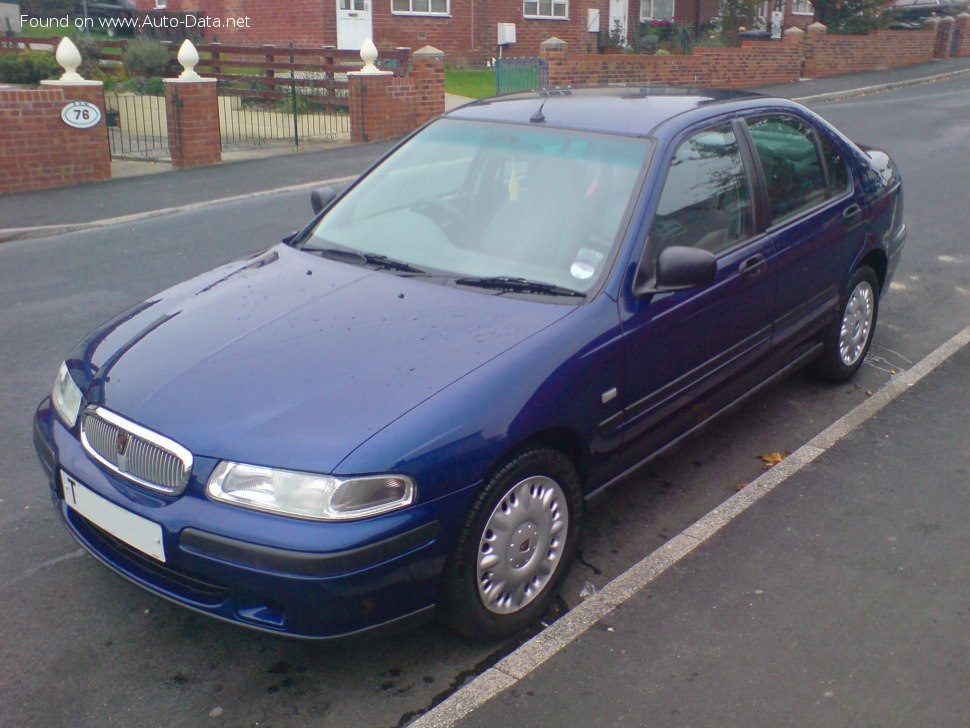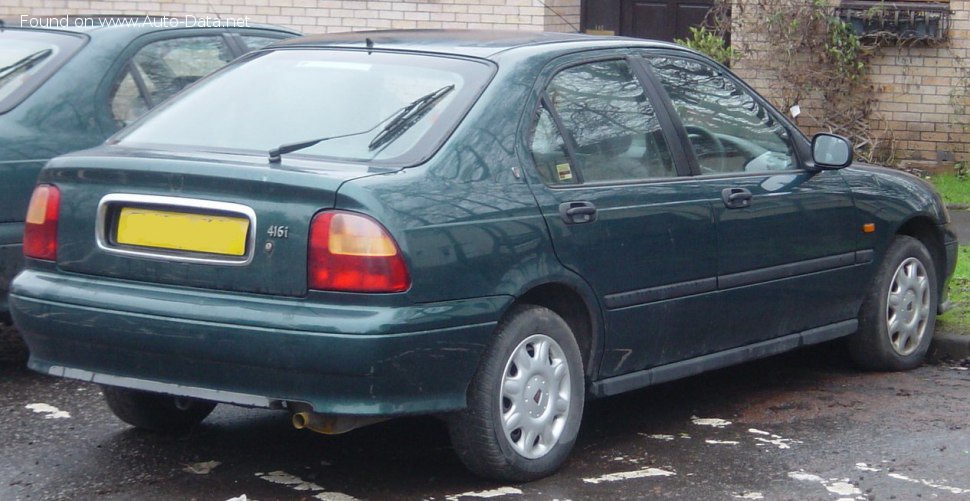
The Rover 400 Hatchback (RT) 414 i (75 Hp) represents a significant chapter in the history of the British Rover Group, specifically within the compact family car segment during the late 1990s. Launched in 1995 as the RT generation, this five-door hatchback was a crucial offering for Rover in its primary European markets. It succeeded the R8 generation 400, which had been a successful collaboration with Honda, and continued to draw on that partnership’s legacy while attempting to carve out a distinct British identity. Produced until 2000, the Rover 400 Hatchback (RT) aimed to blend traditional Rover refinement with modern practicality and efficiency, targeting families and individuals seeking a comfortable and capable vehicle in a highly competitive class.
Rover 400 Hatchback (RT) 414 i: Entry-Level Refinement
While the Rover brand was not officially distributed in the United States, its vehicles, like the Rover 400 Hatchback (RT) 414 i (75 Hp), played an important role in the European automotive landscape. These models were designed with European driving conditions and consumer preferences in mind, emphasizing a blend of ride comfort, understated styling, and practical functionality. The 414 i variant, equipped with Rover’s K-Series engine, was positioned as an accessible entry point into the 400 range, offering a balance of performance and fuel economy for everyday use. It sat at the lower end of the 400 lineup, below the 416i and 420i models which offered larger engines and more features.
Powertrain & Engine Architecture
At the heart of the Rover 400 Hatchback (RT) 414 i (75 Hp) lies Rover’s venerable K-Series engine, a 1.4-liter (1396 cm³) inline-four gasoline unit. This particular variant, designated with the K2F engine code, was a naturally aspirated powerplant designed for efficiency and smooth operation. It utilized a multi-port manifold fuel injection system and an Overhead Camshaft (OHC) valvetrain with two valves per cylinder, a common configuration for mainstream engines of its era, balancing manufacturing cost with reliable performance. The K-Series was known for its relatively lightweight construction and responsiveness, even in this lower-powered guise.
The engine produced a modest but adequate 75 horsepower (hp) at 6000 revolutions per minute (rpm), making it suitable for urban driving and moderate highway cruising. Torque output stood at 86.29 lb.-ft. (117 Nm) delivered at 5000 rpm, providing sufficient pulling power for a vehicle of its size and weight. The power was delivered through a five-speed manual transmission, although a four-speed automatic transmission was also available. The automatic transmission, while offering convenience, did impact performance and fuel economy compared to the manual version. The automatic was a traditional hydraulic unit, lacking the electronic controls found in more modern transmissions.
Driving Characteristics
The Rover 400 Hatchback (RT) 414 i (75 Hp) offered a driving experience geared towards comfort rather than outright performance. With 75 hp, acceleration was leisurely, taking approximately 11.2 seconds to reach 60 mph from a standstill. The 0-62 mph (0-100 km/h) time was 11.8 seconds, and its top speed was rated at 102.53 mph (165 km/h). Compared to the 416i or 420i models, the 414 i felt noticeably slower, particularly when fully loaded or tackling inclines. The automatic transmission further dulled the performance, with noticeable delays in downshifting. However, the engine was smooth and relatively quiet, and the suspension provided a comfortable ride, absorbing bumps and imperfections in the road surface effectively. The steering was light and easy, making it maneuverable in city environments.
The five-speed manual transmission offered a more engaging driving experience, allowing drivers to better control the engine’s power delivery. However, even with the manual gearbox, the 414 i was not a sporty car. It was designed for relaxed cruising and everyday usability, prioritizing comfort and fuel efficiency over dynamic handling.
Equipment & Trim Levels
The Rover 400 Hatchback (RT) 414 i was typically equipped with a reasonable level of standard features for its price point. Basic models included central locking, power steering, and an adjustable steering column. Interior upholstery was typically cloth, with a relatively simple dashboard layout. Higher trim levels, such as the ‘S’ or ‘SE’, added features like electric windows, a sunroof, alloy wheels, and upgraded interior trim. Optional extras included air conditioning, a radio/cassette player, and metallic paint. The 414 i was often chosen by buyers seeking a practical and affordable car with a touch of Rover refinement, and the available options allowed for some degree of personalization.
Chassis & Braking
Underpinning the 400 Hatchback was a suspension system featuring spring struts at both the front and rear, a common and cost-effective setup designed to provide a comfortable ride quality that was often praised in Rover vehicles. Braking duties were handled by disc brakes at the front and drum brakes at the rear, a standard configuration for non-performance-oriented compact cars. The vehicle was equipped with a hydraulic power steering system, offering a familiar and responsive feel to the driver. It rode on 14-inch wheels fitted with 175/65 R14 tires, a common size for its class, balancing grip with ride comfort and cost. The rear drum brakes, while adequate for normal driving, lacked the stopping power and fade resistance of disc brakes, particularly under heavy use.
Market Reception & Comparison
The Rover 400 Hatchback (RT) 414 i was generally well-received by critics for its comfortable ride, refined interior, and understated styling. However, it faced stiff competition from established rivals like the Ford Escort, Vauxhall Astra, and Volkswagen Golf. The 414 i’s modest performance was often cited as a drawback, particularly when compared to the more powerful engine options available in competing models. Fuel efficiency was a strong point, with a combined fuel consumption rating of 27.7 US mpg (8.5 liters per 100 km). Reliability was a mixed bag, with the K-Series engine being prone to head gasket failures in some cases. Compared to the 416i and 420i models, the 414 i offered lower running costs but sacrificed performance. It appealed to a different segment of the market, prioritizing affordability and practicality over driving excitement.
Technical Specifications
| Category | Specification |
| General Information | |
| Brand | Rover |
| Model | 400 |
| Generation | 400 Hatchback (RT) |
| Type (Engine) | 414 i (75 Hp) |
| Start of Production | 1995 year |
| End of Production | 2000 year |
| Powertrain Architecture | Internal Combustion engine |
| Body Type | Hatchback |
| Seats | 5 |
| Doors | 5 |
| Performance Specs | |
| Fuel Consumption (Economy) – Urban | 23.5 US mpg (10 l/100 km) |
| Fuel Consumption (Economy) – Extra Urban | 33.1 US mpg (7.1 l/100 km) |
| Fuel Consumption (Economy) – Combined | 27.7 US mpg (8.5 l/100 km) |
| Fuel Type | Gasoline |
| Acceleration 0 – 60 mph (Calculated) | 11.2 sec |
| Acceleration 0 – 62 mph (0 – 100 km/h) | 11.8 sec |
| Maximum Speed | 102.53 mph (165 km/h) |
| Weight-to-Power Ratio | 14.9 kg/Hp, 67 Hp/tonne |
| Weight-to-Torque Ratio | 9.6 kg/Nm, 104.5 Nm/tonne |
| Engine Specs | |
| Power | 75 Hp @ 6000 rpm |
| Power per Liter | 53.7 Hp/l |
| Torque | 86.29 lb.-ft. (117 Nm) @ 5000 rpm |
| Engine Layout | Front, Transverse |
| Engine Model/Code | K2F |
| Engine Displacement | 1.4 liters (1396 cm³, 85.19 cu. in.) |
| Number of Cylinders | 4 |
| Engine Configuration | Inline |
| Cylinder Bore | 2.95 in. (75 mm) |
| Piston Stroke | 3.11 in. (79 mm) |
| Compression Ratio | 10.5:1 |
| Number of Valves per Cylinder | 2 |
| Fuel Injection System | Multi-port manifold injection |
| Engine Aspiration | Naturally aspirated engine |
| Valvetrain | OHC |
| Space, Volume and Weights | |
| Curb Weight | 2469.18 lbs. (1120 kg) |
| Max. Weight (Gross Vehicle Weight) | 3417.17 lbs. (1550 kg) |
| Max Load | 947.99 lbs. (430 kg) |
| Trunk (Boot) Space – Minimum | 13.07 cu. ft. (370 l) |
| Trunk (Boot) Space – Maximum | 258.5 cu. ft. (7320 l) |
| Fuel Tank Capacity | 14.53 US gal (55 l) |
| Dimensions | |
| Length | 170.08 in. (4320 mm) |
| Width | 66.93 in. (1700 mm) |
| Height | 54.72 in. (1390 mm) |
| Wheelbase | 103.15 in. (2620 mm) |
| Front Track | 58.27 in. (1480 mm) |
| Rear Track | 57.87 in. (1470 mm) |
| Drivetrain, Brakes and Suspension Specs | |
| Drivetrain Architecture | The Internal combustion engine (ICE) drives the front wheels of the vehicle. |
| Drive Wheel | Front wheel drive |
| Number of Gears and Type of Gearbox | 5 gears, manual transmission |
| Front Suspension | Spring Strut |
| Rear Suspension | Spring Strut |
| Front Brakes | Disc |
| Rear Brakes | Drum |
| Steering Type | Steering rack and pinion |
| Power Steering | Hydraulic Steering |
| Tires Size | 175/65 R14 |
| Wheel Rims Size | 14 |
Legacy
The Rover 400 Hatchback (RT) 414 i (75 Hp) entered the European market at a challenging time for the Rover Group. While its predecessor had benefited significantly from its Honda Civic underpinnings, the RT generation sought to establish a more distinct Rover identity, though it still shared its platform with the Honda Domani/Civic. In its home market, the UK, and across continental Europe, the 400 competed in the fiercely contested compact family car segment, going head-to-head with best-sellers like the Ford Escort (later Focus), Vauxhall Astra, Volkswagen Golf, and Peugeot 306. The Rover 400 was generally praised for its comfortable ride, relatively refined interior for its class, and a sense of “Britishness” that appealed to a segment of buyers. The 414 i, with its 75 Hp 1.4-liter engine, was positioned as an economical and practical choice, ideal for new drivers, smaller families, or as a second car. It offered reasonable running costs and sufficient performance for typical daily commutes. The K-Series engine, while known for its lively character, also developed a reputation for head gasket issues in some applications, which could affect long-term ownership perceptions. Despite its qualities, the Rover 400 struggled to achieve the same market dominance as its rivals. Its styling, while more modern than previous Rovers, was often perceived as somewhat conservative compared to more adventurous designs from competitors. Moreover, the brand itself was facing increasing financial difficulties and ownership changes throughout the late 1990s, which undoubtedly impacted consumer confidence and long-term viability. The RT generation 400, including the 414 i variant, represented one of the last attempts by Rover to produce a truly competitive mainstream family car before the company’s eventual collapse in 2005. Today, the Rover 400 Hatchback (RT) is remembered as a testament to Rover’s efforts to maintain its presence in a tough market. While not a groundbreaking vehicle in terms of innovation, it offered a distinctive alternative with a focus on comfort and a touch of traditional British charm. Its legacy is intertwined with the broader narrative of the British automotive industry in decline, yet it remains a functional and somewhat endearing example of a late 20th-century European compact car.