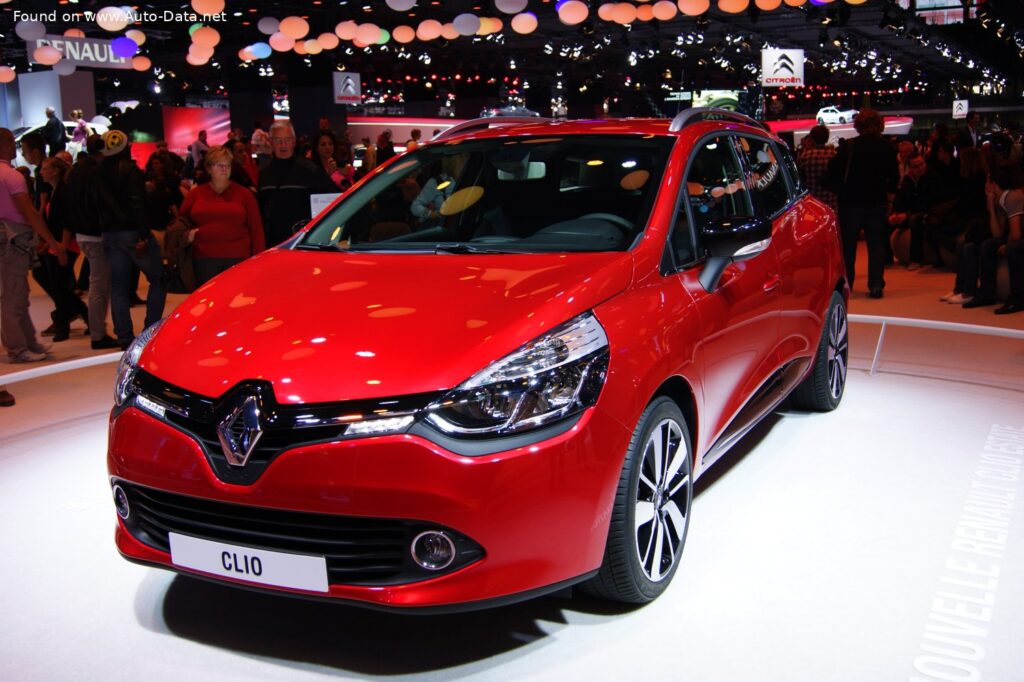
The Renault Clio IV Grandtour (Phase I) 1.5 Energy dCi (90 Hp) start&stop represents a significant offering in the European compact segment, specifically targeting families and individuals seeking enhanced practicality and fuel efficiency within a stylish package. Launched in 2013 and produced until 2016, this generation of the Clio Grandtour, known as an “estate” in European markets and a “station wagon” in American English, built upon the success of the popular Clio hatchback. While the Clio nameplate has a long and storied history in Europe, this particular Grandtour variant was never officially sold in the United States. Its primary role was to provide a more spacious and versatile alternative to the standard Clio hatchback, competing in a fiercely contested segment dominated by other European manufacturers. The “Phase I” designation indicates it is the initial release of the fourth-generation Grandtour, before any mid-cycle refreshes. The 1.5 Energy dCi engine, renowned for its efficiency, coupled with a start&stop system, underscored Renault’s commitment to delivering economical and environmentally conscious vehicles.
Powertrain & Engine Architecture
At the heart of the Renault Clio IV Grandtour (Phase I) 1.5 Energy dCi (90 Hp) start&stop lies a robust and highly efficient 1.5-liter (1461 cm3 or 89.16 cu. in.) K9K 628 inline-four diesel engine. This powertrain, a staple in Renault’s compact and subcompact offerings for many years, is celebrated for its impressive balance of power, torque, and outstanding fuel economy. The engine is configured with two valves per cylinder and employs a sophisticated Diesel Commonrail fuel injection system, ensuring precise fuel delivery and optimal combustion.
Further enhancing its performance and efficiency, the engine is equipped with a turbocharger and an intercooler. The turbocharger significantly boosts air intake, allowing for greater power output from a relatively small displacement, while the intercooler cools the compressed air, increasing its density and further improving combustion efficiency. This setup enables the engine to produce a respectable 90 horsepower at 4000 rpm. More critically for a diesel engine, it delivers a substantial 220 Newton-meters (approximately 162.26 lb.-ft.) of torque at a low 1750 rpm. This ample low-end torque is crucial for effortless acceleration, particularly when the vehicle is loaded with passengers or cargo, and contributes to a relaxed driving experience in urban environments and on highways.
Power is delivered to the front wheels via a smooth-shifting 5-speed manual transmission, a common choice for its direct engagement and efficiency in this segment. The fuel injection system utilizes piezo injectors for enhanced atomization and control. The K9K engine family is known for its relatively simple design, contributing to its reliability and ease of maintenance. The engine block is constructed from cast iron, providing durability, while the cylinder head is aluminum alloy to reduce weight. The valvetrain utilizes a single overhead camshaft (SOHC) design, keeping the engine compact and efficient.
Driving Characteristics
The 90 hp / 5-speed manual combination in the Renault Clio IV Grandtour (Phase I) 1.5 Energy dCi offers a driving experience geared towards practicality and fuel economy rather than outright performance. The substantial low-end torque of the diesel engine makes it feel more powerful than its horsepower figure suggests, particularly in everyday driving situations. Acceleration is adequate for merging onto highways and overtaking slower traffic, but it’s not particularly brisk. The 5-speed transmission is well-matched to the engine’s characteristics, with gear ratios optimized for maximizing fuel efficiency and providing sufficient pulling power.
Compared to higher-output versions of the Clio IV, such as those equipped with the 1.2 TCe gasoline engine, the 1.5 dCi feels less responsive at higher engine speeds. The diesel engine’s powerband is relatively narrow, and it requires more frequent downshifts to maintain momentum when climbing hills or accelerating quickly. However, the diesel’s superior torque delivery makes it less stressed when carrying a full load of passengers or cargo. Compared to an automatic transmission, which was available on other Clio IV trims, the manual option provides a more engaging driving experience and allows for greater control over the engine’s power delivery.
The Clio Grandtour’s suspension is tuned for comfort, providing a reasonably smooth ride over most road surfaces. The steering is light and precise, making it easy to maneuver in urban environments. Overall, the driving experience is refined and predictable, making it a suitable choice for drivers who prioritize comfort and efficiency over sporty handling.
Equipment & Trim Levels
The Renault Clio IV Grandtour (Phase I) 1.5 Energy dCi (90 Hp) start&stop was typically offered in several trim levels, varying by market. Base models generally included features such as air conditioning, power windows, central locking, and an audio system with USB connectivity. Higher trim levels added features like alloy wheels, cruise control, a touchscreen infotainment system, and rear parking sensors. Interior upholstery was typically cloth, with options for upgraded materials and designs on higher trims.
Standard safety equipment included ABS brakes, electronic stability control (ESC), and front airbags. Depending on the trim level, additional safety features such as side airbags and curtain airbags were available. The dashboard configuration was generally straightforward and user-friendly, with a focus on ergonomics. Optional extras included a panoramic sunroof, leather upholstery, and a navigation system. The Clio Grandtour’s interior space was a key selling point, offering ample headroom and legroom for both front and rear passengers. The extended cargo area provided a significant advantage over the standard Clio hatchback, making it a practical choice for families and individuals with active lifestyles.
Chassis & Braking
The Renault Clio IV Grandtour (Phase I) utilizes a MacPherson strut front suspension and a torsion beam rear suspension. This configuration provides a good balance of ride comfort and handling. The torsion beam rear suspension is a cost-effective solution that minimizes weight and complexity. The chassis is constructed from high-strength steel, providing a rigid and safe platform.
Braking duties are handled by disc brakes on the front wheels and drum brakes on the rear wheels in many base models. Higher trim levels often featured disc brakes on all four wheels. ABS (Anti-lock Braking System) is standard, providing enhanced braking performance and stability in emergency situations. The steering system utilizes an electric power steering (EPS) system, which provides light and precise steering control. The EPS system also contributes to fuel efficiency by reducing the load on the engine. Stabilizer bars are fitted to both the front and rear axles to reduce body roll during cornering. The tire size typically ranged from 185/65 R15 to 195/55 R16, depending on the trim level.
Market Reception & Comparison
Critics generally praised the Renault Clio IV Grandtour (Phase I) 1.5 Energy dCi (90 Hp) start&stop for its fuel efficiency, practicality, and stylish design. The diesel engine was lauded for its low running costs and impressive torque delivery. However, some critics noted that the engine could be somewhat noisy and that the performance was not particularly exciting. Compared to other trims in the Clio lineup, the 1.5 dCi was positioned as the most economical option, appealing to drivers who prioritized fuel efficiency over performance. The gasoline-powered versions offered more responsive acceleration, but at the expense of fuel economy. The 1.5 dCi also compared favorably to competitors such as the Skoda Fabia Combi and SEAT Ibiza ST in terms of fuel efficiency and practicality.
Reliability reports generally indicate that the K9K engine is a durable and reliable unit, provided it is properly maintained. However, like all diesel engines, it is susceptible to issues related to the fuel injection system and the diesel particulate filter (DPF). Regular servicing and the use of high-quality fuel are essential for maintaining the engine’s longevity. The Clio Grandtour’s overall reliability is generally considered to be good, with few major issues reported.
Technical Specifications
| General Information | Brand: Renault |
| Model: Clio | |
| Generation: Clio IV Grandtour (Phase I) | |
| Engine Type: 1.5 Energy dCi (90 Hp) start&stop | |
| Production Start: 2013 year | |
| Production End: 2016 year | |
| Powertrain Architecture: Internal Combustion engine | |
| Body Type: Station wagon (estate) | |
| Seats: 5 | |
| Doors: 5 | |
| Performance Specifications | Fuel Consumption (Urban): 4 l/100 km (58.8 US mpg) |
| Fuel Consumption (Extra Urban): 3.2 l/100 km (73.5 US mpg) | |
| Fuel Consumption (Combined): 3.4 l/100 km (69.2 US mpg) | |
| CO2 Emissions: 90 g/km | |
| Fuel Type: Diesel | |
| Acceleration 0-60 mph: 11 sec | |
| Acceleration 0-100 km/h: 11.6 sec | |
| Maximum Speed: 178 km/h (110.6 mph) | |
| Weight-to-Power Ratio: 12.6 kg/Hp | |
| Weight-to-Torque Ratio: 5.2 kg/Nm | |
| Engine Specifications | Power: 90 Hp @ 4000 rpm |
| Power per liter: 61.6 Hp/l | |
| Torque: 220 Nm (162.26 lb.-ft. @ 1750 rpm) | |
| Engine Layout: Front, Transverse | |
| Engine Model/Code: K9K 628 | |
| Engine Displacement: 1461 cm3 (1.5 Liters / 89.16 cu. in.) | |
| Number of Cylinders: 4 | |
| Engine Configuration: Inline | |
| Number of Valves per Cylinder: 2 | |
| Fuel Injection System: Diesel Commonrail | |
| Engine Aspiration: Turbocharger, Intercooler | |
| Engine Oil Capacity: 4.5 l (4.76 US qt) | |
| Coolant Capacity: 5 l (5.28 US qt) | |
| Engine Systems: Start & Stop System | |
| Space, Volume, and Weights | Kerb Weight: 1134 kg (2500.04 lbs) |
| Maximum Weight: 1651 kg (3639.83 lbs) | |
| Maximum Load: 517 kg (1139.79 lbs) | |
| Trunk Space (Minimum): 443 l (15.64 cu. ft.) | |
| Trunk Space (Maximum): 1380 l (48.73 cu. ft.) | |
| Fuel Tank Capacity: 45 l (11.89 US gal) | |
| Dimensions | Length: 4267 mm (167.99 in.) |
| Width: 1732 mm (68.19 in.) | |
| Height: 1445 mm (56.89 in.) | |
| Wheelbase: 2589 mm (101.93 in.) | |
| Minimum Turning Circle: 10.6 m (34.78 ft.) | |
| Drivetrain, Brakes, and Suspension | Drivetrain Architecture: Front wheel drive, Internal Combustion engine drives front wheels |
| Drive Wheel: Front wheel drive | |
| Gearbox Type: 5 gears, manual transmission | |
| Assisting Systems: ABS (Anti-lock braking system) | |
| Steering Type: Steering rack and pinion | |
| Power Steering: Electric Steering | |
| Tire Sizes: 185/65 R15 88T; 195/55 R16 87H | |
| Wheel Rim Sizes: 15; 16 |
Legacy
The Renault Clio IV Grandtour (Phase I) 1.5 Energy dCi (90 Hp) start&stop carved out a significant niche for itself in the highly competitive European B-segment (subcompact) market. Its legacy is primarily defined by its blend of practical utility, stylish design, and exceptional fuel economy, making it a compelling choice for a wide range of consumers. As a model not offered in the North American market, its impact was localized but profound within its target regions.
In Europe, the compact station wagon segment, while perhaps not as dominant as SUVs today, still held considerable importance for families and businesses that valued space and versatility over a higher ride height. The Clio Grandtour directly competed with established rivals such as the Skoda Fabia Combi, SEAT Ibiza ST, and the Volkswagen Polo Variant, as well as the Peugeot 208 SW. Against these competitors, the Clio Grandtour stood out with its more expressive design, which was generally perceived as more dynamic and less utilitarian than some of its German and Czech counterparts. Its strong emphasis on fuel efficiency, particularly with the dCi diesel engine and start&stop technology, gave it a distinct advantage in markets where diesel power was still highly favored for its low running costs and long-distance cruising capability.
The 1.5 Energy dCi engine, in particular, solidified Renault’s reputation for producing reliable and economical diesel powertrains. This engine variant was a workhorse across many Renault and Nissan models, proving its robustness and efficiency over millions of miles. For the Clio Grandtour, it meant a vehicle that was not only affordable to purchase but also inexpensive to run, with low fuel bills and reduced road tax in many European countries due to its low CO2 emissions. This economic appeal was a major factor in its market success. Today, these vehicles are readily available on the used car market, often representing a good value proposition for buyers seeking an economical and practical vehicle. The K9K engine, while aging, remains relatively reliable if properly maintained, and parts availability is generally good.