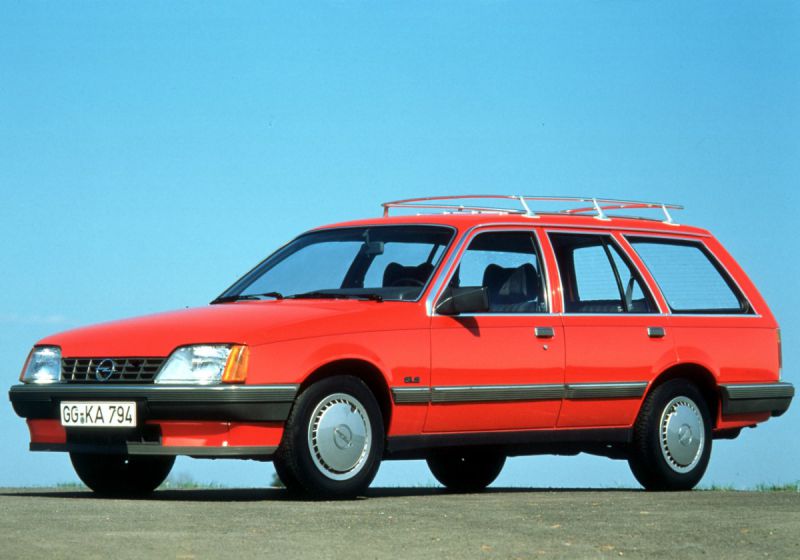
The Opel Rekord E Caravan (facelift 1982) 2.3 TD (86 Hp) represents a significant chapter in European automotive history, serving as a cornerstone of Opel’s lineup during the mid-1980s. As a product of General Motors’ German subsidiary, Opel, the Rekord E was a prominent mid-size to executive family car, particularly in its home market and across continental Europe. Produced from May 1984 to September 1986, this specific variant, featuring a 2.3-liter turbocharged diesel engine, was part of the facelifted E generation, which debuted in 1982. While the Rekord nameplate was largely unknown in the United States, its legacy in Europe as a reliable, spacious, and economical family station wagon (known as an “estate” across the Atlantic) solidified its reputation as a practical and enduring vehicle for its time. The Caravan body style, in particular, underscored its utility, catering to families and businesses alike who required ample cargo space without sacrificing comfortable passenger transport.
Powertrain & Engine Architecture
Under the hood, the Opel Rekord E Caravan (facelift 1982) 2.3 TD (86 Hp) featured an inline four-cylinder, 2.3-liter (2260 cm³) diesel engine, designated as the 23DT. This powertrain was a testament to the growing demand for fuel efficiency in Europe following the oil crises of the 1970s. Equipped with a turbocharger, a relatively advanced feature for a mainstream diesel engine in the mid-1980s, it produced a respectable 86 horsepower at 4200 rpm and a robust 139.4 lb.-ft. of torque at a low 2200 rpm. This torque output was crucial for the vehicle’s role as a load-hauler, providing ample pulling power for its size and weight.
The engine utilized a precombustion chamber injection system, a common design for diesel engines of that era, known for its smoother operation and quieter running compared to direct injection systems of the time. This system involved injecting fuel into a precombustion chamber connected to the main cylinder, where it was partially ignited before entering the main combustion chamber. This resulted in a more complete and controlled burn. Power was delivered to the rear wheels via a five-speed manual transmission, offering drivers a greater degree of control and contributing to the vehicle’s overall fuel economy. The transmission itself was a robust unit designed to handle the engine’s torque output. While an automatic transmission was available on other Rekord E models, it was not offered with the 2.3 TD engine.
Driving Characteristics
The driving experience of the Rekord E Caravan 2.3 TD was defined by its practicality and focus on usability rather than outright performance. The 86 hp engine, while adequate, didn’t provide brisk acceleration. The 0 to 60 mph time of approximately 15.2 seconds reflects this. However, the engine’s 139.4 lb-ft of torque, available from a low 2200 rpm, made it well-suited for hauling loads and maintaining comfortable cruising speeds on the highway. The five-speed manual transmission allowed drivers to keep the engine in its optimal power band, maximizing efficiency and responsiveness. Compared to the gasoline-powered Rekord E variants, the 2.3 TD offered significantly better fuel economy but lacked the higher top speeds and quicker acceleration of those models. Compared to the later 1.8L and 2.0L gasoline engines, the diesel offered a more relaxed driving experience, prioritizing fuel efficiency and durability over sporty performance.
The rear-wheel-drive layout provided a balanced feel, although it wasn’t particularly sporty. The suspension, tuned for comfort, absorbed bumps and irregularities in the road well, making it a pleasant vehicle for long journeys. The steering was relatively heavy, typical of European cars of that era, providing a sense of connection to the road.
Equipment & Trim Levels
The Opel Rekord E Caravan 2.3 TD was generally positioned as a mid-range offering within the Rekord E lineup. It wasn’t the base model, but it also lacked the luxury features found in the higher-end trims. Standard equipment typically included cloth upholstery, a basic AM/FM radio, manual windows, and a heating and ventilation system. The interior was designed for durability and practicality, with hard-wearing materials and a functional layout.
Optional extras available for the 2.3 TD included power windows, a sunroof, upgraded audio systems, and metallic paint finishes. Higher trim levels, available with gasoline engines, offered features like leather upholstery, central locking, and more sophisticated audio systems. The Caravan body style itself was a key feature, offering a large cargo area with a split rear seat for added versatility. The rear suspension was often reinforced to handle heavier loads, a benefit for those using the vehicle for commercial purposes.
Chassis & Braking
The Opel Rekord E Caravan 2.3 TD utilized a traditional body-on-frame construction, providing a robust and durable chassis. The suspension consisted of independent front suspension with MacPherson struts and a rigid axle rear suspension with leaf springs. This setup prioritized ride comfort and load-carrying capacity over sporty handling. The front brakes were ventilated discs, providing good stopping power, while the rear brakes were drum brakes, a cost-saving measure common in vehicles of this era. The car’s curb weight of 1270 kg (2799.87 lbs) contributed to its stable feel on the road.
Stabilizer bars were fitted to both the front and rear axles to reduce body roll during cornering. The steering was a recirculating ball system, providing a relatively heavy but precise feel. The tires were typically steel-belted radials, offering a good balance of grip and durability.
Market Reception & Comparison
Critics generally viewed the Opel Rekord E Caravan 2.3 TD as a practical and reliable workhorse. Its fuel economy was a major selling point, particularly in a Europe still sensitive to oil prices. The turbocharged diesel engine was praised for its torque and responsiveness, making it well-suited for long-distance travel and hauling loads. However, the engine’s performance was not considered exciting, and the car’s handling was not particularly sporty.
Compared to other trims in the Rekord E lineup, the 2.3 TD offered the best fuel economy but the slowest acceleration. The gasoline-powered models were more refined and offered a more engaging driving experience, but they were also more expensive to operate. Compared to rivals like the Ford Granada and Volkswagen Passat, the Rekord E Caravan 2.3 TD offered a competitive combination of space, fuel economy, and reliability. It was often seen as a more affordable alternative to the more premium Volvo and Mercedes-Benz wagons.
Technical Specifications
| Category | Specification |
| Brand | Opel |
| Model | Rekord |
| Generation | Rekord E Caravan (facelift 1982) |
| Type (Engine) | 2.3 TD (86 Hp) |
| Start of production | May, 1984 |
| End of production | September, 1986 |
| Powertrain Architecture | Internal Combustion engine |
| Body type | Station wagon (estate) |
| Seats | 5 |
| Doors | 3-5 |
| Fuel consumption (combined) | 8.1 l/100 km |
| Fuel Type | Diesel |
| Acceleration 0 – 60 mph | 15.2 sec |
| Maximum speed | 165 km/h (102.53 mph) |
| Weight-to-power ratio | 14.8 kg/Hp (32.63 lbs/Hp) |
| Weight-to-torque ratio | 6.7 kg/Nm (14.77 lbs/Nm) |
| Power | 86 Hp @ 4200 rpm |
| Power per liter | 38.1 Hp/l |
| Torque | 189 Nm @ 2200 rpm (139.4 lb.-ft. @ 2200 rpm) |
| Engine Model/Code | 23DT |
| Engine displacement | 2260 cm³ (2.3 Liters / 137.91 cu. in.) |
| Number of cylinders | 4 |
| Engine configuration | Inline |
| Cylinder Bore | 92 mm (3.62 in.) |
| Piston Stroke | 85 mm (3.35 in.) |
| Compression ratio | 23:1 |
| Number of valves per cylinder | 2 |
| Fuel injection system | Precombustion chamber injection |
| Engine aspiration | Turbocharger |
| Valvetrain | SOHC |
| Engine oil capacity | 5.5 l (5.81 US qt) |
| Coolant | 11.5 l (12.15 US qt) |
| Kerb Weight | 1270 kg (2799.87 lbs.) |
| Max. weight | 1900 kg (4188.78 lbs.) |
| Max load | 630 kg (1388.91 lbs.) |
| Fuel tank capacity | 70 l (18.49 US gal) |
| Length | 4678 mm (184.17 in.) |
| Width | 1720 mm (67.72 in.) |
| Height | 1475 mm (58.07 in.) |
| Wheelbase | 2668 mm (105.04 in.) |
Legacy
The Opel Rekord E Caravan 2.3 TD has proven to be a remarkably durable vehicle. Many examples are still on the road today, a testament to the quality of its construction and the robustness of its diesel engine. While not highly sought after by collectors, it remains a popular choice among enthusiasts who appreciate its practicality and simplicity. The 23DT engine, while not known for its high performance, is generally considered reliable and relatively easy to maintain. Parts availability can be a challenge, but a dedicated network of Opel enthusiasts and suppliers continues to support these vehicles.
In the used car market, the Rekord E Caravan 2.3 TD represents an affordable and practical option for those seeking a classic European station wagon. Its fuel economy and spacious interior make it well-suited for everyday use, while its robust construction ensures that it can withstand the rigors of regular driving. The Rekord E Caravan 2.3 TD stands as a reminder of a time when cars were built to last, prioritizing practicality and reliability over flashy styling and cutting-edge technology.