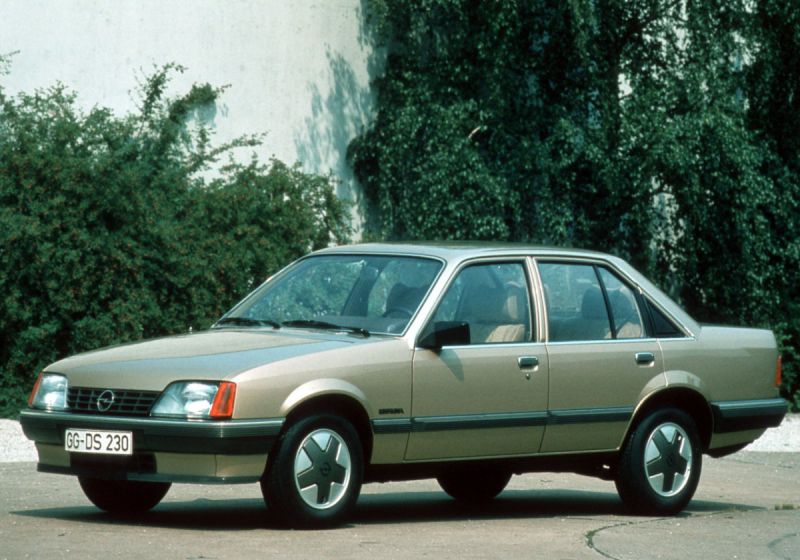
The Opel Rekord, a name long associated with dependable and practical family transportation in Europe, reached its fifth and final generation with the Rekord E, produced from 1977 to 1986. This article focuses on the significant facelift introduced in September 1982, specifically the 1.8-liter variant producing 75 horsepower. This iteration of the Opel Rekord E (facelift 1982) represented a crucial mid-cycle refresh, modernizing its aesthetics and engineering in a rapidly evolving automotive landscape. Positioned as a mid-size sedan, the Rekord E competed in the heart of the European family car market, offering robust engineering, ample space, and economical operation – characteristics highly valued by consumers.
The 1982 Opel Rekord E 1.8: A Mid-Range Offering
While never officially sold in the United States, the Opel Rekord E was a cornerstone of General Motors’ European operations, demonstrating the brand’s commitment to reliable, rear-wheel-drive vehicles. The 1.8-liter, 75 hp model occupied a key position in the Rekord E lineup. It wasn’t the base model – that was typically a 1.6-liter – but it wasn’t the performance-oriented versions either, like the later 2.0-liter or 2.2-liter engines. This 1.8L variant aimed for a balance between affordability, fuel economy, and acceptable performance for everyday use, targeting families and commuters who prioritized practicality over sporty driving dynamics. It was a volume seller, representing a significant portion of Rekord E production during the 1982-1986 period.
Powertrain & Engine Architecture
The Opel Rekord E (facelift 1982) 1.8 was powered by Opel’s 18N engine, a naturally aspirated, inline four-cylinder unit displacing 1796 cubic centimeters (109.6 cu. in.). This engine was renowned for its durability and relatively simple design. It featured a Single Overhead Camshaft (SOHC) valvetrain with two valves per cylinder, a common configuration for the era balancing efficiency with manufacturing simplicity. Fuel delivery was managed by a Solex carburetor, a technology beginning to be superseded by fuel injection but still prevalent in mainstream models of the early 1980s. The carburetor was tuned for fuel economy and smooth operation rather than maximum power output.
The 18N engine produced 75 horsepower (56 kW) at 5400 rpm and 99.57 lb-ft (135 Nm) of torque at 3000 rpm. This power was typically channeled to the rear wheels through either a four-speed manual transmission or a three-speed automatic transmission. The automatic transmission, a Borg-Warner unit, was a popular choice for buyers prioritizing convenience. It featured a torque converter and a relatively simple gear selection process. The gear ratios were optimized for fuel efficiency and smooth acceleration, rather than aggressive performance. The automatic’s shift points were calibrated to keep the engine within its optimal torque range for everyday driving.
Driving Characteristics
The Rekord E 1.8 with the automatic transmission offered a comfortable, if not particularly exciting, driving experience. Acceleration was adequate for merging onto highways and navigating city streets, but it wasn’t designed for quick sprints. The automatic transmission contributed to a smooth and effortless driving style, particularly in urban environments. Compared to the manual transmission version, the automatic slightly reduced acceleration due to power losses within the torque converter and the transmission itself. The manual version felt more responsive and offered better control, appealing to drivers who enjoyed a more engaging driving experience. The 1.8L engine, even with the automatic, provided sufficient power for cruising at highway speeds, though overtaking required careful planning. The rear-wheel-drive layout provided predictable handling, but it lacked the cornering stability of more modern front-wheel-drive designs.
Equipment & Trim Levels
The 1982 facelift Rekord E 1.8 typically came with a reasonable level of standard equipment. Base models featured cloth upholstery, vinyl flooring, and a basic instrument cluster. Higher trim levels, often denoted by suffixes like “GL” or “SR,” added features such as upgraded cloth or velour upholstery, a more comprehensive instrument panel with additional gauges, and optional extras like a sunroof, power windows, and central locking. The dashboard design was functional and straightforward, with clearly labeled controls. Air conditioning was often an optional extra. Exterior features included chrome bumpers, steel wheels with hubcaps, and relatively simple exterior trim. The GL trim level typically included upgraded wheel covers and additional chrome accents.
Chassis & Braking
The Rekord E utilized a traditional body-on-frame construction, providing a robust and durable chassis. The suspension consisted of independent front suspension with MacPherson struts and a solid rear axle with leaf springs. This setup prioritized ride comfort and load-carrying capacity over sporty handling. The steering was a recirculating ball system, offering a relatively heavy but precise feel. Braking systems varied depending on the trim level and market. Base models typically featured drum brakes on all four wheels, while higher trim levels often included front disc brakes and rear drum brakes. Anti-lock braking systems (ABS) were not commonly available on this model. Stabilizer bars were fitted to both the front and rear axles to reduce body roll during cornering, though their effectiveness was limited by the overall suspension design.
Market Reception & Comparison
The Opel Rekord E 1.8 Automatic was generally well-received by European automotive critics as a practical and reliable family car. It was praised for its spacious interior, comfortable ride, and fuel efficiency. However, it was often criticized for its relatively uninspired styling and lack of performance compared to some of its rivals. Compared to the more powerful Rekord E variants, such as the 2.0 or 2.2-liter models, the 1.8 offered a more economical option, but at the expense of acceleration and overall driving enjoyment. Against competitors like the Ford Taunus, Volkswagen Passat, and Peugeot 504, the Rekord E 1.8 held its own in terms of practicality and reliability, but it often lagged behind in terms of styling and technological innovation. Fuel economy was competitive, typically ranging from 25 to 30 mpg depending on driving conditions.
Technical Specifications
| Engine Type | Inline Four-Cylinder, Naturally Aspirated |
| Engine Displacement | 1796 cc (109.6 cu in) |
| Horsepower | 75 hp (56 kW) @ 5400 rpm |
| Torque | 99.57 lb-ft (135 Nm) @ 3000 rpm |
| Fuel System | Solex Carburetor |
| Transmission | 3-Speed Automatic (Borg-Warner) or 4-Speed Manual |
| Drivetrain | Rear-Wheel Drive |
| Brakes (Front) | Disc or Drum (depending on trim) |
| Brakes (Rear) | Drum |
| Suspension (Front) | MacPherson Strut, Independent |
| Suspension (Rear) | Leaf Spring, Solid Axle |
| Curb Weight | 2458.15 lbs (1115 kg) approximately |
| Top Speed | 99.42 mph (160 km/h) approximately |
| 0-60 mph | 15.7 seconds approximately |
| Fuel Economy (Combined) | 25.6 US mpg (9.2 l/100 km) approximately |
Legacy
The Opel Rekord E 1.8 Automatic, while not a particularly sought-after classic today, remains a testament to the era of durable and practical European motoring. The 18N engine, when properly maintained, proved to be remarkably reliable. However, age and corrosion are common issues with surviving examples. The automatic transmission, while generally dependable, can be prone to wear and tear over time. In the used car market, these Rekord Es are relatively affordable, appealing to enthusiasts seeking a classic European sedan for restoration or as a nostalgic daily driver. Parts availability can be challenging, but a dedicated network of Opel enthusiasts and suppliers exists to support owners. The Rekord E 1.8 represents a significant chapter in Opel’s history, embodying the brand’s commitment to providing dependable transportation to a broad range of customers.