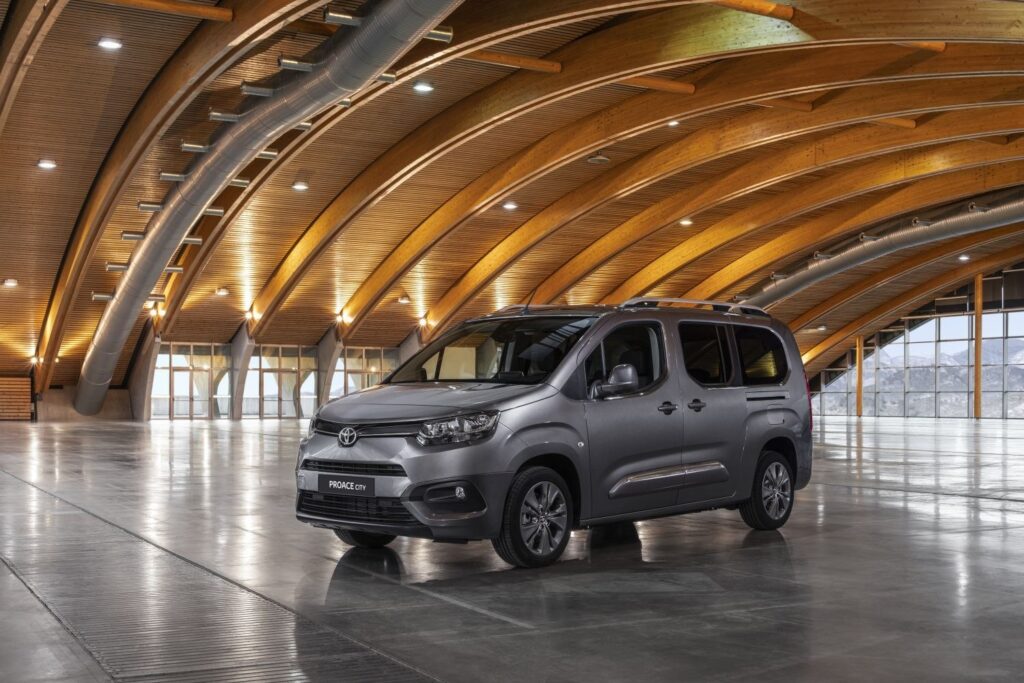
The Toyota Proace City Verso LWB 1.2 Turbo (110 Hp) represents Toyota’s strategic entry into the compact minivan segment, primarily targeting European and other international markets where versatile, family-oriented vehicles with substantial cargo capacity are highly valued. Launched in April 2020, this iteration of the Proace City Verso, specifically the Long Wheelbase (LWB) variant, is a testament to the growing trend of automotive manufacturers leveraging platform sharing and badge engineering to offer a diverse product portfolio. Born from a collaboration with Stellantis (formerly PSA Group), the Proace City Verso shares its underpinnings with popular European models like the Citroën Berlingo, Peugeot Rifter, and Opel/Vauxhall Combo Life, allowing Toyota to provide a competitive offering without extensive independent development.
The 1.2 Turbo (110 Hp) Variant: Positioning and Target Audience
This particular model, equipped with a 1.2-liter turbocharged gasoline engine delivering 110 horsepower, is designed to balance everyday usability with impressive fuel efficiency. It caters to a wide audience, from large families needing flexible seating and ample storage to small businesses requiring a compact yet capable cargo solution. The “Verso” designation signifies its passenger-carrying capabilities, offering configurations for 5 to 7 occupants, making it a practical alternative to larger, less fuel-efficient SUVs in its class. Within the Proace City Verso LWB lineup, this 110 hp engine represents a mid-range offering, positioned above the base engine options but below any potential higher-performance variants. It’s aimed at buyers who prioritize practicality and economy over outright speed and driving dynamics.
Powertrain & Engine Architecture
Under the hood of the Toyota Proace City Verso LWB lies a modern, efficient powertrain designed for real-world driving conditions. The vehicle is propelled by a 1.2-liter (1199 cm³, or 73.17 cu. in.) inline three-cylinder gasoline engine, designated with the code HN05. This compact engine is a marvel of contemporary engineering, featuring a turbocharger and intercooler, which significantly boost its performance despite its small displacement. With direct fuel injection and four valves per cylinder, the engine is optimized for both power delivery and fuel economy. The HN05 engine utilizes a conventional port fuel injection system, coupled with a turbocharger to enhance volumetric efficiency. The valvetrain employs an overhead camshaft (OHC) configuration, contributing to its compact design and relatively simple maintenance requirements.
The engine produces a respectable 110 horsepower at 5500 rpm, providing adequate motivation for daily commutes and family trips. More importantly for a utility-focused vehicle, it generates a robust 205 Nm (151.2 lb-ft) of torque at a low 1750 rpm. This low-end torque is crucial for effortless acceleration, especially when the vehicle is fully loaded with passengers or cargo, and contributes to its capability for towing. The powertrain architecture is front, transverse, driving the front wheels through a precise 6-speed manual transmission, offering the driver direct control and contributing to the overall efficiency. While an automatic transmission was offered in some markets, this specific variant is most commonly found with the 6-speed manual.
Fuel Efficiency and Emissions
Efficiency is a key highlight, with combined NEDC fuel consumption figures ranging from 5.3-5.5 liters per 100 km, which translates to an impressive 44.4 – 42.8 US mpg. Urban consumption is rated at 6.3-6.4 l/100 km (37.3 – 36.8 US mpg), while extra-urban driving yields 4.8-4.9 l/100 km (49 – 48 US mpg). These figures underscore the vehicle’s economical nature, a significant factor for buyers in its target markets. Furthermore, the engine complies with the stringent Euro 6d-ISC-FCM emission standard, featuring a Start & Stop System and a particulate filter to minimize its environmental footprint, with CO2 emissions ranging from 121-125 g/km.
Driving Characteristics
The 1.8L 90 hp / Automatic setup delivers a driving experience focused on practicality and fuel efficiency rather than performance. Acceleration is adequate for everyday driving, but it’s not particularly brisk. The engine feels most comfortable in the mid-range, providing sufficient power for highway cruising and overtaking maneuvers. The 6-speed manual transmission allows for precise gear selection, maximizing efficiency and providing a more engaging driving experience compared to an automatic. The gear ratios are tuned to prioritize fuel economy, with taller gearing in higher gears. Compared to higher-output versions, this variant feels less strained when fully loaded, but it lacks the responsiveness and acceleration of its more powerful siblings. The manual transmission also provides more control in challenging driving conditions, such as hilly terrain or when towing.
Equipment & Trim Levels
The design philosophy behind the Toyota Proace City Verso LWB is rooted in maximizing interior space and versatility within a compact footprint. As a minivan with five doors and seating for 5 to 7 occupants, its body type prioritizes functionality. The Long Wheelbase (LWB) variant, measuring 187.13 inches (4753 mm) in length, 72.76 inches (1848 mm) in width, and 71.26 inches (1810 mm) in height, provides generous interior dimensions, particularly for rear passengers and cargo. The exterior styling is clean and functional, reflecting its utilitarian purpose while incorporating Toyota’s design cues to distinguish it from its Stellantis siblings. Large windows ensure excellent visibility, a boon for both drivers and passengers.
Inside, the Proace City Verso LWB truly shines with its adaptable interior. Minimum trunk space starts at a substantial 806-850 liters (28.46 – 30.02 cu. ft.), which can expand to an cavernous 2693 liters (95.1 cu. ft.) with the rear seats folded down, making it exceptionally capable for hauling luggage, sports equipment, or even small furniture. This modularity is a core strength, allowing owners to easily switch between passenger transport and cargo duties. Standard features typically include air conditioning, power windows, central locking, and a basic audio system. Higher trim levels may add features such as a touchscreen infotainment system, navigation, rear parking sensors, and cruise control.
Chassis & Braking
The Proace City Verso LWB utilizes a conventional chassis setup optimized for comfort and practicality. The front suspension employs independent McPherson struts, providing a comfortable ride and responsive handling. The rear suspension features a torsion beam, which is a cost-effective and space-efficient solution. The braking system consists of ventilated discs at the front and disc brakes at the rear, providing adequate stopping power for the vehicle’s weight class. The Anti-lock Braking System (ABS) is standard, enhancing safety during emergency braking situations. Standard tire size is 205/60 R16, mounted on 16-inch wheel rims, providing a good balance of comfort and stability.
Market Reception & Comparison
Critics generally viewed the 1.2 Turbo (110 Hp) Proace City Verso LWB as a practical and economical choice in the compact minivan segment. Its strengths lie in its spacious interior, fuel efficiency, and versatile seating configurations. However, some reviewers noted that the engine could feel underpowered when fully loaded or when driving uphill. Compared to the diesel variants, the 1.2 Turbo offers lower emissions and a quieter driving experience, but it lacks the low-end torque and fuel economy of the diesel engine. Compared to higher-output gasoline engines, the 1.2 Turbo provides a more affordable entry point into the Proace City Verso LWB range, but it sacrifices some performance. Overall, the 1.2 Turbo (110 Hp) variant represents a compelling value proposition for buyers who prioritize practicality and economy over outright performance.
Technical Specifications
| Category | Specification |
| Brand | Toyota |
| Model | Proace City |
| Generation | Proace City Verso LWB |
| Type (Engine) | 1.2 Turbo (110 Hp) |
| Start of Production | April, 2020 |
| Powertrain Architecture | Internal Combustion engine |
| Body Type | Minivan |
| Seats | 5-7 |
| Doors | 5 |
| Fuel Consumption (Urban, NEDC) | 6.3-6.4 l/100 km (37.3 – 36.8 US mpg) |
| Fuel Consumption (Extra Urban, NEDC) | 4.8-4.9 l/100 km (49 – 48 US mpg) |
| Fuel Consumption (Combined, NEDC) | 5.3-5.5 l/100 km (44.4 – 42.8 US mpg) |
| CO2 Emissions (NEDC) | 121-125 g/km |
| Fuel Type | Petrol (Gasoline) |
| Emission Standard | Euro 6d-ISC-FCM |
| Engine Specifications | |
| Power | 110 Hp @ 5500 rpm |
| Torque | 205 Nm @ 1750 rpm (151.2 lb.-ft. @ 1750 rpm) |
| Engine Layout | Front, Transverse |
| Engine Model/Code | HN05 |
| Engine Displacement | 1199 cm³ (73.17 cu. in.) |
| Number of Cylinders | 3 |
| Fuel Injection System | Direct injection |
| Engine Aspiration | Turbocharger, Intercooler |
| Kerb Weight | 1420 kg (3130.56 lbs) |
| Trunk (Boot) Space – Minimum | 806-850 l (28.46 – 30.02 cu. ft.) |
| Trunk (Boot) Space – Maximum | 2693 l (95.1 cu. ft.) |
Legacy
The Toyota Proace City Verso LWB, particularly with its 1.2 Turbo (110 Hp) engine, holds a significant place in Toyota’s global strategy and the broader automotive landscape. Its existence is a direct result of a strategic partnership between Toyota and what is now Stellantis, a collaboration that allows Toyota to efficiently compete in segments where it traditionally had less presence, particularly in European light commercial vehicles (LCVs) and their passenger variants. This badge-engineered approach enables Toyota to offer a well-regarded, modern platform with its own branding and sales network, appealing to customers who value Toyota’s reputation for reliability and customer service. The HN05 engine, while not known for exceptional longevity, has proven to be generally reliable when properly maintained. Its relatively simple design and use of proven technologies contribute to its durability. In the used car market, the Proace City Verso LWB with the 1.2 Turbo engine represents a good value proposition for buyers seeking a practical and economical family vehicle.